Browsing articles tagged with " international relations"

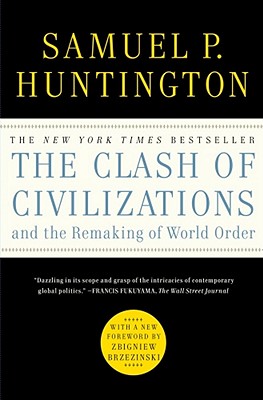
The Clash of Civilizations and the Remaking of World Order by Samuel P. Huntington

In The Clash of Civilizations and the Remaking of World Order, Samuel P. Huntington attempts to define the post-Cold War world. His conclusion is that, instead of an “us” and “them” approach to world politics, we must view the world as that of many civilizations, including mainly the West (generally Christian), Sinic (Chinese), Islamic, Hindu (Indian), and Japanese civilizations. Observing the world and predicting future encounters, therefore, revolves around the dynamic political relationships among these civilizations.

While this was an incredibly challenging book for me to get through*, I am incredibly glad I persevered. While I of course was familiar with the Cold War relations between USSR and the USA, I hadn’t seriously considered the state of the world after the Cold War. Huntington’s book is quite interesting, although it is dated. Because it was written in 1995, I found myself wondering many times how 9/11 changed the face of the world in terms of his philosophies. Continue reading »

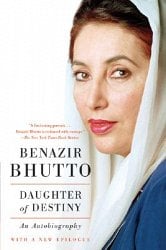
Daughter of Destiny by Benazir Bhutto

Bhutto’s autobiography, Daughter of Destiny (published in 1988 as Daughter of the East), tells a completely unique story. Bhutto was the first woman prime minister of a Muslim country (Pakistan), and she first went through years of struggle, including years of solitary confinement, before she could be an example of democracy.

Much of her autobiography was written prior to 1988, before she was elected prime minister. She says she wrote it “to set down the record of the brutal Martial Law regime of General Zia ul-Haq” (page 374). The remainder of her book shares how she was briefly allowed to serve the country and restore some democratic freedoms before a dictatorship again gained control of the country.

Despite all the drama with which Bhutto wrote, for much of the time I was reading, I fundamentally didn’t understand the import of resisting the regime. From my couch in the USA, it seemed to be an unnecessary, violent political struggle. Then I read a letter Bhutto received from a political prisoner:

I prefer to be hanged than live under the oppressor. To give in is not our principle. We are not ready to call a donkey a horse, or black or white, out of fear of Martial Law. (page 276)

I finally understood a little bit what it meant to live under a dictator: it meant denying what you know to be true because you’re threatened.

That type of understanding is why I read about the histories of other cultures. I feel I cannot relate at all: I live in a peaceful country and have my entire life. Bhutto’s story is one of a country that had been (relatively) peaceful her entire life (for she was born into an independent Pakistan), until a military dictator took over the democratically elected government and established military rule.

Benazir Bhutto shares her passion for Pakistan, the people of Pakistan, and democracy in her autobiography. I only wish it were better told: Daughter of Destiny had serious flaws that made it a frustrating read. Continue reading »

Kissinger by Walter Isaacson

Real Politics

Recently, I’ve been watching The West Wing, which aired on NBC from 1999 to 2006. We’re currently watching season 5 of 7. This television show follows the eight White House years of Democratic President Jed Bartlet and his staff. Of course, being a television drama, President Bartlet has an incredibly interesting presidency (the details of which I won’t divulge in case you are intrigued and care to watch the show).

The most intriguing part of this show is watching and learning about political processes. I don’t know how accurate the portrayals are of the West Wing, White House, and Congressional debates, working situations, and characters. But with each episode, I wonder what the real political situation is for the subject.

Because I have been so absorbed by this fictional political situation, I decided to read about the real thing. I really enjoyed reading Walter Isaacson’s biography of Einstein a few months ago, and I was eager to read another of Issacson’s biographies—this time a biography of Henry A. Kissinger, national security adviser to Nixon and later Secretary of State to Nixon and Ford.

I’ll begin my review by saying that I don’t recommend this book, although I am glad I read it. (Does that make sense?)

It’s not that Isaacson did a poor job. In fact, I think his analysis and portrayal of Kissinger is incredibly well researched and thorough. He does a great job of avoiding his own commentary and opinion. The problem is that Henry A. Kissinger was a man without morals. He was not a likeable man for me. Continue reading »

Search

Archives

RSSrebeccarreid on Twitter

Creative Commons License