
I’ve have been itching to read Jane Austen lately, and although I’ve decided to read Sense and Sensibility for Valentine’s Day, I found a few things that could satisfy my craving right now! A movie or two also may help in the coming weeks.
Jane Austen: A Life by Carol Shields
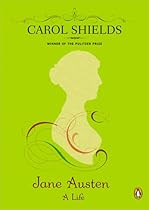 I loved Carol Shields’ biography of Jane Austen! The narrator for the audiobook had a lovely Austen-esque British accent, which gave it a great sense of place. Then Shields began by admitting that she’s an “amateur Jane Austen fan” who goes to the Jane Austen Society of North America meetings because she loves Austen so much. That made me think of her as a kindred spirit.
While I haven’t read many Austen novels (yet), I loved Shields’ emphasis on the fact that we can learn from and compare Jane Austen’s own life to the setting, characters, and situations in her novels.
It was very short (about 5 ½ hours, the equivalent of 180 pages) and yet I feel I have a greater understanding of the remarkable woman who wrote some delightful romances.
Some random facts about Jane Austen (and long-time Austen fans probably already know all of these things):
- Jane Austen spent her first years farmed out to a neighbor for nursing purposes. (Apparently, mothers did not normally feed their own babies.)
- Jane Austen had a romantic interest in Thomas Lefroy but neither of them had money, so nothing came of it.
- Jane Austen was engaged for one night to Harris Big-Wither. She returned the next morning to cancel the engagement.
- Jane’s sister Cassandra was engaged to a sailor, who died. He left Cassandra all his money in his will. Cassandra never married.
- Jane’s father wrote the query letter to a publisher for the manuscript of Pride and Prejudice; he really believed in her!
- Jane’s novel (now known as) Northanger Abbey was purchased for ten pounds, but never published; Jane eventually bought it back. It was not published until after her death.
- When her father retired (he was a vicar), he moved the unmarried Austen sisters to Bath, where he died, leaving his widowed wife and two unmarried daughters rather poor. Jane did not write any novels during the ten years she lived in Bath.
- Jane had to pay out-of-pocket to get Sense and Sensibility (first published novel) printed.
- Jane Austen was “encouraged” to dedicate Emma to the Prince Regent, which she was probably not happy about, since he probably never read it.
- Jane Austen died age age 41 of what may have been breast cancer (although Wikipedia suggests Hodgkin’s lymphoma).
Jane Austen’s Little Advice Book edited by Cathryn Michon and Pamela Norris
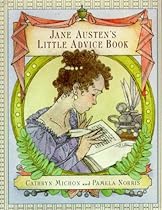 Then I turned to a short little quote book that jumped out at me while I was at the library one day. The editors of this quote book admit feeling a little guilty to earning money on this book, since Jane Austen herself never earned more than £700 in her lifetime. Yet, it’s rather cute and it was fun to read over the course of an hour.
Using only Jane’s own words, including letters, her unpublished works, and her published novels, the editors give us Austen’s “advice” on Men and Women, Love and Marriage, Family, Worldy Things, The Human Condition, Social Life, The Literary Life, Odd Topics, and Jane Predicts the Future. They readily admit that they take quotes out of context, and I must say that the editors’ comments on each quote are the most amusing parts. From those chapters, I must say my favorite part was the “predicts the future” section, with such quotes as these.
On Predicting the Success of the TV Series E.R.
A sick chamber may often furnish the worth of volumes. (from Persuasion)
On Not Worrying About the Ozone Layer
What fine weather this is… at least everybody fancies so, and imagination is everything. (from the letters of Jane Austen)
There are 125 pages worth of fun quotes, and reading through them got me even more excited to read Sense and Sensibility (as well as the other novels) in the future.
Two Histories of England by Jane Austen and Charles Dickens
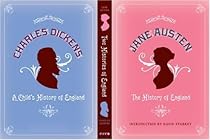 Jane Austen’s The History of England and A Child’s History of England by Charles Dickens are a bit harder for me to write about because, um, I know nothing about the history of England. Therefore, I missed the delightful jibes and jokes that Austen wrote and, while I understood Dickens had an interesting bias and judgment of history, it did not make sense to me in a historical way as the writer of the introduction indicated it would.
Jane Austen wrote her short manuscript for her sister when she was 16, and it was clearly a parody of history books. From my perspective, it certainly was amusing. For example:
“Edward the 5th: This unfortunate prince lived so little a while that nobody had time to draw his picture.” (page 5)
Her snide remarks about various kings and queens really went over my head, since, as I mention, I know little about England’s history. I can only assume her frequent and over-the-top defense of the Stuarts was more sarcasm.
Charles Dickens’ A Child’s History of England is also sarcastic and judgmental. He refers to King James the First as “His Sowship” because that’s what James’ favorite helper called him and Dickens “cannot do better than call his majesty what his favourite called him” (page 72). The disdain is just dripping throughout the descriptions of the king’s reign.
But Dickens’ history (which is much longer, and apparently is only an excerpt from the whole) is packed full of all sorts of extraneous details that make it fascinating and fun. I loved learning about the Gunpowder Plot through Dickens’ imaginative story!
To me, the most amusing thing about Dickens’ account is that, according to the introduction, it was actually a part of the school curricula for British school children “well into the 20th century” (introduction, page ix). My question is: was it used as a history text or rather as a humourous part of British culture? As I read, I kept laughing at the thought of this being a proper history textbook. There were so many descriptive beheadings!
I first saw this on Heather J.’s blog and I had to get it!
Have any people from England read Austen’s or Dickens’ histories? I’m curious as to the “accuracy” and/or the impact of the humor on those that actually are familiar with the history of England.
Which Austen novels are your favorites? I’ve still only read Pride and Prejudice and Northanger Abbey. (But I’ve seen all the movies!)

I love Carol Shields and Jane Austen so I’ve been looking for this book. I’m glad you liked it!
My faves are P&P and Persuasion. I also read Austen’s “History”. I thought it was funny. She wasn’t very impressed with Elizabeth I.
I remember reading about Jane Austen and her one-night-long engagement. How brave of her to cancel it like that, after she’d already agreed – even today, I know it’s crazy difficult to admit you’ve made a mistake with an engagement, let alone in Jane Austen’s day!
I’ve been looking for an audiobook and the bio by Shields looks like a winner. I love the idea of the advice book as well. Time to bust out the Christmas list.
What fun Austen books you’ve been reading! My favorite Austen is P&P with Persuasion a close second. I’m going to be re-reading Mansfield Park soon. It is the only Austen book I didn’t like and I hope a re-read changes my opinion!
That advice book sounds great! I’ll have to check out the biography, too. I’ve been wanting to learn more about Austen.
That little book of advise looks like a fun one. I loved the way she talked. She was so witty and sarcastic. I could read her over and over.
These look great, I will have to add them to my wishlist 🙂
Pride & Prejudice is still my favorite, even after reading all the rest. I can’t help it, I just adore Mr Darcy.
I have 2 Histories of England on my list for Everything Austen. Do you think I should read Dickens’ part first to get a better understanding of the history?
“What Jane Austen Ate and Charles Dickens Knew” by Daniel Pool describes and explains a lot of terms used in the Victorian era novels, but I don’t think it would be any help regarding British history as referred to by Austen or Dickens. I didn’t know that they had written up their opinions on English history; I should look into those volumes!
I have read Shields’ bio of Austen a couple of times–it is lovely to read, and truly reflects her love of Austen. I must say, though, that Shields is, I believe, the only biographer who has come up with the breast cancer theory, and I can’t help but wonder whether she was transferring her own illness onto Austen. I also thought that Shields painted a harsher picture of Austen’s mother, and I wondered how accurate and fair that really was. That said, it is a moving, powerful tribute to a truly great author and an enjoyable read.
I’ve read Austen’s history a couple of times–and my wonderful brother gave me a copy that is a facsimile of Austen’s handwritten manuscript, which is one of my prize possessions. I am partial to Elizabeth in the Elizabeth/Mary Queen of Scots debate, however, and so can’t agree with Austen when she champions Mary over Elizabeth. It’s an absolute brilliant piece of Austen’s juvenelia and is a wonderful glimpse into Austen as madcap, no-holds-barred inventive young writer trying out her craft and she’s going for the joke not historical accuracy! If you like her history, you might try some of her other early stories–they’re crazy!
I haven’t read Dicken’s history, but I would like to as I like satire quite a bit.
I’m nearly done with this book as well — I’ve been reading it in bits and pieces. I like it but it doesn’t really seem like a straightforward biography to me.
Loved Carol Shield’s Jane Austen bio. And loved her History of England – haven’t read the others though, so will have to keep my eyes open for them. Thanks for mentioning them here. 🙂
I read Carol Shields book earlier this year and I really liked it, too!
Chris, no she wasn’t, although I wonder if it was sarcasm? I have such a hard time picking up on those things… I just wonder if I missed a few jokes.
Jenny, yeah, the engagement story was very interesting. She and her sister were staying at his house and they had to make a break for it when she told him she changed her mind….
Trisha, it worked well as an audiobook!
Stefanie, I haven’t read many of them yet, so don’t know if I’ll like them all! But I just love the idea of reading them so I’m hoping I will like them. Mansfield Park is the only one of the movies I didn’t love.
Anna, yes, the advice book was fun! And I loved the biography!
Lula O, the editor’s commentary on the quotes is just as delightful too!
Bella, I love Darcy too!
J.T. Oldfield, that may be a good idea! But Dickens and Austen had just opposite biased commentaries on the royalty, so maybe reading a real history book would be more enlightening…
Valerie, I think my mom has that book. Thanks for the recommendation!
JaneGS, I haven’t read any other bios of Austen, so your commentary is very interesting — especially about the breast cancer!
Actually, Dickens didn’t intend his to be satire — he meant it as a real history, and it was used in British schools! That’s what makes it funny from this perspective because it seems all biased!
Karen, no, it wasn’t quite a straight biography — but I like the analysis of the books she includes. I know some people don’t like that, but I think it does help to know a person!
Court, I hope you enjoy the others too!
Kailana, glad you liked it!
How did I miss your review of this?! I’ll have to blame my recent bout of blog skimming. *hangs head in shame*
OK, so you, like me, missed many of the jokes in the Austen/Dickens book. I don’t feel so bad about that now. 🙂 But it sounds like you enjoyed it anyway, and that it was worth reading, which I’d definitely agree with.
The part about the Dickens text being used in schools (into the 20th century!) really made me laugh as well.
So glad that you picked this one up – it’s fun to compare thoughts on such an odd little book!
You may be interested in seeing the new website on Carol Shields – http://www.carol-shields.com
I would appreciate your making a link to this website when referring to Carol Shields – for example in your comments on Carol’s JANE AUSTEN.
Keep up the good work. Donald Shields, Trustee, Carol Shields Literary Trust (and the husband of the late Carol Shields)