

For our Thanksgiving homeschool unit, we learned more about Squanto by reading Joseph Bruchac’s masterpiece Squanto’s Journey (Harcourt Children’s Books, 2000). Illustrated by Greg Shed, this gorgeously illustrated book tells the story of Thanksgiving from the perspective of a young man who had grown up in the area that became Plymouth Bay. Squanto was kidnapped

Alice Dagliesh’s The Thanksgiving Story (illustrated by Helen Sewell) is nonfiction picture book about a child’s family traveling to Plymouth. Because it is has dated illustrations, it was not a favorite for my son. Ironically, The Thanksgiving Story won a Caldecott Honor for its illustrations. The Thanksgiving Story has lots of details, and we read it over

My son (age 5) and I learned about the departure of the pilgrims and the voyage of the Mayflower in Tattered Sails by Verla Kay and Dan Andreasen. Although Kay never mentions either the Mayflower or the pilgrims by name, in her book, she depicts children in a crowded and dirty city, a crowded and dirty boat, and then

I couldn’t resist picking up Joseph Bruchac’s Pocahontas. Although fictionalized, it is obvious from the complexity of the story that Bruchac did research into the John Smith and Pocahontas story. I loved the alternating viewpoints: one chapter was Pocahontas’ narration, and the next would be Captain John Smith’s. Their voices were unique. I really enjoyed seeing

To accompany our history studies in our homeschool, I read Pocahontas and the Strangers by Clyde Robert Bulla. But, although I had intend to read it aloud to my son (age 5) as well, but we didn’t get to it. Bulla’s story is the romanticized story of Pocahontas saving John Smith’s life. I liked reading it, but

Together, my son (age 5) and I read A Lion to Guard Us by Clyde Robert Bulla. In this middle-elementary reader, a young girl in England struggles to keep her brother and sister together after her mother passes away. Because her father was a part of the advance group that traveled to Jamestown, she determines to get

For my personal history education, I enjoyed the longer children’s nonfiction book (almost middle grade nonfiction) and detailed The Lost Colony of Roanoke by Jean Fritz. Fritz has a way of making history come alive. Her writing is geared for upper elementary school students or middle school students, and her book subsequently provides an increasing amount of
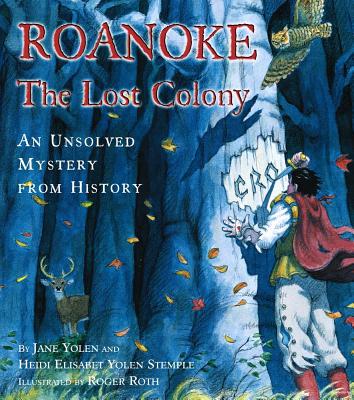
My son (age 5) and I read about the mystery of Roanoke in Jane Yolen’s Roanoke, The Lost Colony: A Mystery from History. Told from the perspective of a fictionalized child with a detective father, Yolen’s picture book had just enough information about the colony of Roanoke to interest my son, but without too many

I read a number of Cybils nominees again this week, but today I bring you just one. It is unlike any other picture book I’ve read this year! In a bizarre twist of storytelling, Creepy Carrots by Aaron Reynolds and illustrated by Peter Brown (Simon and Schuster 2012) is a ridiculous story about carrots who

James Fenimore Cooper created an American heritage in his historical fiction novels of the American frontier. For that reason alone I would be glad to say I’ve finally read one of his works. The Last of the Mohicans (first published in 1826) is a romanticized story of the dying days of the Native American culture.

Raisin Reads is a column with thoughts on children’s literature straight from the mind of a kid! About the author: Raisin is five years old. He likes to read, and he wants to be a construction worker when he grows up. I like Mercy Watson to the Rescue because when the fire department comes, Mr.

Benjamin Franklin: An American Life by Walter Isaacson (Simon and Schuster, 2003) is a fantastic portrait of a complex man. I have always loved Ben Franklin (ever since I read Ben and Me by Robert Lawlor as a child). Reading Isaacson’s biography helped me to see why I liked it him so much: he was,
Page [tcb_pagination_current_page] of [tcb_pagination_total_pages]