
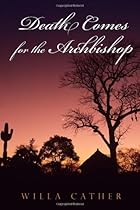
 Willa Cather’s Death Comes for the Archbishop profoundly moved me.
Perhaps it was Cather’s perfect capture of New Mexico: while I have never been to New Mexico, I feel I now can perfectly imagine the place, the pain, and the joy that the setting evokes. Also, while there are religious elements in the book (after all, it tells the story of the first Roman Catholic Bishop of New Mexico), Cather’s emphasis seems to be the human connections, the legends, and the memories of those living in a challenging yet beautiful era in American history.
Archbishop was a different classic to read: in some respects, it is a collection of stories, not a novel. When early reviews complained that book was hard to classify, Cather herself said “why bother?” She at times calls it a “legend” or a “narrative” (from the introduction, Everyman Library’s Edition).
Because of its loose structure and subtle plot, it tells of the Bishop Latour’s life and that of his friend, Father Valliant at a leisurely pace. In fact, my first read (three weeks ago) surprised me: I found myself struggling to be motivated to read it. (It was also during the Christmas holiday, so I was busy and probably not in the mood for a thinking book.) Because I’m preparing some discussion questions for my infant book group, I decided to reread it this week. (I was feeling horribly nervous about keeping a discussion going. Unfortunately, this is how I feel every month when I go to prepare for book club!)
So I reread Archbishop, knowing that it is slow, thoughtful, and not so much a novel but more a series of vignettes. And I loved it. The last 75 pages last night had me in tears as I pondered the life of the priests. While I loved My Antonia, this is my new, absolutely favorite Cather (of those two, at least). It has far more depth to the characters, the language, and the setting , and I was emotional moved as I read it. I may add it to the “Books Read in 2010 That I Love and Want to Reread Someday” list I’m starting in my head.
Note: Because I don’t believe Death Comes for the Archbishop can be “spoiled,” I discuss the book in below without hesitating to reveal some details.
I finished rereading Archbishop last night, after having finished Mrs. Dalloway on Tuesday, and maybe it was the slow-reading mood I’d had with Woolf that made Archbishop so rewarding this time around.
I am not a Catholic, but I do consider myself religious. Similarly, Cather was religious, but she was not a Catholic when she decided in 1927 to tell the story of the 1850s Catholic missionaries to New Mexico. Yet, her book is a religious one because she describes nature in terms of religion.
This mesa plain had an appearance of great antiquity, and of incompleteness; as if, with all the materials for world-making assembled, the Creator had desisted, gone away and left everything on the point of being brought together, on the eve of being arranged into mountain, plain, plateau. The country was still waiting to be made into a landscape. (page 94-95)
The book as a whole is not overly religious. Rather than celebrating any organized religion, Cather is celebrating humanity and the beauty of nature. She almost gives more space to the Indian traditions, legends, and religious beliefs than she does to the Catholic priests’ beliefs. The priests are just her vehicle to the legends. Catholic, Mexican, and Indian legends are all fascinating to me, despite the fact that I don’t know much about any of them!
A good portion of Archbishop is about service and friendship. I suspect this post cannot possibly capture the beauty of the text and the emotions I felt as I read about those subjects in Cather’s words, but I will try to do my best.
Because Father Valliant went to seminary in France with Bishop Latour, they are close. They were very different: Bishop Latour always planned ahead and Father Valliant was always full of energy to go do what was needed right now. But these differences were what made the book so rich. Both served the Catholic and non-Catholic populations and touched people in different ways, and because they saw life so differently, the moments of togetherness were perfectly captured and realistic. Although other relationships among the people touched me, it was the friendship between the two missionaries that touched me most: they’d given up a life of ease for a life of struggle, all because they wanted to serve. Yet they still had each other to understand how hard it was. How they must have depended on each other! (I say as if they were real… Although Cather based them on real missionaries, the story was a fiction.)
Finally, Death Comes for the Archbishop actually is about death, but it’s also about life and memory. In her introduction, A.S. Byatt indicates that there is confusion with the title:
“It arouses expectations in the reader which are not fulfilled – that death and the Archbishop are of equal importance in the narrative, whereas in fact the Archbishop’s death is only one further incident in the series of frozen gestures, moments of insight, small comedies and agonies which make up the fresco.”
I agree that the Archbishop himself is of utmost importance. But so are the Indian friends, and the New Mexico landscape, and dear Father Valliant, none of whom are mentioned in the title. I think Cather chose to include death in the title because that is what life is: we live to die. I am dying right now. How we live (i.e., what we choose to do with our time) determines how we will eventually die.
As he entered his last convalescence, Bishop Latour gave this bit of wisdom:
“I shall not die of a cold, my son. I shall die of having lived.” (page 267)
Death Comes for the Archbishop tells the story of Bishop Latour’s death, which is how he lived. He lived in service to others, looking ahead and planning for the future. Only before his death could he stop considering the future and recall, with fondness, his past. Cather’s narrative is absolutely beautiful in capturing his story!
Now that I’ve finished this reread, I am incredibly excited for my book club meeting next Wednesday night! I feel I have so much I want to discuss, and this book has much more in it for discussion than My Antonia (which I think many people read in high school or college). I have barely touched on all the themes that stand out to me after these two reads. I just really hope the others didn’t get hung up on the “slow” aspects as I did at first.
If you hated My Antonia, have you tried this one? I’m curious to know if those who dislike Cather know about this masterpiece. This is, of course, much slower than Antonia in pacing (believe it or not), but the end result is far more rewarding, I believe.
Have you read any books lately that moved you emotionally (not necessarily in a tear-jerker kind of way)?

You know, I can’t remember the last time I cried while reading a book – it’s a very rare occurrence for me, but generally speaking, any book I give 5 stars was one I found very powerful and one that produced strong emotions in me!
I find it so interesting that you have now re-read several books in quick succession (generally for book club, I believe)! Normally I just try to read my books close to the meeting so that they’re fresh in my mind, but that’s about it! You put me to shame!
I love this book. I was sort of so-so about My Antonia, but I decided to read this one because my dad is a HUGE Cather fan and this is his favorite. I was not disappointed. I was carried along the whole time, and even though I myself am not a religious person, I loved the look at religion here. I loved it because so much of it was flexible and in harmony with people without worrying so much about rigid rules. The people, the connections, the friendship, and above all helping each other, were what mattered most, and to me, that’s what religion and charity should be all about. It made me very happy to read. Maugham does the same thing with the Catholic sisters in The Painted Veil, too.
Don’t worry about being nervous about your book club. In time, that gets much easier. I was really super nervous for 6m to a year, but now I am so familiar with my group that I dont’ get nervous at all anymore.
I have only read one book by Cather – One of Ours – and don’t remember having strong feelings for it either way. But, this one sounds very interesting to me! I lived in New Mexico as a child and grew up going back for vacation every summer. I would love to read her interpretation of New Mexico.
I’ve read a couple of Cather books and loved them all, especially My Antonia. This book is one that’s been on my TBR for awhile. Looks like I should bump it up!
I’ve read the same two Cathers as you and I loved Archbishop. The ending made me cry too. The whole book I think is more skillfully written and much more subtle than My Antonia.
I have heard so many good things about Cather, but have never tried her. I think I should- obviously, she speaks to people on many levels.
What a beautiful post, Rebecca. Even though I didn’t enjoy Archbishop nearly as much as you did, I very much relate to the deep resonances you felt while reading this book (in fact, I just finished my Mrs. Dalloway post, and feel similarly about that novel). It’s such a special experience to find books that touch us like this – congratulations on having encountered one of yours. 🙂
I think reading this in high school killed it for me. :/ But now I’m curious about My Antonia!
I just finished a novella “Hunger” by Lan Samantha Chang, that definitely affected my emotions, although I didn’t cry. There are short stories in the book as well, and I’m curious to see if they’re as powerful
I’ll be finishing Archbishop tonight – I’m on the last few pages. I’m enjoying it and can’t wait to discuss next week.
I agree with you that it seems more a collection of connected stories than a novel. Sometimes while reading it I get a biblical feeling about it, like Cry The Beloved Country.
I have My Antonia on my to-read shelf — I’ll try to read it soon to compare it to Archbishop.
The last book that made me cry was The Boy in the Striped Pajamas. When I closed the book at the end I just had to sit and think for a few minutes and started crying because of the way it ended.
You asked about ’emotionally moving’ stories….I have to tell you, I buy books to sell on line. One came in a batch called, “The Fur Person”. It was by Mary Sarton and was simply delightful and a true story about a cat that came to live at her house. Telling the story of his life was embellished by her, I am sure, but the part of his life with her was all true. It was emotionally delightful and she said, “it is a book for grandmothers to read to their grandchildren”. How true, I began reading it to my 10 yr old granddaughter and she finished reading it herself. The illustrations are wonderful. I had never seen this book before and then the other day I ran across another copy at another used book store! What are the chances of that. I would recommend this little read to anyone!
Steph, I think it’s the nervousness of having to lead a discussion that is making me want to make sure I know them really well! But yes, rereading so soon after a first read is very enlightening.
Amanda, I didn’t realize Painted Veil also has some religious people in it. We’re also reading that for book club. They’re going to think I keep choosing “religious” books! oops. I’m glad to hear that the day may come when I’m not so nervous about leading a discussion.
Allison, I have never been to New Mexico and yet I feel like I’ve seen it now! I hope you enjoy it if you do read it.
Suey, It feels different from the only other Cather I’ve read but I do hope you enjoy it too!
Stefanie, yes: I love the more subtle-ness to it. Glad you enjoy it too!
Aarti, apparently there are those who don’t like Cather’s style! But I enjoyed this one obviously!
Emily, I think I need to reread Mrs. Dalloway a few times before it’s going to speak to me in a similar way! But I do love finding these kinds of books.
Eva, so sorry high school ruined it for you! I think it does take a bit more patience to love this book than I had in high school! I also enjoy My Antonia but I found this one so much more rewarding in the end.
Suzanne, I really didn’t intend for all of our book club books to have a “biblical” feeling to them! How odd that they all seem to! I haven’t read Boy in the Striped Pajamas yet, but it’s on my TBR!
Ann, sounds like a great little book!
I feel a little stupid – I have heard of this book many times, but didn’t know it was by Cather! I will have to check it out. I enjoyed My Antonia, and the title of this one has always sounded intriguing. The last book I had an emotional reaction to was Mrs. Dalloway. J Before that, it was probably The Girl Who Stopped Swimming. Neither one was in a tear-jerker way, just in a moving, can’t get the book out of my head kind of way.
Lindsey, Oh, if I felt stupid for every book I hadn’t heard of, I’d be very sad! No worries, this one is slower but I enjoy it far more in the end.