
A few weeks ago, I overheard an eight-year-old girl say to an adult in all seriousness, “I’m so hungry, I’m going to die!”
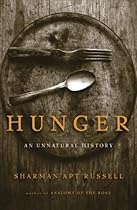 I couldn’t help thinking to myself that she had no idea what true hunger was; nor do I. In Hunger: An Unnatural History, Sharman Apt Russell details what it means, physiologically, to be hungry. Then she goes beyond the science of hunger and into the social aspects by reviewing the history of how we learned to help starving people recover and the various current worldwide issues surrounding hunger, from Anorexia Nervosa to refugees. It is an intriguing look into a social problem that everyone experiences, even to a small extent, every day.
The first portion of Hunger details the various stages of hunger: how does the body react after 36 hours without food? 7 days? 30 days? Interspersed with the explanations (which, thankfully, are not overly scientific) are historical examples of people who lived or currently live without eating for various amounts of time. (One morbidly obese man fasted for 380+ days, for example.)
Subsequent chapters of Hunger detail various social issues, for example, the ways hunger has been used as political statement; studies during World War II when people were starving to death; the Minnesota Experiment, in which some young men were given near-starving diets for six months in order to determine the best way to re-feed (in preparation for re-feeding the hundreds of thousands of hungry people at the end of World War II); the anthropological aspects of being hungry; anorexia nervosa; hungry children worldwide; re-feeding malnourished adults in the midst of famine; and more.
True story: Every time I began to read this book, I’d feel like eating. But then I’d eat too much and have a stomachache, because I wasn’t really hungry. Just thinking about being hungry (and reading about starving people) made me want to eat! There’s a chemical explanation for that – I read about it in the book.
I found Hunger to be a fascinating introduction to the subject. Russell’s book is best described, I believe, as an overview, neither focusing heavily on science nor on social issues. It’s very accessible and a quick read. I highly recommend it if such an overview is what you’re looking for.
 I chose to read Hunger: An Unnatural History as a part of the World Citizen Challenge for the “Worldwide Issues” category, my issue being world hunger. While it didn’t focus on world hunger to a great extent (as I had hoped), I feel it provided a wonderful foundation for other books I hope to read about the worldwide social issues surrounding hunger. I do hope to read more about the subject, and Russell’s book has sparked my interest.
Personally, I have a hard time going more than about 20 hours without food: I get very faint and my arms and legs start to shake, especially if I stand up too fast. I must eat breakfast. But everyone is different. When did you last eat? How long have you gone without food? How did you feel?
If you have reviewed Hunger on your site, please leave a link in the comments and I’ll add it here.

This sounds absolutely fascinating. I’m adding it to my wishlist!
And I’m curious about that chemical explanation. I guess that’s also the reason why I was always reaching for the cookies when reading about people going hungry in Life as We Knew It.
That sounds like a must read. We throw around the word hungry like we know what it feels like, but we really don’t, do we?
This sounds slightly creepy but extremely interesting. I think I might add it to my Word Citizen reading list. Thanks for the great review 😀
I really want to read this one! I was hoping you’d have a positive review. 🙂
Since I happen to be recovering from a horrid illness, the last time I was hungry was a few days ago. I went over 72 hours with maybe 10 or 15 crackers…it was awful. And today I think I’ve already eaten five meals to try to catch up the calories. On a normal basis, I like to eat small meals throughout the day, so I don’t react very well to going without food. Like you, I get really dizzy, which is scary.
I’ve had friends who battled anorexia. Very, very sad. And my sister was on the cusp of an eating disorder for awhile (we’re pretty much the same height-5’3″-and I naturally weight around 107 no matter how much I eat and exercise, so she got it into her head that 125 was obese…then she stopped eating for awhile one summer and dropped to 103….it was awful, and I mercilessly harassed her into putting some weight back on). Depressing.
Speaking of hunger strikes, one of the books I just read for this challenge-Belfast Diary-detailed a hunger strike I didn’t even know about that occurred in a North Irish prison during Thatcher’s time…four or five IRA men starved to death.
Finally, and just out of curiousity, does she treat fasting at all? My family visited Egypt during Ramadan, and I had friends in college who observed it, and it never ceases to amaze me that they not only don’t eat anything, but don’t even drink *water*. Definitely a positive aspect of hunger-faith and mind over matter!
Sounds like a really interesting book. Like Nymeth, I’m interested in that chemical reaction.
I rarely go without food. I get that faintness you talked about after very short amounts of time, sometimes 4 hours, sometimes 7, never more than that (except while I’m sleeping). I developed hypoglycemia in college and am paranoid about not eating, now.
Oh I couldn’t read something like this. It would make me sad and very hungry!
I’m not positive but I think I’ve gone a whole day without eating before and I won’t do that again! I have to eat two or more meals a day or I get these incredibly awful headaches.
I have no idea how long I could go without eating. If I’m bored, food is a constant thought (no surprise there). But, for instance, when I’m at a dog trial and running courses with Max all day, I don’t think about food at all. We get done with a 12 hour day and I suddenly think, “Man, I’m hungry!” 🙂
This book looks great!
Lezlie
Nymeth and Amanda, Maybe “chemical” isn’t the right word for the reaction. And unfortunately I read the book in January and wrote most of this review about three weeks ago…I’ve kind of forgotten. But it’s something about how when you think about hunger your brain sends a notice to your body saying “eat.” Some people who are overweight have improper control of that brain connection so their body tells them to eat when they just ate. If your body is full, it tells your brain to stop eating — for those obese people, the “stop eating” command never gets through. Something like that….
Kathy and Tuesday, it was a lighter read — meaning that the writing was very accessible — but it was a very difficult subject to read at the same time. Fascinating is a good word, I think.
Eva, oh I hope you start feeling better! That’s no fun. Maybe don’t read this one when your sick….
I learned about that hunger strike in this book. Apparently, their deaths didn’t make that much political difference. These days, there are so many “hunger strikes” that they don’t seem to. Very sad way to die, I’d think!
And yes, the book does address fasting, and she does discuss the faith side of things. Actually, day-long fasts and longer-termed medically supervised fast seem rather innocuous and may be beneficial. She even talks about “fasting resorts” for people suffering from medical conditions. I can’t personally understand the draw for a week-long medical fast, but apparently it helps?!
Personally, I fast for about 16-20 hours, no food or drink, once a month for religious reasons. It’s not impossible, and I don’t feel like it requires a lot of faith…I guess you can say it’s a habit. But I am weak by the end and I do make my husband drive 🙂
Amanda, I get faint in the middle of the day sometimes too, and I wonder why, when I go at least 8 hours at night? I guess the moving around/exercise makes the difference…
Ladytink, Like I said, it did make me hungry — or at least think I was hungry!
Lezlie, I understand that “too busy to eat feeling.” I’ve gotten that too, like when I was at college working 3 jobs and going to classes, etc. But I also tend to eat eat eat if I’m not busy….
I can sometimes go a while without eating and other times my hands start to shake. I hate the shaking hands feeling. But I do love to eat. A lot. It’s very sad to hear stories of those who don’t have enough to eat. I am blessed to have so much.
This sounds like it might fit the Science Challenge, too? I am intrigued by this. I like books that explore a simple sounding topic and you learn more than you ever expect to.
Natasha, I love eating too. Time for breakfast!
Care, It’s not very scientific — mostly talking about science without putting any in. I would count it as Social Science, not Science Science.
I think that sleeping/not sleeping change is more programmed than anything else. I mean, if I wake up at 4 in the morning and can’t get back to sleep, within half an hour, I’m starving, because it’s the morning breakfast call. My body thinks it’s time to wake up, and therefore eat. I’ve gotten insomnia where I couldn’t go back to sleep until I’ve eaten something. I also have gotten into the habit of eating a bowl of cereal around 8:30 or 9 pm, and can’t sleep until I do so, no matter how much I try to do away with that habit. I’ve programmed myself. It’s hard to break that programming. In college, I had one class in the morning, then a 1-hour break, then classes straight for 6 hours, so I ended up eating breakfast and lunch only about 2 hours apart, with lunch around 10am. It took years to undo what that one semester did to me. For years I would get faint if I didn’t have a snack around 10. Now, thankfully, I’ve unprogrammed myself.
It’s the same thing, I’m told, with nursing a baby – as the baby sleeps longer at night, your body learns to produce less milk during that time.
Your experience of reading “Hunger” reminded me of my experience of shortness of breath when I read “Into Thin Air.” The Minn. hunger experiment was a plot point in “The Story of Marriage” by Andrew Sean Greer, I hadn’t heard of it before. In that book, the subjects who were starved and then fed were conscientious objectors. His description of the experiment was painful, and I believe I got up and ate.
Amanda, I had some crazy eating schedules when I was in school — as in, no lunch break between work and classes….I was always munching on snacks and eating as I walked…..
Interesting comparison of nursing a baby thing to training our bodies to eat…I think you’re right on.
Kim, I learned about the Minn. hunger experiment in this book too! Painful to read is a good description. I would never be able to volunteer for such an experiment. I like eating too much. I’d go nuts. (as did some of them…)
Yep-Belfast Diaries goes into why the deaths didn’t make a huge difference, and you can feel the author’s frustration! I’m impressed that you fast once a month, although what said made me laugh. 😀 Anyway, this book sounds really comprehensive!
Eva, it’s comprehensive without being overbearing. It still felt like an overview. Easy to read physically; difficult to read subject matter-wise.
That sounds really interesting. I love books like this. I can’t go very long without eating before I become nauseous and dizzy. I have to eat breakfast too and after 4-6 hours without eating I don’t feel well.
Callista, glad it sounds interesting to you! I did think it was a fascinating book to read, albeit a challenging subject!