
Maybe this is odd but I’m not crazy about adventure stories. Characters are stereotypes, the adventures they must go through are stereotypes, and all ends up well in the end. I guess I just hope for a little depth or humor or ambiguity when I read.
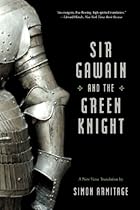
Sir Gawain and the Green Knight was, in many senses, a knight’s adventure story as I’d stereotype them, with the addition that in the end (mini-spoiler!) he learns a lesson about Christian goodness that was necessary and appropriate for the 1400s, when this story was captured. What made reading Sir Gawain and the Green Knight a delight for me, then, was not the story, or the characters, or the lessons learned. I enjoyed reading Sir Gawain for the language.
Eva mentioned the luxurious alliteration in her recent review of the same work, so I sought out Simon Armitage’s translation. I loved the passages, and because I don’t know how else to say it’s awesome, I’m just going to give you a quote from my favorite part, the beginning of chapter two, in which the year passes.
So the festival finishes and a new year follows
in eternal sequence, season by season.
After lavish Christmas come the lean days of Lent
when the flesh is tested with fish and simple food.
Then the world’s weather wages war on winter:
cold shirnks earthwards and the clouds clim;
sun-warmed, shimmering rain comes showering
onto meadows and fields where flowers unfurl;
woods and grounds wear a wardrobe of green;
birds burble with life and build busily
as summer spreads, settling on slopes as it should.Now every hedgerow brims
with blossom and with bud,
and lively songbirds sing
from lovely, leafy woods. (page 55-56, lines 500-514)
It just goes on in beauty, and if I didn’t have to worry about copyright, I’d share with you the summer and autumn passages too.
Compare to the same passages, translated by Marie Borrof (From the Norton Anthology of World Masterpieces, seventh edition).
And so this Yule to the young year yielded place,
And each season ensued at its set time;
Aftre Christmas there came the cold cheer of Lent,
When with fish and plainer fare our flesh we reprove;
But then the world’s weather with winter contends:
The keen cold lessens, the low clouds lift;
Fresh falls the rain in fostering showers
On the face of the fields; flowers appear.
The ground and the groves wear gowns of green;
Birds build their nests, and blithely sing
That solace of all sorrow with summer comes ere long.And blossoms day by day
Bloom rich and rife in throng;
Then every grove so gay
Of the greenwood rings with song.
I like that one too, and it is interesting how different they are. I’ve just started a book about the history of the English language, so it may help me understand how Old English worked.
So yes, in the end, Sir Gawain learns a lesson. Although I predicted it, I still thought it was clever. And I enjoyed seeing a true knight in action: being honorable, true, and otherwise cool, like the guy in armor on the cover. I want to own this book just so I can look at this cover longer!
Next up: Beowulf! Although I am still not crazy about adventure stories, I should give it a try too. Plus, Heaney’s cover is just as pretty.
Which translation do you prefer for the passage above? While I haven’t the poem in the second translation, I like it as well, but the first (Simon Armitage) seems so much more accessible to me!
Do you like adventures or knights’ tales?

I have to admit, when Jason read and reviewed this, I put it on an automatic no-thanks list. He told me about it in detail and it just sounds so pointless to me. Maybe it isn’t, and I’m not saying it’s pointless, just to ME it sounded pointless except that it was old. I don’t like things just because they’re old, you know?
This translation looks great! I don’t know how I feel about adventure tales generally, but I have a soft spot in my heart for this particular one. When I was a kid, I was in love with these books about Sir Gawain by an author called Gerald Morris, so it was exciting when I finally found the original Sir Gawain and the Green Knight.
It’s interesting that you remarked that you don’t much care for adventure stories – I feel somewhat similar! Sometimes I want a book that is action-packed, but one of the reasons I didn’t really like Great Expectations is because the early part of the book is just Pip getting into one adventure after the next. I guess I just have to be in the right frame of mind, but I think I tend not to like picaresque novels as much as other styles (Huck Finn is the one notable exception I can think of).
I’m not sure, reading this, I felt like Gawain was ‘honorable’ and ‘true’. I mean, sure, he didn’t sleep with the queen, but sat around flirting with her all day – not seeming too terribly sorry to do it. He showed to keep his promise, I’ll give him that. But if chivalry is making pointless oaths with anonymous magical beings, I’m not sure I’m a big fan of chivalry – the Greek Gods did that all the time, and you’d THINK at some point, you’d learn that these things never work out, and you should probably stop swearing on the River Styx before you know what you’re in for. I kind of felt like the whole story in Gawain was kind of surreal, and teh portrayal of the queen as tool to be manipulated in order to trick him into revealing his moral ambiguities just felt cheap to me.
That being said, I am glad you enjoyed it. I felt like it was weird when I read it, and the farther I get from it, the less I like it. I understand it’s an artifact of it’s day, but for me, the story had only the two elements: the adventure (I’m not a big fan of adventures either) and the morals (I disagree with the moral lesson).
What did you think the lesson he learned at the end was, out of curiosity?
Amanda, for me, it wasn’t the “point” of it or the plot that I enjoyed — just the language. In fact, I’d be with you that the story is rather blah. But I really did enjoy reading the poetry.
Jenny, I can’t really comment on the translation as I haven’t read the others but I really found it readable and yet so beautiful! Loved the alliteration thing.
Steph, that’s how I felt about The Hobbit. Blech. Too many dumb adventures and nothing else to keep me going. But I guess I forgive a boring plot when it’s prettily written 🙂
Jason Gignac, I can see your point. I kind of thought he was rather idiotic, so maybe he was being naive to think entertaining the queen but not sleeping with her was keeping his honor. Maybe too, it’s a relic of the day it was written and for their morals he was being honorable.
I thought the lesson he learned was to be honest in everything and trust in your honesty. I don’t think it was the best way to teach the lesson.
To me, the story had two elements: an adventure plot (blah to me) and beautiful writing (wow, so great). So for me, I read it for the language over everything else. If it was badly written, I wouldn’t have liked it.