
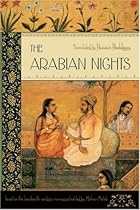
 It’s bawdy. It’s erotic. It may be inappropriate for young minds. It’s irreverent, especially considering a strict Islamic world such as the 1500s when they were written. And yet, The Arabian Nights has historically been an immensely popular collection of stories.
As The New Lifetime Reading Plan reminds me, these were one of the first “best-sellers,” the popular fiction of centuries past. I read the tales to gain a better understanding of a traditional literature.
It’s easy to see the appeal. The stories remind me of the Grimm brothers’ tales in that magical things take extreme directions. But while Grimms’ tales had morals and were told in the guise of children’s tales, The Arabian Nights tell plain crude stories that cater to the basest of instincts: sex, betrayal, alcohol, and thievery to name just a few. But beyond the magical elements and the crudity, the tales themselves claim a higher place as they emphasize the import of story-telling in general.
The tales themselves are tales within tales within tales. In each section, someone is telling a tale to save their life. In the basic frame element, the queen Shahrazad tells stories every night to keep her husband, Shahrayar, from murdering her in the morning (she stops at key moments of the story to build suspense). The characters in the stories she tells do the same thing, as they come to genies or kings who threaten to kill them.
“What until you hear my incredible story!” the characters cry. In most cases, their creative stories save their skins, for they truly are incredible.
It was entertaining, albeit challenging, for me to read. I struggled at first (as I mentioned here), and so I began by reading just five or ten pages a day. I thought taking it in small doses would help. But the “nights” divisions didn’t really make for good stopping and starting places, and I found myself lost amid the various stories. It worked much better for me to read it in 40-page intervals. If I followed one story from beginning to end, I could keep reading on momentum.
Some stories were much more interesting to me; those without magical elements actually bored me. And while I enjoyed the translation I read (done by Husain Haddawy), it was taken from a 1500s manuscript that omitted stories such as Ali Baba, Aladdin, and Sinbad. After having read 425 pages, I still don’t know those traditional stories, which is a huge disappointment. I knew it was going to be the case, but I’m still disappointed. I’m actually going to get Haddawy’s companion volume (which translates those subsequent stories) so I can experience those “traditional” stories as well.
To be honest, after reading The Arabian Nights and parts of the companion by Robert Irwin, I find myself considering why this is literature. They aren’t written well (in my opinion) and they are really quite crude in subject matter. Don’t misunderstand me: I do think The Nights is “literature” and I did find it worthwhile reading. I just wonder what it is that kept these stories going for so many years.
I think the answer hearkens back to the fact that these stories applaud and reverence stories themselves. The original, now anonymous, author of The Nights wrote something that championed a good story teller. And anyone who loves stories can appreciate that.
What do you think makes something “literature”?
Other Reviews:
- A Striped Armchair (thoughts on beginning the Huddawy translation)
- Once Upon a Bookshelf (thoughts on a Selection of stories)
If you have reviewed The Arabian Nights, leave a link in the comments and I’ll add it here.

When I read Don Quixote, I kept wondering the same thing – WHY is this considered good literature? It’s bawdy, crude, not particularly interesting or well-put-together, or well written. The answer: because it was the first book ever with a character with personality, rather than generic mythological-like characters. It was the first book with a narrative drive, and therefore it holds its place in literature.
Maybe Nights was like that – it fulfilled some new niche in the literary world, and so gained fame that way?
Congratulations for finishing it! I’m sure I’ll get round to reading this one day, but I think I have enough long reads on my hands at the moment.
Amanda, I think the difference is I did enjoy reading this — I seem to recall you didn’t like Don Quixote, right?
Yes, Nights was, I think, a completely new way of approaching literature: stories. In some respects I see it as genius for it’s era. Not that I’ve read a lot of 1500s stuff, but still.
Jackie, he he, I understand the need to get away from long reads! I’ve had a lot lately…
I don’t really believe in separating “literature” from popular fiction, so I’m not sure how to answer! I’m sorry to hear you were disappointed. I’ve been meaning to read these again for so long…I had an edition my mother gave me as a child, but it was of course abridged and sanitized. I’d like to read the “real” thing at some point.
I’m working my way through it now, and I have to say, I’m having a challenging time reading it as well! When I finish, I’ll let you know what I think of it.
Nymeth, I think you make a great point. Why do I assume “literature” is anything different?!
I’m not sure disappointed is the right word: I liked what I read, I guess I just feel incomplete, even after turning the last page. So I’m going for the second volume! I also wished for more magic. I think the second volume has more magic too!
Penny, I wondered many times why it was challenging for me to get through, especially since I’m pretty sure I did like in the big picture. Why do you think it’s challenging? Just such dense prose?
I recently got this translation and looking at it side-by-side with the English-from-French translation done in the 1860s, this modern translation by Haddawy is by far better and much more readable. Anyone who has tried to read “The Arabian Nights” in the past using a different translation, should try Haddawy’s translation.
I hope to blog about the comparisions later, after I read more!
Valerie, Oh, I’m glad to hear that this one is most readable. I’m curious if you’ll be disappointed not to get Aladdin or Ali Baba. I was just sad at the end! Hence, I’m going to read another volume of Arabian Nights translated by Haddawy.
Does the English-from-French translation go in the same order? I was very curious.
“Much obliged to you for this smart survey! I’ve forever been interested by ‘The Bedouin Evenings,’ and Husain Haddawy’s interpretation appears to be a genuine pearl. It’s magnificent to hear that his adaptation catches the pith and lavishness of the first stories.