
I always love to pick up a slim volume of poetry, a volume that contains poems all by the same author, because it helps me to pick up on themes, it helps me get to know an author, and it lets me really feel the emotions the author celebrates.
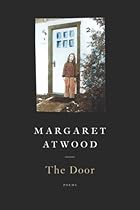 Margaret Atwood’s The Door was published in 2007, and as such is a reflection on life from a position of maturity. Atwood was born in 1939, and the poems reflect her growing realization that she is aging. Some of the poems are sad. Some seem almost bitter. The volume I got from the library also had an audio disc of Atwood reading half of the poems – a touch that gave these poems a personality beyond the mere(!) words.
One has to be careful not to interpret poetry as autobiographical, for often it is not. But even if these poems are fiction, they are so real, I felt they were real. I felt Atwood was telling me something about her life: she was telling me what it is like to be almost 70 years old, reflecting on the world, a life, and a career.
Can you tell I enjoyed reading this volume of poetry? After I read it all, I listened to the audio. And then I reread some of the poems, hearing her voice. Atwood’s poetry is more emotional and I’d suggest slightly more complex than Billy Collins’ poetry (reviewed here). But I still think it’s highly accessible to one unfamiliar with poetry.
This titular poem is absolutely a perfect poem. In a sense it captures the entire book, as it is capturing a life through an image of a door opening and closing. In the beginning, you are scared of the spiders inside the door. Then, you don’t even notice it because you’re going to a dance. By the end, you step in. “The door closes.”
“The Door” … is about, well, about life, all of it, the living of it and the meaning of it, all seen through the metaphor of a swinging door and all in two pages.
Go read it right now. I can’t find it online or I’d link to it. It’s so very good.
The sections of the volume seemed to follow the various stages of watching the door, i.e., the various stages of life and experience.
Section 1 of the volume has poems that are a reflection on childhood memories and connections: the hearth of the home. A childhood pet dying; revisiting a dolls’ house as an adult; a father’s story; mother dying (this was one of my favorites, called “My Mother Dwindle…”; read it online here). The last poem in this section “Crickets,” brings it all together, comparing crickets to the familiar ant-and-grasshopper analogy:
As for the crickets, they’ve
been censored. We have
no crickets on our hearths. We have no hearths. (page 19)
Section 2 is a reflection on a literary career. This was by far my favorite section, from “Heart” which talks about how her heart (i.e., poetry) has been sold, leaving her heartless (read it online here), to “Owl and Pussycat, Some Years Later” in which Owl (who I believe to be Atwood) reflects on their life to her college friend Pussycat:
The worst is, now we’re respectable.
We’re in anthologies. We’re taught in schools,
with cleaned-up biographies and skewed photos. (page 33)
Section 3 is a reflection on the tragedies of life. Two that stood out to me were “Ten O’Clock News,” which reminds us how much we want to ignore the tragedies around us, and “War Photo,” in which the narrator strives to immortalize a dead woman in a photo (another one of my favorite poems; I can’t find it online for you to read).
Section 4 is the hardest section for me to place. In fact, I didn’t understand some of the poems in it. I think Atwood’s poems are trying to get beyond the tragedy of life and back to the everyday. “Enough of These Discouragements” and “Possible Activities” are more about of the monotony of every day, I think, but “The Line: Five Variations” is a bit too different for me to place.
Section 5 is reflection on aging and dying. “Boat Song” is about a band playing as a ship sinks; “Dutiful” and “String Tail” are reflections on a lifetime of doing what other people want, and wondering why. “The Door” ends the volume, and was also one of my favorite poems in the collection. The end was a great place for that poem: save the best for last.
After I wrote this post, I found a couple of other reviews, including Wikipedia’s description of the sections of this book. The others are very good at talking about poetry and interpreting it. I’ve never even read a poem by Margaret Atwood before. Please keep in mind that I’m not a poetry critic; I just like these poems. I’m still learning how to read poetry and I have no idea how to talk about it. (In fact, reading the other reviews makes me rather embarrassed for how unofficial I sound.)
Should I stop trying to talk about poetry? I could just say “I liked it.” I wonder if my attempts to understand the poems really help anyone trying to decide if they want to read it.
Have you read any of Atwood’s poetry? What’s stopping you?
I picked up this volume for the Martel-Harper Challenge.
Other Reviews:
If you have reviewed The Door on your site, leave a link in the comments and I’ll add it here.

I loved your review! I’ve been looking for modern poets I could read and so many of them are just it seems trying to be clever or trying to be shocking. I’ll put this one on my list! 🙂
This sounds really great. I’ve only read The Handmaid’s Tale — I’m sort of embarrassed I didn’t know Atwood wrote poetry too!
Loved your review. I really enjoy reading poetry and delving into the thoughts of poets. I’ve never read any of Atwood’s poetry, but I have read some of her novels. Have you ever read Adrienne’s Rich’s Diving Into the Wreck. Is Atwood’s poetry similar to that? Curious, because I love Adrienne Rich 🙂
Great review.
I haven’t tried anything by Margaret Atwood yet, but I’m very tempted too. I keep getting told The Blind Assasin and The Handmaid’s Tale are good.
I don’t know how to talk about poetry either, even if I’ve been reading them all my life. I just “feel” them.
I’ve read this book by Atwood and while I did like it, it didn’t make much of an impression on me. I’ve forgotten about it, actually, lol. I love reading your thoughts on it, though.
Jason, some of the other, more professional reviewers seemed disappointed with Atwood’s poetry in this volume. But I liked it! Collins is, I think, is the most accessible I’ve read, but I’ve read very little thus far!
Kim, I didn’t really either, but she was a poet first, in the 1960s. One of the poems in this volume was about how “it’s okay to be a poet again.”
Tracie, I read some Adrienne Rich in an anthology, and I also enjoyed it. That volume sounds good. I am putting it on my list!
Bella, I enjoyed Handmaid’s Tale, although it wasn’t my favorite. This volume is quite different, of course, since it’s poetry. I think being able to write well in many genres is an impressive talent!
Claire, I haven’t been reading poetry my whole life. In fact, I avoided it until a certain point, probably age 18, then I liked something and read it for a year, then I ignored for a decade. I’m going to try to put it back in my regular reading schedule, now that I’m blogging.
It seems that others who’ve read lots of poetry say that about this volume; see the posts linked to above.
@everyone, I”m glad the consensus is you like reading my thoughts. I just feel self-conscious because I don’t have anything actually useful to say about it! I don’t have the vocab.
I’ve only read a handful of her poems, but I love them all. In fact, just for how much I like her writing in her novels I could tell I’d like her poetry too. I’ll have to pick this up at some point.
Nymeth, I haven’t read many of her novels, but I do like these poems! She’s written well in so many different genres, and I think that’s a sign of a good writer!
I’ve heard of Atwood but I’m not positive if I’ve read it or not…
Ladytink, well, if you like modern poetry, you’d probably like this!
I’m glad you got Margaret Atwood. I have The Door too (bought it second hand for just two bucks), and was floored to hear Margaret Atwood’s voice for the first time (Never occured to me to look up any audios/videos of her online.)
Poetry reading, Bear Lament, and Owl and PussyCat Some Years Later are my favorites. 🙂