
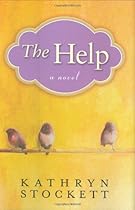
 I was a skeptic. I had heard the hype and still I avoided The Help by Kathryn Stockett. My book club decided to discuss it this month and I grudgingly put a hold for it at the library. The hold came in and I let it sit on my TBR shelf for a week before I finally picked it up one night at 10 p.m., with a sigh, and began to read. I figured I’d read until I got bored or fell asleep.
And then I read until an embarrassingly late hour. I couldn’t put it down. The next day, I persuaded my toddler to take a nap. Then, instead of taking a needed nap myself, I finished the book. This was a book I wanted to keep reading. I wanted to see what happened.
The Help has flaws. It is not a perfect novel in any way. But I really enjoyed reading it, and the themes it addresses and the way it is written (for the most part) all work together to bring me into it and make it a page-turner.
The Help is about three women in 1960s Jackson, Mississippi, two of whom are black maids and one is a young white woman trying to come to terms with the civil rights movement so present in those years. From the first pages (once I got used to the voice, which is written in a black dialect for the most part), I wanted to know what happened to these people. I felt drawn in to the setting; it was like I was in Jackson, Mississippi. I liked that, and as my story above attests, I couldn’t stop reading this book once I started. I wanted to know how it all worked out, I wanted to see Hilly and her friends shamed, and I wanted to see the black maids, who had been discriminated against for so very long, come out on top.
My favorite character was Aibileen, who I found to be most clearly defined as an individual. I suspect Ms. Stockett began with Aibileen and created the other characters afterwards. I really wanted to know more about Aibileen’s story, her relationships with her charges, and pretty much anything. She was so clever. I loved Mae Mobley too. I wish she had a chance of not becoming like her mother.
I haven’t ever been to Mississippi, nor have I read much Southern literature, for some of the reasons Ms. Stockett mentions in her afterward/author note. I don’t have a favorable opinion of Southerners, given the history of racism. (I’m not to excusing Chicagoans from being racist, of course, but…) Of course, this is bias against the South is completely unfair, and Stockett’s book helped me to see that. But still, some of the things I noticed that I consider flaws might not be so if I had a better understanding of the Southern way of thinking.
The things in the novel that bothered me revolved around the characterization. Skeeter didn’t seem real to me, as compared to the two maids. It was inconsistent that Skeeter didn’t have a southern “voice” as the two black maids did, and Skeeter’s viewpoints also seemed unrealistic since she was suddenly noticing the race issue for the first time at age 24. I never understood how Skeeter was friends with Hilly. I didn’t think Skeeter’s personal development felt complete by the end. I also found the lack of Serious Repercussions to be unrealistic. I suspect it would have been difficult to get away with what they did.
In my book group last night, there was one woman who was raised in the South (although her parents were from California) and one who lived there for a decade in the 1990s. Both of them thought Skeeter’s attitudes and gradual realization of racism were accurately portrayed, and people still have attitudes like Hilly’s toward blacks. I guess I just have a hard time wrapping my mind around the Southern way of life. To think people still have these attitudes toward African-Americans makes it seems like a foreign country. Both of those women in my book group indicated that people in the South like Hilly still exist and don’t think they are racist. That is the most disturbing thing to me.
My new wonder is what do African-Americans think of this white woman’s portrayal of them? I wondered that as I read as well.
In the end, I really enjoyed reading The Help (given I couldn’t put it down!). I didn’t think it was perfect, and I probably won’t ever reread it. Maybe because I went in to it with low expectations, though, I found it a satisfying, engaging read well worth the hype.

I loved this book. I thought the characterization was compelling and very realistic.
.-= Stephanie´s last post on blog ..Book Review: The Postmistress =-.
Stephanie, Glad you loved it too!
Glad to hear it! That it lived up to the hype and all. This is our book club read for May, and I’m very excited to finally read it.
Suey, I think it worked very well as a book club pick! There’s a reason it’s the newest pick for book clubs this year!
I know that you don’t read much contemporary fiction, so the fact that you enjoyed this book so much really says something to me! Of course I’ve heard great stuff about it for months now, but I haven’t made it a priority (especially since I’ve been trying to rein in my book buying). I know this is one that I will read, hopefully soon!
Before I moved to Nashville, I had no interest in reading Southern fiction, but that’s changed since I’ve been here. It’s true that racism does run rampant in the South, but having traveled quite extensively, I know this is not something that is specific to a certain region. I certainly appreciate the perspective that Southern fiction provides me into the culture and traditions that have shaped this part of the U.S. even if I don’t necessarily agree with all of the beliefs!
.-= Steph´s last post on blog ..“Blindness” by José Saramago =-.
Steph, yeah, I was skeptical of it mostly because it WAS modern fiction. But I was satisfied. I forgot you were in Nashville!
I absolutely agree with you about Skeeter. I didn’t think her character was realistic at all, particularly her epiphany at the END of the novel.
.-= Aarti´s last post on blog ..Sunday Salon: Do you fall for the hype? =-.
Aarti, yeah, Skeeter was disappointing to me in terms of development, but the others were fun to “meet.”
I enjoyed this book and couldn’t put it down either. I agree that it wasn’t perfect though. I can’t remember exactly wasn’t right about it, but I do remember thinking a few things didn’t add up. I’ll forgive it though as it was so compelling.
.-= Jackie (Farm Lane Books)´s last post on blog ..Does the age of the author matter? =-.
Jackie, Yeah, for me it was compelling enough to keep reading (obviously!!) and so flaws are okay.
Whew! I’ve lived in the South most of my life and I’m really anxious to read this book. I have to say though, that I think the South of today is unfairly labeled as being more racist than the rest of the country. The South has become very diverse – there are people from all over the world living here now. Yes, there is racism here, but it’s also in the North. Did you hear about the young man in New Jersey who made a racist remark over the PA system in Wal-Mart?
Kathy, I hadn’t heard about that incident. So awful! Definitely, there is racism everywhere, not excusing anyone. This book seemed to show a CULTURE of racism that seemed quite different from any I’ve seen elsewhere. I certainly hope (and expect) it’s changed since the 60s!
I agree, the South gets the most blame for racism, but it is everywhere. I think it’s because it used to be so blatant. I haven’t spent much time in the Deep South but I’d like to think it’s better nowadays. Racism definitely exists up North, there are skinheads and neo-Nazis from all over which I find so scary. I think a lot of racism in the North is more subtle (unlike the guy from Wal-Mart).
.-= Karenlibrarian´s last post on blog ..The Island of Dr. Moreau by H. G. Wells =-.
Karen, someone in my book club pointed out that in other communities racism is against other cultures, Latinos, for example. Something to consider…
I got the impression that the only reason Hilly and Skeeter were friends is that it was a left-over friendship from when they were younger. But still… !!!
.-= rhapsodyinbooks´s last post on blog ..Review of “The Dead & The Gone” by Susan Beth Pfeffer =-.
rhapsody, yeah, I got that impression too, but I wondered why it took Skeeter so long to realize Hilly was a jerk!
Your thoughts remind me of that Flannery O’Connor quote about how Northerners will think anything written about the South is grotesque – unless it’s actually grotesque, in which case they’ll think it’s realistic. Ever since I read that, I’ve been second-guessing my responses to Southern lit! 🙂
I love Southern regional writers, but for some reason I still don’t see myself picking up this book…maybe I’m just a snob about all the hype. Is the Skeeter character the one Stockett based on herself? Interesting that she would feel the least convincing to you and others.
.-= Emily´s last post on blog ..Essay Mondays: Tanizaki =-.
Emily, well, it’s modern fiction, so it truly doesn’t compare to, say, Flannery O’Connor. I was a snob about it too but enjoyed it in the end. Yeah, Skeeter is based on Stockett, I imagine. Maybe it’s hard to write about yourself in a realistic way?
Glad you liked it (for the most part). I really adored the story and probably didn’t think much about characterization (though definitely the maids were more compelling than Skeeter). I, too, wondered about how African-Americans felt about the white writer…
.-= melissa @ 1lbr´s last post on blog ..First Favorites and Winners! =-.
melissa, maybe it’s because the maids actually had a story to tell? Skeeter seemed to me to be more filler. But I’m glad you adored it!
Like you, I’ve been avoiding it because of all the hype. I’m not so sure I’ll like it, too, but maybe like you I will. 😀
.-= claire´s last post on blog ..I am loving =-.
claire, I probably would have kept avoiding it but then my book club chose it so I thought I’d give it a try after all. I’m glad I did 🙂
ps Claire, maybe it’s good to go in to it with LOW expectations!
“I don’t have a favorable opinion of Southerners, given the history of racism. (I’m not to excusing Chicagoans from being racist, of course, but…) …. To think people still have these attitudes toward African-Americans makes it seems like a foreign country.”
I really hate this. I get so fed up with the rest of the country acting like racism in their bit of the world is an aberration, as opposed to the constant never-ceasing pattern they believe it to be in the South. People are racist when they hang out with loads of people who look and think exactly like they do, which is as true in Chicago as it is in New Orleans.
For the record, I’ve lived in the Deep South nearly all my life (barring summer vacations, three years of my tothood, and a study abroad year in college). Places I’ve heard the n-word used as a racial slur to my face are as follows: Princeton, NJ, Sunnyvale, CA, Portland, ME, and Colchester & London in the United Kingdom. Over twenty years living in Louisiana, and no one’s ever used that word to me.
I’m sorry if I’ve been sharp in this comment, I’m not trying to fuss at you; and I know that my experience of the South has been colored by the fact that I live in a really diverse city, and come from a diverse and liberal family. I hereby announce the end of my ranty comment. 😛
.-= Jenny´s last post on blog ..Reviews: Yes Means Yes & Female Chauvinist Pigs =-.
Hi Jenny, so sorry that this offended you. I really didn’t intend it as such. I guess my point was that in this book I saw a separate CULTURE that looked down on the blacks and it really seemed foreign to anything I’ve seen. Part of that is this was depicting the 1960s in Jackson Mississippi, I’m sure, in the midst of the Civil Rights Movement. You are, of course, spot on that there is racism everywhere and I’m not excusing myself and my city by any means.
Have you read this book? Very curious to know your impression of it.
No, I haven’t read it, I’ve been reluctant because I do feel it’s not Stockett’s story to tell. My mother read it and found it annoying in a lot of ways, like she felt that Stockett used the old, tired stereotype of black women being so good at quieting kids, and how she didn’t get the dialect right. But she said the story was so gripping she ended up enjoying it a lot anyway. I’ve been on the fence about whether to read it or not for ages.
Looking back at my comment, it seems so unfriendly! I’m sorry! I didn’t mean to snap at you, I was in an awful mood yesterday. 🙁
As well, it’s a difficult subject for me because I always feel like I’m treading dangerously near sounding like a racism-defending Confederate-flag-waving bigot. And I’m not! I hate the horrible Confederate flag. I’m not so much defending the South against charges of racism as I am objecting to its being made the whipping boy for the racism that exists in various forms throughout the country (which I think happens all too often). All of which to say, this post struck a nerve. But I know you’re not saying the South is the only place that’s racist, and again, I’m sorry I snapped at you.
.-= Jenny´s last post on blog ..Reviews: Yes Means Yes & Female Chauvinist Pigs =-.
Jenny, it’s okay and I’m sorry it struck a nerve on a awful mood day! Feel better!
I may yet read this but probably not until long after the hype has died down. I lose patience really quickly with Southern fiction–and I’ve lived in the South my whole life!
I think what I find difficult about a lot of Southern fiction is how simplistic it is about race. Of course, racism is a terrible thing–that much is simple. But the lived experience is so much more complicated. In the fiction I’ve seen, you basically get two kinds of white Southerners (1) the enlightened liberal on a crusade for Civil Rights and (2) the evil, ugly, unpleasant racist monster. But in reality there are all kinds of shades of gray that relate to where people got their racist ideas from, when and why they express those ideas, whether their racist ideas include a denial of civil rights and basic human dignity, and how open they are to change. I just never see that multifacetedness addressed in fiction, and I’ve gotten the impression (perhaps a mistaken one) that The Help kind of stays on the simplistic level.
And just for what it’s worth, I’ve encountered plenty of outright open, vociferous racists in the South, but, as Jenny says, it’s not a constant drumbeat. Of course, the racist voices were no doubt louder in the Civil Rights era than they are now, but in my experience these days it’s generally not socially acceptable to be openly hostile to people of other races. What people do among their close social circles is another matter. And you do see some more subtle, latent hostility, but I imagine that’s true everywhere.
.-= Teresa´s last post on blog ..Speak =-.
Teresa, I didn’t think this was simplistic. In the novel, there were some white people in the middle of the opinion spectrum, being influenced by the outspoken racist monster (who is called Hilly) and there were plenty of white people who loved the maids and ignored the unspoken “rules” of interaction.
I see what what you’re saying about racism in the South and like I said to Jenny, I didn’t intend to imply it’s only there.
It’s good to hear that more than two types of Southern whites are represented in The Help. Most of the reviews I’ve seen talk only about Skeeter and Hilly, and I’ve gotten an impression that most of the white characters are like Hilly, and the reality is that racism in the South, like everywhere, comes in lots of forms. There’s out and out viciousness and more subtle discrimination and separation. And then there are the people who have racist beliefs but only because that’s all they were ever taught and never had the chance to learn anything different.
I’m keep thinking specifically of people like my grandmother who said some upsetting things about African-Americans–specifically as regards interracial dating–when I was young, but she was only repeating what she’d been taught herself and speaking to me in genuine concern and love. By the end of her life, she had different views, and the photo placed by her coffin was of her holding her biracial grandbaby, with a big smile on her face. It’s people like her who in fiction get written off as racists–full stop–when really they’re just badly taught and open to change, and sometimes that change takes years.
.-= Teresa´s last post on blog ..Speak =-.
Teresa, there ARE in between people, but their story is not the main part of the book, so I can see why people focus on Hilly and Skeeter, the two extremes. I kind of want to know about the others — can’t remember their names, even.
How sweet that your grandma could change throughout in life, loving that little grandbaby. It must be hard to change deeply held beliefs that her parents taught her…
I read this book last month and really enjoyed it. I’ve been following interviews and such about the book and its author. As an African American I enjoyed it but I’ve read in articles and such that some AAs didn’t enjoy it. Not because of the dialect but because they felt it wasn’t Stockett’s story to tell.
The story is kind of simplistic because the background of Hilly, the antagonist, isn’t told. Readers don’t know why Hilly is racist except that she is. I didn’t care to know why she was racist. When I looked at the structure of the novel, I wondered where would Hilly’s story fit in at? I’m glad that the book wasn’t graphic about racial violence. There’s so much material that goes into graphic detail about racial violence, that it’s easy for a reader to find something else to read if they wanted to know that. All in all, Stockett does show what’s at stake if you talked about what was going on at that time.
.-= Vasilly´s last post on blog ..What inspires you to keep blogging? =-.
Good point about Hilly’s story — we didn’t really get much background about her. And her mother seemed like a much better person, so that is a little odd.
.-= Karenlibrarian´s last post on blog ..The Island of Dr. Moreau by H. G. Wells =-.
Karen, I did think there was something missing to Hilly, but like Vasilly, I was okay with that. Maybe Hilly’s husband (the political ambitious person) influenced her a lot.
Vasilly, I totally agree about it not being her story to tell — and I can see why African Americans would not appreciate that.
I can see what you say about Hilly. I kind of saw her as someone who was just trying to be “cool” so she was always worrying what others thought. I’m with you though on not wanting to know all the details of her life, though.
I’m also glad there wasn’t lots of racial violence depicted, although I wondered if it was realistic that there wasn’t Severe Repercussions to what they did. I never did stop worrying about what was going to happen to them!
Hey, Rebecca! I couldn’t stop worrying about the characters too! I was so scared for them! I loved how the characters described what was the difference between a white woman getting revenge and a white man. I hope more people come forward and write more stories about another occupations and things we haven’t noticed. If Stockett hadn’t wrote this story, most of us wouldn’t have ever thought of black maids taking care of white children. Did you know some members of Stockett’s family isn’t talking to her because of the book?
.-= Vasilly´s last post on blog ..What inspires you to keep blogging? =-.
Vasilly, I hadn’t know that her family wasn’t talking to her….interesting. And yes, I do hope there are more people who come forward to tell their stories. So maybe, even if this wasn’t Stockett’s story to tell, it’s still a great thing that she told it!! It opens the way for others to tell their stories…
I was struck by the relationships that develop between the black maids and the white children they care for. Mae Mobley and Skeeter obviously adored their caregivers.
I’m glad you enjoyed the book — it was one of my favorites last year.
.-= Suzanne´s last post on blog ..April in Paris – What’s in a Name Challenge =-.
Suzanne, I loved Mae Mobley. One of my favorite scenes was when she told her dad that her teacher taught her her that game….
I loved the book also, but all the comments have definitely given me a lot to think about. I actually didn’t notice that Skeeter didn’t speak in dialect either (I don’t think any of the white characters did, and most of them probably had Southern accents also). I got the impression that Skeeter was so struck by it after her caregiver disappeared and she started looking for her. It isn’t a perfect book, but there’s a lot of great stuff in it, a great book for discussion.
.-= Karenlibrarian´s last post on blog ..The Island of Dr. Moreau by H. G. Wells =-.
Karen, yeah, I think Skeeter’s transformation began when her caregiver disappeared but I never thought it was completed. (I hope the author does NOT attempt a sequel though.) I agree, great book for discussion!!
I loved this book very much. As you said, I do wish to know what actually happened to them later on…Probably Kathryn can write a sequel if she is confident to do a good job 🙂
.-= Elizabeth´s last post on blog ..Book Review : The Help By Kathyrn Stockett =-.
Elizabeth, oh I really hope she does NOT do a sequel. I think she should write about something else in the era but not try to continue this story. It’s so well done as it is!
This was sitting on my library pile for weeks and the hype put me off reading it; it was finally it’s inclusion on the Orange Prize longlist that made me pick it up earlier this week. Like you, I could not put it down! No, it isn’t perfect but a lot of it rang true to me – if you live in a town/city/country where racism is endemic, if it is the status quo, then people like Hilly are going to exist and never question what they do, think and say as wrong. I find the attitude that Hilly, Elizabeth, Skeeter etc. have insidious and, in a way, more alarming than racial violence – Hilly views other people as racist and is so blinkered and hypocritical and those around her don’t question it/challenge her … if it wasn’t for the Civil Rights movement then people like Hilly would still be living their lives in the same way, treating people in the same way, and some still are.
Claire, What didn’t you like about Skeeter’s attitude?! Her name on the list surprised me. Maybe it was a mistake? At any rate, I’m glad you liked it too!
It wasn’t a mistake in the relation that I was referring to her: Skeeter and Lou-Ann were sympathetic and weren’t racist but they never stood up to Hilly and challenged her views so how was she ever to learn and be open to change? Yes, Skeeter took action against Hilly but in a way that was only playing her at her own game rather than in a way that educated her. I understand why it was shown that way but it was also frustrating… I wish that somebody had sat Elizabeth down too and made her fully see that it was her in Chapter 2. Moreover, Skeeter was rather naive and it was only towards the end of the novel where she actually recognised the importance of the book and that irritated me. I loved the book but the characters did have their limitations, as they would have in life.
.-= Claire (Paperback Reader)´s last post on blog ..Claire’s Corner =-.
Claire, oh okay, I see! I was bothered that she wasn’t more outspoken too. I had a hard time believing that she hadn’t noticed racism until she was 24 years old! The people in my book group that had lived in the south indicated, though, that it was completely realistic to the era! That people all the time hadn’t noticed the disparity, even if they’d been raised by a white woman who is not allowed to sit at the table, etc.
I totally agree about Skeeter being naive. Maybe that’s why her character seemed less engaging to me.
Thanks for clarifying what you meant. I think I agree.
Rebecca, I’m native to Mississippi, and I can tell you The Help represents things pretty accurately. I wasn’t happy with all aspects of the book, either. Of course I can’t recall anymore what bothered me about it, since I’ve read too much in between, but I seem to recall I thought it could have been more concise. Also, I found it incredible Skeeter was never caught parking so close to the area the African Americans lived. It didn’t seem all that likely she’d have gotten away with as much as she did. But overall it was entertaining. Not great literature, but fast moving.
.-= Lisa Guidarini´s last post on blog ..Tragedy too deep for words. =-.
Lisa, yeah, I thought she’d have had some serious consequences once she was found out. But hey, I guess in order for it to succeed she had to get away with it!
I didn’t know you were from Mississippi! It must be interesting to read a book like this. The others in my book group from the south also seemed to think it was pretty accurately represented!
I am giving away a copy of this book on my blog if anyone wants one to give away or to read themselves
http://polwig.com/home/need-a-good-read-here-is-the-help/
.-= polwig´s last post on blog ..Toddler Friendly Chinese Chicken =-.
Oh I was so happy to find a real honest review of this book ! I never heard of the book at all ! I do not tend to read popular nor best sellers so hadn’t a clue even what it was about . Someone on a homeschooling list said they were reading it and all the ladies answered saying yes how great it is . So I took it out from the library .There are still over 200 people have it on hold .
I still had no idea it was about the south at all for all I knew it was about a butler in England lol
I began reading , #1 I too do not find it to be absolutly well written . It is an okay summer read for me easy breezie type read . about 1/2 way through the book now I thought to myself “is this book written by a white woman ” and in particular one who knows black women ? Now I have to say I’m a Canadian . I have very little experience with southerners what so ever beside family from Okalhoma who come up every summer to vacation .
For me the charaters although supposed to be fiction , seemed fakey , if that makes sense ? what I mean is even a fictional charater should seem real . very real .
For me the characters I had trouble with and what made me ask the question were the black maids . I honestly felt “would a black women really say that ? would a black woman really have that responce ? ” It is not that a white woman cannot write about this subject same with a black woman writing about a white woman but it is as if she truly did not know the inside of a black maid’s mind . I have no idea , really but it seemed like I said lacking in realness to some small degree that just bothered me a pinch . needless to say the trheme is a good one , the lives of the charaters do keep me coming back for updates etc. so like I said I’m finding it a good summer read .
I just saw the movie with friends. I did not read the book because there seemed to be so much hype about it. Like Rebecca, I have mixed feelings about The Help. A good story that needs to be told. Because those who did not live through the 1960s, do not realize how very prejudiced this country was. And also, how far we have come in acceptance of some diversity.
And yet, we haven’t changed at all. How do Americans treat Hispanics? I’m sure the story of “The Help” is true today in 2011, in many communities along the Southwest. And how about the Muslim community? How are they treated on the East Coast?
Prejudice is alive and well in the USA. If we learned anything from “The Help”, it is to look within ourselves and recognize our own bigotry and work to broaden our minds and hearts.
Like almost everyone else I too was reluctant to read the book because it was so over hyped. But the movie had just come out and my friend recommended it to me with such vigour that I thought I better read it because I hate to watch the movie before the book.
I finished the night after I started. It is a very good book! Not difficult but some times it’s nice to just read a story that flows. Somethings are a little unbelievable though. Like Rebecca said the lack of backlash is a little bit unrealistic but It’s nice to imagine they wouldn’t be in a lot of trouble.
I highly recommend it, it’s not cheesy or an overdone romance or anything. Its just a simple historical period novel that keeps you wanting to know what happens in the end.
Having never been to the United States I never grew up learning about this period of History in the as much detail as many in the USA must have but it was very interesting indeed.
Definately read the book.