
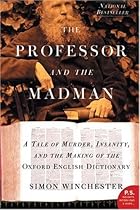
 In The Professor and the Madman, Simon Winchester delves into two contrasting yet similar personalities who helped to create the Oxford English Dictionary (OED). One is the professor, Dr. James Murray, a prolific scholar who undertakes the daunting task of creating a comprehensive dictionary; the other is a madman, Dr. William C. Minor, a schizophrenic American residing in England at an insane asylum for criminals and reading prolifically to find the words so needed for the dictionary.
The Professor and the Madman is not primarily about the making of the dictionary. (For a comprehensive history of the Oxford English Dictionary’s genesis and early creation, I would suggest The Meaning of Everything, also by Simon Winchester, which I also enjoyed.) Rather, The Professor and the Madman is a dual-biography of two odd characters, how they came together, and how they were different. While Winchester argues that the story has two protagonists, I felt that William C. Minor was the actual protagonist of this story. This was his story: how, despite madness, he could be of inestimable use to the makers of the dictionary.
Minor’s story was fascinating, as he was mentally ill in a day when there was no treatment for it. However, I didn’t find myself drawn to his character, nor did I want to know too much about his madness. To me, the most interesting aspects of this biography were the details about the dictionary making, which I had already read about in The Meaning of Everything.
That said, I highly enjoyed listening to the audiobook, as the author is the narrator and does an excellent job both at writing a compelling account and at reading it. For those interested in the making of the OED but not interested in the detailed “hows” behind it, I’d recommend The Professor and the Madman, which is a personality-driven account of how it was done, rather than the detailed historical account found in The Meaning of Everything.
I want to thank Rose City Reader for her great overview of the works by Simon Winchester. Upon reading her review, I recalled how much I enjoyed listening to Winchester’s other books and I remembered that I owned the audiobook for The Professor and the Madman. (How I forgot that I had it is a long story.) I look forward to reading (or listening) to others of Winchester’s works. They are always interesting and well done.
When you read a history, do you prefer a personality driven account (like a biography) or a historical account? I tend to think I’d prefer a biography, but this is a case where I preferred the historical review more.
In addition to The Professor and the Madman, I’ve read Krakatoa and The Meaning of Everything.
Note: If you listen to the audiobook, make sure you listen beyond the acknowledgements. There is a very interesting interview with the current editor of the OED.
If you have reviewed The Professor and the Madman, leave a link in the comments and I’ll add your link to this post.

While I normally tend to prefer personality driven account, it sounds from your review that I’d prefer the historical account. I love reviews that compare and contrast like this.
I listened to this one a while back and I really enjoyed it. The history is fascinating, and I loved learning all the new words.
I’ve picked this book up many times but have never actually bought it. I may have to check it out!
I prefer the personality driven account, but to break it down even further, I prefer a book that tells a story rather than a book that just throws facts at me.
Very interesting review!
@Jessica: The Professor and the Madman was the bestseller, so I really can’t speak for everyone. I liked them both! @Heather Johnson: yes, I loved how he put words in each chapter head! It made it “educational” too. @Chefdruck: it’s a really interesting book. @ak: I think all of Simon Winchester’s histories do a great job of telling a story in the midst of the history, which is why I love his accounts! Even the Meaning of Everything had the various personalities as a major factor. I think the difference between this and MoE is in MoE, the dictionary was the protagonist; in P&M, the two men were the protagonists. Interesting to see the different perspectives.
I loved this book! What have you heard, if anything, about “The Man who Loved China“?
Diana Raabe, I haven’t read it or really heard much about it! Let me know if you read it and it’s worth it!
Thanks for this review. I had listened to TPATM a couple of years ago, and since have been trying to convince my wife to let me purchase the complete set. She said I could take out a life insurance policy on her, and buy it if she dies, which, believe it or not, I did. (Purchase the insurance, not the dictionary!) I ran across TMOE on Audible.com and thought it must just be a rename, but am excited to see I have another book to look forward to.