
While very few parents and parenting books still argue that corporal punishment will help turn out a well-balanced child, most do propose time-outs, bribes, and praise as successful disciplining techniques for raising well-behaved children.
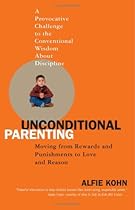 In Unconditional Parenting, Alfie Kohn goes further. He argues that conventional techniques (such as time-outs, bribes, and even praise) may harm our children emotionally. Kohn argues that time-outs and bribes, for example, may get children to do just what they are told to do (“well-behaved”), but they fail to help a child learn for themselves and they fail to engage the child in life. Even praise stifles the child’s creativity rather than encouraging the child to evaluate their work for themselves. Rather than “doing things to” their children, parents should “work with” them at all times. “Doing to” techniques, Kohn argues, only represents love that is conditional on the child’s behavior. Parents should always show unconditional love for their children.
Kohn’s arguments are compelling and convincing, and I highly appreciate some of the advice he imparts. Unconditional Parenting is apparently well-researched, and the end notes provide lots of further information.
In the end, however, I dislike the authoritative tone Kohn imparts for his ideas; I found myself repeatedly wondering why he’s an “expert.” His oldest child is ten years old; how is he to say what will work for the long-run? He has yet to parent through the teenage years. Besides, I think any “successful” parenting requires more of a balance than he seems to propose.
I Disagree
I fail to be convinced of some of Kohn’s philosophical ideas for parenting.
First, for example, Kohn argues that time-outs are to a child a “time out from love” because the child did something wrong.
[It] communicate[s] to the children that if they do something we don’t like, we’ll make them suffer in order to change their behavior [just as hitting does]. (page 29).
He argues that forcing a child to take a time-out should only be in “extraordinary circumstances” (page 152). But I personally believe time-outs can be good for children. As an adult, I may occasionally need a personal time-out; certainly, children who are in the midst of a tantrum are unable to choose for themselves if it is necessary. Taking a break from a social environment is the natural consequence for a child who is refusing to act socially. Letting a child calm down in a different setting does not seem to shut off “love.”
Also, I’m not convinced that praise and rewards are horrible. Kohn argues that if we praise immediately, children don’t stop to ask themselves if they personally are happy with the result; children act only because they expect a response from a parent, not because they want to personally do the act. If they don’t have a parent nearby that will praise them, they may not do the act at all.
When there’s no longer a goody to be gained, they’re less likely to help than are kids who weren’t given a reward in the first place. (page 32).
I can see this fact with the “say thank you” phenomenon parents encourage, and I do think Kohn has a point. However, Kohn goes a bit too far in his argument; I personally don’t see myself stopping my applause of my son when he does something I’m proud of, nor do I think withholding praise would be natural.
There are many more concepts that I am not convinced of; these are just two examples of his unconventional ideas that go a little overboard.
I’m Intrigued
But Kohn has some interesting insights that I’ll remember. Some concepts that I really appreciated:
- Think long-term.
[Ask yourself:] Are my everyday practices likely to help my children grow into the kind of people I’d like them to be? (page 3)
Perhaps when your child doesn’t do what you’re demanding, the problem isn’t with the child but with what it is you’re demanding. (page 121)
- Respect your kids as you’d respect a fellow adult. How would we feel about our boss if our boss started yelling at us?
Few of us would think of berating another adult in the tone that is routinely used with kids: “What is the matter with you? How many times do I have to remind you to look around for all your things before you leave? Do you think I have nothing better to do than . . .” and so on. With an adult, we’d be more likely to say, simply, “Here’s your umbrella.” (page 49)
Better than yelling is telling. Better than telling is explaining. Now let’s add: Better than explaining – or better than only explaining – is discussing. … We want kids to “talk back” to us, as long as they do so respectfully – and we want them to get better at it. (page 196, 197)
- Let your children make choices.
We make fun of what used to be called “yes-men” in the office, those deferential employees who never disagree with the boss, so what makes us think that “yes-children” would be ideal? (page 54)
The way kids learn to make good decisions is by making decisions, not by following directions. (page 169)
- Say you’re sorry to your children. When we make mistakes as parents, and it’s okay to let our kids know we’re sorry.
We shouldn’t pretend to be more competent than we are. And when we screw up, we should admit it. … My advice is to make a point of apologizing to your child about something at least twice a month. … First, it sets a powerful example. … Second, apologizing takes you off your perfect parent pedestal and reminds them that you’re fallible. In fact, it shows them that it’s possible to acknowledge (to ourselves and to others) that we make mistakes, and that things are sometimes our fault, without losing face or feeling hopelessly inadequate. (page 125-126)
In the end, Kohn has some valuable insights into parenting, but I don’t think his opinions are always relevant for my personal parenting needs, or for parenting in general.
This was my first “parenting” book; I’ve only read “child development” books before. Do you ever read parenting books? What author qualifications would you expect before you believed him or her?

How interesting! I’m not a parent, but I spent last year as a full-time nanny, and I agree with your disagree and intriguing sections. I spent the last week w/ my niece again, and whenever she asked me to do something I didn’t want to do, I’d ask her ‘why,’ but she’s still too young to actually answer! Anyway, I can’t imagine never receiving praise from my parents…I think it would make me much more needy for the approval of others than independent.
Eva, the praise thing was tricky — I think his point is to be proud of our kids no matter what, instead of praising only when they do what we want. Your comment that not having praise would make you needy is interesting too because that’s the opposite result he supposes! (he thinks kids are too needy on the approval of others because of praise). Intriguing arguments, but a bit too much for me to actually implement!
I don’t really look at qualifications when it comes to whose advice I will listen to but generally I won’t listen to someone who has never had children. I think that if you don’t have kids its hard to truly understand what it is like to be a parent.
I will read books and take in the advice but will decide whether it makes sense to me or not. Me and my Husband have had various discussions about books and what some people say and we come to our own conclusions. I think that is important as opposed to just taken what someone says as gold.
I must admit I do like this book but I found Raising Our Children, Raising Ourselves by Naomi Aldort to be am uch better read and something that is close to my heart. I think they are similar in some ways (although to be honest I only read half of the Kohn book!) but I just Naomi. She has a website too and some great articles.
Marie – Cot Bed, I agree, I think I’d have a hard time taking advice seriously from someone who never had kids! Thanks for the suggestion, I’ll have to find it next time I’m in a parenting book mood (usually about once a year, lol).
I liked the first part of the book, Unconditional Parenting, by Alfie Kohn, but I found it very little practical when it came to what you should do instead.
So I like to have the first part as a theoretical back up (to know why I’m doing what I’m doing), but then in practice, I rely more in PET by Thomas Gordon, that paradoxically states that you cannot love a child unconditionally, because you are affected by his behaviour and you will find some of his behavious unaceptable (but teaches you how to influence the child to change that behaviour, how to be more tolerant yourself, how to change the enviroment to change the situation). And then my bed site bible is “How to talk so kids will listen and how to listen so kid will talk”.
PET has some chapters inspired by Alfie Kohn, and it is also againts rewards and praise with the hidden agenda of changing a behaviour, but as well as ‘How to talk” puts the focus on you describing the good behaviour or explaining how it makes you feel, rather than getting a label on the child such as ‘god boy’. Instead something like: ‘You cleaning the table has saved me some time and I thank you for that’.