

Harper Lee’s To Kill a Mockingbird is a story of two children’s growing understanding of the double standards of the world. It’s also the story of a small community struggling to come together during the economic era of the Great Depression and the political upheaval of a mixed racial pre-Civil Rights southern town. It is

After I finished reading The Pickwick Papers by Charles Dickens (first published serially in 1836-7), I began to read the introduction to my edition1. Almost immediately, it confirmed what I’d thought as I’d read it: that Mr. Pickwick is a Don Quixote and Bertie Wooster character. So I stopped reading the introduction; I’ll tell you

When I first read it, I pitied Emma Bovary. How stuck she was in her world! What a victim of circumstance! True, she made wrong decisions. But she was trapped in a relationship that bored her. On this read, I hated her. She made stupid decision after stupid decision. She did not have the ability

I had never before read a biography of Charles Dickens, but having read 7½ works by the author1, I’ve generated a good idea of the issues that are important to him. Andrea Warren’s new biography for young readers wonderfully captures the man and his stories. Although Charles Dickens and the Street Child of London (Houghton

Previously by Allan Ahlberg, illustrated by Bruce Ingman is a different type of fairy tale. It goes backwards, showing that each nursery rhyme or fairy tale characters came from somewhere else. showing the effect of the action before showing the action. It begins, for example, with Goldilocks: Goldilocks arrived home all bothered and hot. And

Madame Bovary was a landmark book in the ways it blended romanticism and realism. Yet, its author, Gustave Flaubert despised the minutiae of everyday life, as well as the traditions and morals of society. The story of his life and how he, who despised realism, came to write a monumental novel of realism, is particularly

The Three Snow Bears by Jan Brett (Putnam, 2007). Aloo-ki is a young Inuit girl. Her huskie team has floated away from her on an ice flow, and she sees a little igloo with the warm smell of soup. What follows is, of course, her finding what is just right in the house: the smallest bowl of

Goldilocks by Ruth Sanderson (Little, Brown, 2009). Although Ms Sanderson’s story begins in a traditional way, the end has a rewarding twist. Goldilocks stays to help make the beds, repair baby bear’s chair, and then, just when she thinks she will be eaten, she suggests her gathered blueberries. The book includes a recipe for the blueberry muffins

Goldie and the Three Bears by Diane Stanley (HarperCollins 2007). As the cover suggests, Ms Stanley’s version of the story has an autumn setting. Young Goldie is a picky girl who only likes her peanut butter sandwiches one way, loves to read books every afternoon, and otherwise ostracizes friends by her honesty about her preferences. One day,

Rubia and the Three Osos by Susan Middleton Elya, illustrated by Melissa Sweet (Hyperion Books, 2010). Rubia is a retelling of the story, using interspersed Spanish vocabulary words. The family of bears leaves their sopa (soup) on the table when they go for their walk, and Goldilocks discovers it is caliente and frío, a chair is too suave, and so forth. Raisin didn’t
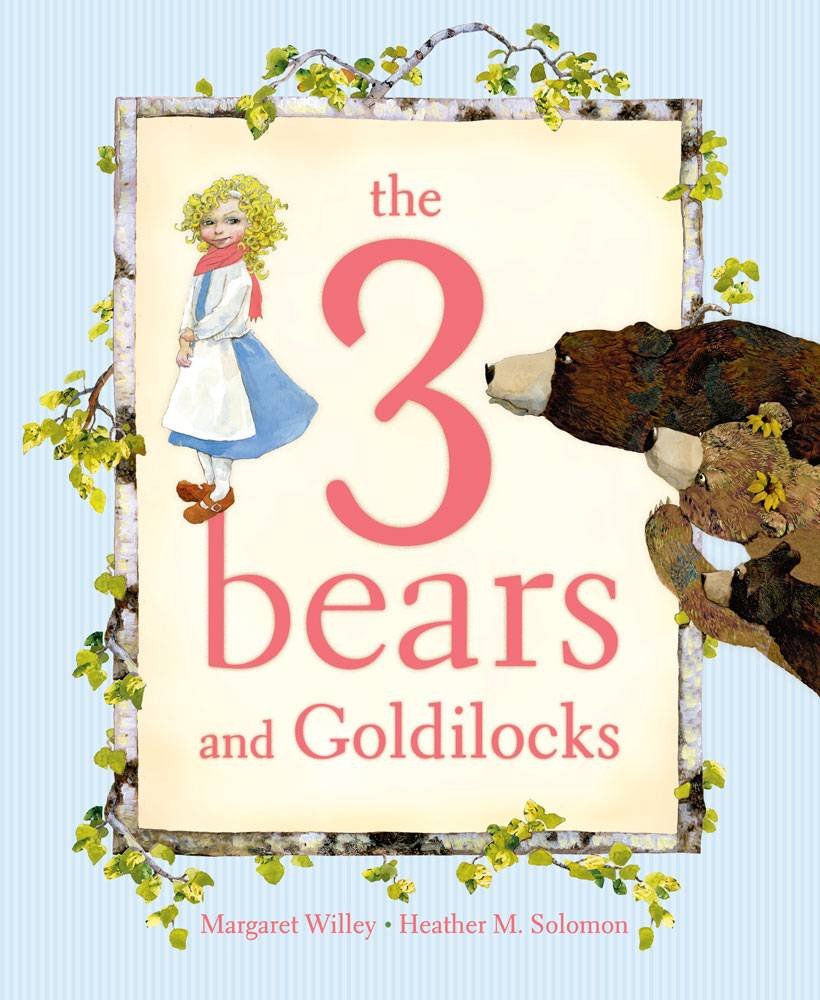
The 3 Bears and Goldilocks by Margaret Wiley, illustrated by Heather Solomon (Atheneum Books, 2008). Margaret Wiley’s retelling is one I kept thinking of as I pondered this project. In fact, her creative retelling prompted me to consider this project in the first place! Goldilocks is a curious girl, and her father warns her in the beginning

I’m actually doing the telling here because my son wouldn’t talk loud enough. He can do it just fine, I promise. I think the video camera made him nervous. But he sure loves watching it! I realize by posting this that I reveal myself as quite a nerd. But you already knew that, right?
Page [tcb_pagination_current_page] of [tcb_pagination_total_pages]