
I greatly enjoyed the compact On Tyranny by Timothy Snyder (reviewed here), which gave a brief look at twenty ways tyranny begins to appear in government. So, I was hoping for something similar in Timothy Snyder‘s On Freedom (published 2025). He gave a nice explanation of what freedom means and entails, but it was not as succinct and as clear as the previous book was. In all, rather than a short overview, On Freedom is a philosophical explanation of what it means to be free. It quotes widely from philosophers in history, as well as explains experiences in modern politics and his own life, to examine what it means to be free.
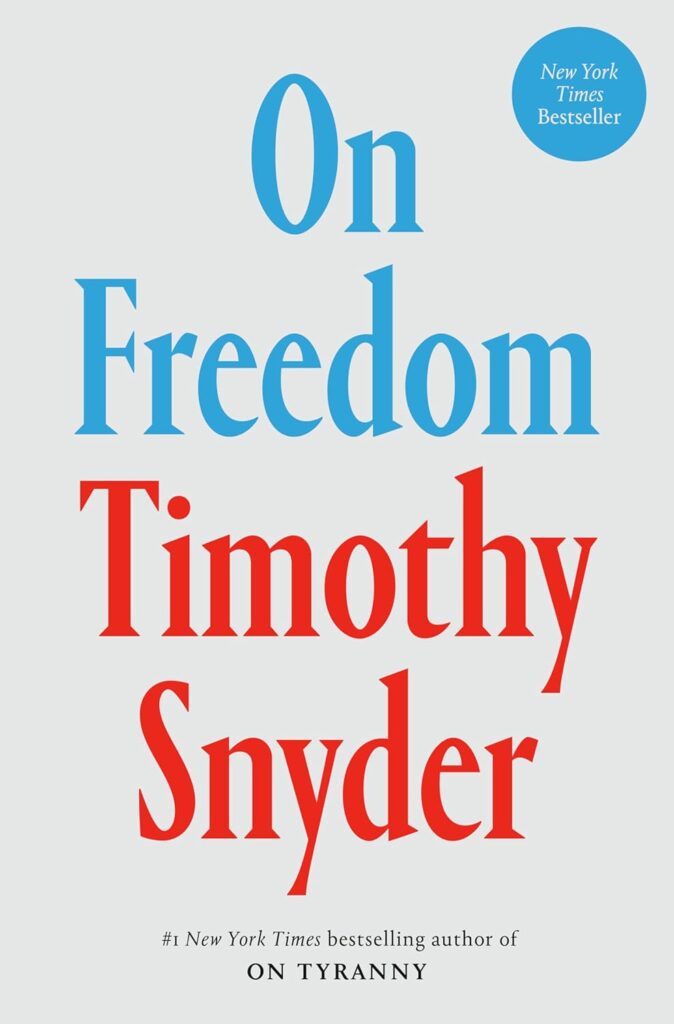
Although the structure was not as I was expecting, nor what I would normally enjoy, the content of Snyder’s volume was eye-opening and informative. He gives five qualities of freedom and connects how those five aspects contribute to continued freedom. In general, his main argument is that freedom is positive, not negative. In other words, for one to be free, they must have freedom to something rather than freedom from something. In other words (in my own ridiculous example), being free means free to choose your clothes for the day, not freedom from someone telling you what to wear.
Snyder’s five main positives of freedom are Sovereignty, Unpredictability, Mobility, Factuality, and Solidarity. Sovereignty means one is in control of oneself. You are your own boss to choose what you do. This is the most basic form of freedom. I’d suggest that most democratic countries give their people sovereignty. A five-year-old has more sovereignty than a one-year-old, and a ten-year-old has more than that. I consider how much sovereign my 14-year-old has compared to my soon-to-be 19-year-old child.
Unpredictability means that people can choose different things. We don’t know what someone will choose when they are given a particular choice. My example: When a teenager is able chose what to do on Friday night, he or she will be unpredictable, unless their freedom has been curtailed. If they are not free to leave the house, there is predictability. If they are free to leave but must stay within 10 miles of home, their is a little unpredictability, but the options are still fewer than if they are able to go anywhere to see anyone. As a person gets older, their unpredictability becomes greater. In terms of government, we are free to be unpredictable in our republic. When the government curtails this ability by law, we lose freedom. Even reducing hospitals could be curtailing unpredictability. I think of it that way, and I do see ways we’re becoming less free (see the overturning of Roe v. Wade).
Mobility, factuality, and solidarity are the points in which I start to see American freedoms being reduced significantly. Mobility means not just able to move from one place to another but to move from one bracket of society to the next. Because of changes to economics in the United States, we have fewer chances to move from poor to middle-class to wealthy. Healthcare costs restrict us, high taxes for all but the wealthy keep us in our place, and less reliable employment, inflation, and so forth all keep us down rather than mobile. Obviously, we have more mobility than in some countries of the world, but I would rather focus on the changing freedoms here. From the 1940s to 1960s or so, there were lots more chances for mobility due to the societal supports for families after WWII, including the GI Bill and taxes on the wealthy rather than the poor. The crux of the New Deal was that the policies would help lift people from one sphere into another by giving a crutch to help. Mobility has been severely curtailed because of the dismantling of the governmental social services that help lift up the less fortunate in society. Some may rejoice in the reduction of government. I see it much as Snyder does: a way to limit and reduce freedoms for those less fortunate from day one of their lives.
Factuality is certainly questioned in this age. We should have the freedom of facts, but in so many ways truth is being skewed and hidden from people in American society. Further, solidarity suggests that all agree on what freedom means — not necessarily agreeing on basic concepts but that we are all there for each other, that we are on the same side of freedom. Now our society is wholly divided into “us” and “them” in many different ways. The President has encouraged the lies and divisions rather than encouraged solidarity and factuality. Our society is becoming less free as a result.
I left off reading On Tyranny with a feeling of unease that our nation is leading toward tyranny. I finished reading On Freedom with an unease and certainty that our nation is becoming less free. There are plenty of political discussions in the book and some will disagree with his take on things, of course. But overall, it is a philosophical examination of a concept I’m fascinated by. The mix of personal story, historical examination, philosophic comparison, and political discourse was not what I was expecting, but On Freedom is a strong treatise on an important concept. It is a work I will need to reread to better understand.
