
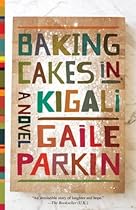
 At first, Baking Cakes in Kigali by Galie Parkin reminded me of The No. 1 Ladies Detective Agency by Alexander McCall-Smith.
In both novels, an independent woman in an African country runs a business and listens to the gossip of her neighbors, showing the reader a little bit about African locale, but also illustrating the pure spunk behind a strong woman in various situations. Both books share humorous anecdotes in a light, easily accessible tone. Even when difficult things happen, the tone remains hopeful.
But that is where the similarities end. McCall-Smith graciously paints the beautiful and peaceful, yet poor, Botswana. Parkin, on the other hand, illustrates a pained Rwanda. The stories Angel hears are those of genocide survivors. And yet, even Angel’s story is ultimately full of hope.
Angel bakes cakes: cakes for christening, cakes for welcomes and farewells, cakes for birthdays and weddings. With each cake, we learn a little bit more about the people Angel lives with in the Rwandan town of Kigali. Angel is from Tanzania, and her family has come to Rwanda in the year 2000, like many, to help the Rwandan’s rebuild after the horrors that were genocide.
While at first glance, the novel is about Angel’s scrumptious cakes, it doesn’t take long to realize that the gossip she hears from her associates is different from gossip we might hear. Some of the stories were funny, especially those that illustrated the clash between American culture and African ways of life. But other stories were haunting.
I guess you could say that this novel helped put Rwanda on the map for me. While I knew subconsciously about the genocide, it took these stories to make it real.
After the Tungarazas visit the genocide memorial, their friend asks Pius Tungaraza what he wrote in the memorial book:
“Never again”…
“That is what they said when they closed the death camps in Europe,” said Angel…
“And if those words had meant anything then, there would not be places like the one we’ve just been to today, with books where people can write never again all over again,” said Pius. (page 65)
Even more haunting than the physical reality of the murders was the truth of what it meant to be a survivor. Story after story tore at my heartstrings.
So although it is delightful to read about a new country with which I am unfamiliar, Baking Cakes in Kigali is not really a light read. It shares a message of both tragedy (the story of the survivors) and hope, for its ending message is that we can move on: there is a purpose to life, even after a horrendous tragedy.
In her review (which prompted me to pick up the novel), Amanda said that this book made her both laugh and cry. I second that.
I suggest you go read it! I suspect you won’t be disappointed.
Gaile Parkin worked in Rwanda for two years as a counselor, teacher, and helper to survivors. The scariest part of this novel is that, while it is fictionalized, these stories are based on true ones.
What do you know about Rwanda? How did you learn it?
Have you read any memorable book based on a true story?
Other Reviews:
- The Zen Leaf
- The Book Nest
- Book Gazing
- Bailey’s and Books

I’m so glad you liked it. And that quote – isn’t that the most powerful thing?? I had to include it. I’m adding to a link to your review in mine.
Here is the bad thing about reading book blogs: constantly adding to the list of books I want to read. I recently watched a documentary about a doctor revisiting Rwands and the facility where he was volunteering during the genocide. Talk about heart-wrenching. This book has been added to my wish list.
Amanda, That’s so funny because I forgot you’d quoted that same passage! I had two different passages marked and I decided to include this one over the other. I guess it’s the most memorable one, huh.
Cara Powers, ha ha!! Yeah, I was so intrigued by Amanda’s review, I went out and found this one! I do hope you get to it. It’s very good.
I”m glad you enjoyed this one – I’m looking forward to it.
Ouch – that excerpt hurt my heart. As a rule, I’ve steered clear of books about genocide, and I’ve never been able to decide if that’s a reasonable boundary given how emotional I get, or a cowardly avoidance of something it’s important for me to face. Either way, lots of guilt. 😛
I know quite a bit about Rwanda, just because of my academic/personal interests! The best book I’ve read about the genocide is by Philip Gourevitch-it’s entitled We Wish to Inform You That Tomorrow We Will Be Killed With Our Famillies. It’s heart-wrenching; especially during the first part I was often crying so hard I couldn’t see the words anymore, but it fills you in completely. And there were some heroes of the genocide-Gourevitch talks about them too.
You should read “Left to Tell” by Immaculée Ilibagiza. It is a story of the Rwandan Holocaust. It is really good.
I wasn’t a fan of The No. 1 Ladies Detective Agency, but this one sounds as though it has more depth.
I recently read Not Untrue and Not Unkind by Ed O’Loughlin which was about war correspondents in Rwanda. That book distanced you from the horrors though, as you saw things through the eyes of a reporter.
I would be interested in reading this one – I like books which move you – especially ones that can make you laugh and cry in a short period of time. Thanks for the recommendation!
Kathy, I hope you enjoy it!
Jenny, well, I do too. This is the first book even remotely about genocide that I’ve ever read. I think it’s the most tame–because there isn’t graphic descriptions of the violence or anything. It’s all told from the perspective of the survivors.
Eva, the more books people recommend, the more I get scared! I don’t know if I can handle a book that makes me cry THAT much, but it’ll go on my “to read when I feel like I can handle it” list.
Haiku Amy, how emotionally wrenching is that one?
Jackie, I liked it because it was so much deeper. On the surface level, it has similar themes in that a woman hears gossip and tries to run a business, but there is no mystery and the stories she hears are a bit more heart-wrenching. I hope you like it if you read it.
I love the cover! Sounds like a good book.
Everything I know about Rwanda I learned by watching “Hotel Rwanda” I felt so helpless and to think during our lifetime and even presently. I don’t like the helpless feeling. I’m listening to “Roots” now and it is so depressing and disturbing the inhumane cruelties of greedy men. When will it end?
So does this book have a happy ending? I’m not sure I want to read it when I’m such an emotional basket case when reading such abusive behavior.
Stephanie, I liked it!
Tami, well, as I said in my response to Jenny’s comment, I think this book is about as tame as you can get. A happy ending? How happy is life, sometimes? I think this is a book about hope, ultimately, but it does illustrate the grim realities of war and specifically genocide, all by listening to the stories of those who went through it — I imagine it’s not nearly so violent as Hotel Rwanda (which I haven’t seen). This is just the stories (fictional but based on true ones), told 6-7 years after the fact.
I do think it’s worth reading!
Well, my mom said she cried when she read “Left to Tell.” I can’t recall crying, but it was pretty sad. I don’t want to give away too many details, but the author said the people doing the killings were mostly neighbors and people that she knew. Very sad stuff.
Haiku Amy, I got that fact from this book too. As in, the radio said “go kill your neighbor now. Or else the army will kill you.” Wow. I’m afraid to read a nonfiction account about this! But thanks for sharing the book because I really should. My ignorance is pretty embarrassing!
I love the title and cover art of the book – those two factors alone would make me lift this book off the shelf.
I wish there were more books, films, and art about Africa that deals with these modern struggles, the stories of Africa are so diverse and complex and art is the perfect opportunity to create awareness.
RC of strangeculture, I agree, we need to stay aware of these things. Thanks for sharing! I hope you enjoy this book.
I read a few McCall-Smith’ and he does subtly touch on some of the more gruesome events in Botswana, such as child kidnapping and the like, but he does do it in such a subtle way that if you blink you may miss the line. Enjoyed those books though.
Jon, yes, I have enjoyed McCall-Smith’s books, but I do think they are very subtle. This one is more poignant. But I like it for that!
Baking cakes in Kigali takes you by the hand and down the road to meet all those colourful, amazing characters, unique beings, with their heartwarming, unsettling, funny and oh so sad stories – people and stories that will forever leave their foorprints in your heart.
Thank you Angel, thank you Gaile for taking us along and helping us understand and process those things so horrible, those images so haunting that we had previously put them in the back of our minds;bringing them into proportion and serving them in small doses so we may absorb, understand and learn, as of course this is Africa, where people are used to sharing the good and the bad.
Thank God for this book, which allows us Muzungu glimpses and insights we could otherwise never have had.