
In 1934, an African-American doctor invented a surgical procedure that allowed black people to become white (specially, Nordic) in all respects. Black No More, Incorporated, became a highly profitable business, and the people of world were forever changed.
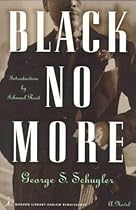
Such is the premise of George S. Schuyler’s Black No More. It caught my eye because of the science fiction/dystopian aspect. I don’t normally read science fiction, but to come across a Harlem Renaissance science fiction novel seemed so far out of the norm for that decade of African-American literature that it intrigued me.
I know I missed a lot of the humor of the era because of my unfamiliarity with most of the characters of the Renaissance. The novel’s pacing, characterization, and development also had plenty of flaws. But overall I loved the issues it raised about self image and society. It reminded me of issues today, especially the world’s obsession with body image. Today we have plastic surgery and liposuction to attempt to make everyone alike the world.
The important thing about reading Schuyler’s novel is understanding the purpose and context. It’s pretty obvious from the beginning that Schuyler is not serious in expecting things to happen like this, even if such a surgery was suddenly invented. The introduction to my volume claims it is a burlesque, which Merriam-Webster defines as follows (third definition omitted):
1 : a literary or dramatic work that seeks to ridicule by means of grotesque exaggeration or comic imitation
2 : mockery usually by caricature
Schuyler certainly mocks the leading figures of the Renaissance. Dr. Shakespeare Agamemnon Beard is a caricature of W.E.B. Du Bois; Santop Licorice is Marcus Garvey; Mme Blandish is C.J. Walker, self-made millionaire during the Harlem Renaissance for her hair care products. Schuyler gives these characters their own agenda, and it is amusing to see their reaction to the basic elimination of the race issue.
Throughout, Schuyler is mocking the entire race issue. Would “becoming white” have solved the problems of the African-Americans in Harlem in the 1930s? In this novel, he ridicules the idea by showing how superior all the blacks became, once they were white. (For example, almost as soon as the main character, the unsuccessful Max Disher, becomes white, he is able to infiltrate the orders of the racist Knights of Nordica and siphon off the money for his own future use.) What if white was suddenly the shunned race? What if everyone were exactly the same race? Why is race an issue at all?
I certainly hope that we have come somewhere on the race issue. If we were given the option of changing our skin color, would we? Why? Would it make a difference in how successful we are?
Even beyond the race issue, the novel still seemed familiar. After all, the world I live in does seem to force an image on me. When people get on the cover of People for having surgeries to better fit the “model,” I feel Schuyler’s novel is not that far-fetched. Of course, in his novel, he was able to provide surgeries for $50, a price that, during the Great Depression in Harlem, was well within budget for many people. If liposuction was that cheap, how many of us would flock to it?
Black No More reminded me of the Uglies series to some extent, but it illustrated the beginning of a movement to make everyone being the same. Being a classic African-American novel, Black No More dealt mainly with race issues and the effects of discrimination. But it still speaks to us today, and it is well worth reading simply for the reminder of the superficial world we live in and the dangers of forcing or expecting conformity. The satire and humor also make it an entertaining historical read, albeit one with some flaws.
Read for the February 2010 Classics Circuit.

I have never heard of this book before but now I really want to read it. I love dystopian novels and this one sounds like a really good one. Thank you for such a great review.
.-= Zee´s last post on blog ..Author Portrait: Astrid Lindgren =-.
Wow this sounds really interesting! The first thing i thought of was the Uglies series, too.
.-= Amanda´s last post on blog ..Virginia Woolf: A Biography (Vol 1), by Quentin Bell =-.
That book sounds fascinating. I feel like we’ve made progress since that book was written, but we still have a long way to go.
.-= Kathy´s last post on blog ..Our Life in France – banking, money and numbers =-.
I haven’t heard of this book before, but I love the sound of it. I’ve added it to the wishlist!
.-= Jackie (Farm Lane Books)´s last post on blog ..Ruby’s Spoon – Anna Lawrence Pietroni =-.
Like everyone above, I have never heard of this one before, but it does sound like a fascinating book. I wonder if it’s not better known because bulesque can often get dated very quickly? I am definitely going to look into it!
.-= Aarti´s last post on blog ..Book Event: Stephen Benatar on the East Coast =-.
This sounds like an amazing book. Put straight onto my wishlist.
It’s so interesting – reading about the premise, how a proceedure’s been invented to turn black people into white. It’s interesting that here (in the UK particularly) we now have such a craze for tanning. Everyone wants to be as BROWN and DARK as possible.
.-= Ceri´s last post on blog ..Toy Story 3 Trailer #2 =-.
I too think that this sounds interesting and really not quite all that far-fetched. In the book I read for this Circuit I was struck by how often the black people identified each other by the shade of their blackness and the lighter they were the “better” they seemed.
.-= Suzanne´s last post on blog ..Home to Harlem =-.
I’ve never heard of this but it sounds fantastic! I may need to read up a little more on the period before I read it, which hopefully will help me recognize the satire.
.-= Jenny´s last post on blog ..Fire and Hemlock, Diana Wynne Jones =-.
Interesting. The novel may have been meant to be a spoof, but as you point out, today there actually are so many ways to change how we look, even if it’s not exactly the same surgery he was writing about. Not to start a huge discussion or anything, but I have traveled to Asian countries where residents have told me outright that they wish they had “white” skin like mine. (I’m a super-pale midwesterner.) So I think this is definitely something that people still think about.
.-= Maire´s last post on blog ..Lady Susan by Jane Austen =-.
Zee, I hope dystopian is the right word: it really is the early stages of creating the dystopia. I enjoyed reading it. I hope you do too!
Amanda, obviously, this one is about race. But it kind of points out similar things as Uglies. And it’s the early stages of the “surgery” so it kind of showed me what the early days of Uglies may have been!
Kathy, yes, it did make me wonder how society really is in terms of race now: hopefully a lot better than this…
Jackie, I don’t think many have heard of it! One of those little known classics.
Aarti, There are some dated aspects, but maybe that is because, as you say, burlesque may have dated it. Also, I like to hope that the racist issues aren’t quite as relevant? I wish.
Ceri, I hope I haven’t over praised this book because while I enjoyed reading it and it is very interesting, I wouldn’t call it amazing. Maybe because I don’t pick up on all the satire! There are some flaws. But yes, I really did enjoy reading it!
Funny thing about the tanning. That’s exactly what I thought. I have very pale skin and lots of freckles and when I was younger I ALWAYS wanted a tan. Never succeeded.
Suzanne, I think that’s what I most hope has changed since the 1930s: I really hope/wish that black people don’t wish their skin was a different shade. It just breaks my heart that so many of the Harlem Renaissance books focus on that aspect of racism.
Jenny, I felt I’d read a lot about the era lately, and I could tell a few of the characters. But some were not obvious to me. It’s obvious Schyuler was close to the people he was making fun of. I think he’s trying to show there are problems with all organizations that address race issues.
Maire, That makes me sad to think that some people in Asian countries still have a similar connotation about pale skin being better!
Funny story: When I went to South America, people kept telling me (I’m also pale) that I needed go in the sun more often. They thought I was sick.
This books sounds really interesting! It sounds like it could have been done a little better, so I’m not sure if I’ll read it, but the concept is interesting. That ties into the concept of “passing” that’s come up in a lot of the Circuit novels this time.
I’m surprised about what Maire said about some Asian cultures. Asians always seem very proud of the heritage and seem somewhat exclusive, so I wouldn’t have thought that. I’m mainly familiar with the Japanese culture though, so maybe I’m applying something about them to all Asian cultures, and I am stereotyping in general and shouldn’t do that!
But we do seem to want what we don’t have. Ceri’s point about tanning is good – apparently most of us whites want to be orange! And people who have curly hair want straight hair and vice versa, and everyone wants to be skinny, but the really skinny people want a few more curves. I’m also really pale, and I have some people compliment my porceline skin and want to know how to get it, and others who think I look sick, as you mentioned.
.-= Lindsey´s last post on blog ..Missing in Action =-.
Lindsey, I too have been surprised by the concept of “passing” in so many novels. I guess it’s true: so many people want to be what they are not. It’s commentary on what it must have been like to be dark skinned in those years.