
I was dressing my 10-month-old son on his bedroom floor the other evening when he started reaching up. I saw his fingers brush the edge of the orange cover of Goodnight Moon by Margaret Wise Brown, which was on the edge of the second-lowest shelf. Once he was fully clothed in pajamas, I sat him up and pulled the book off the shelf.
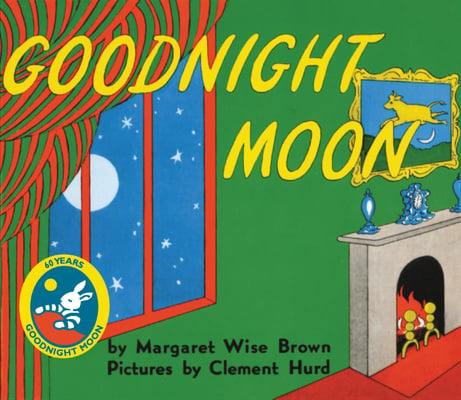
“In the great green room,” I began, setting him on my knee.
He stopped squirming and clapped his hands together, ready for his story.
My son was 3½-months-old when my mother sent him Goodnight Moon for Christmas. At that point, it was one of the five children’s books that was not 16,000 miles away in storage. I read it to him every night for months.
At first, I thought I’d get tired of reading him the same story every night. After all, at four months, I know he wasn’t really listening or looking at the pictures. Reading to him was a struggle for a few months, especially when he started “eating” the books (literally taking a bite out of one book). But nights like the other night, nights when he is excited to read, reinforce the need to keep reading.
Besides, I’ve found that I love to read Goodnight Moon. Yes, every night the little bunny says goodnight to the same objects in his same green room in the same order. But it is a different experience every night. Some nights I point out the toys in the pictures. Some nights we read slowly. On some squirmy nights we read very quickly. Some nights we read backward because my son wants to turn the pages himself.
The words are simple, and the rhymes are lilting and gentle. Goodnight Moon is a lullaby.
Goodnight stars.
Goodnight air.
Goodnight noises everywhere.
I recently purchased Children’s Literature: A Reader’s History from Aesop to Harry Potter by Seth Lerer. I have only just begun to read it, but so far I enjoy it very much. It is a textbook about children’s reading, and, as the subtitle states, Lerer is following the child-aged reader through history, rather than the writer, as many such books do.

As I read the introduction, I felt shivers of excitement as he talked about the power children’s literature can have on a child’s life. Lerer wrote:
Even the most ordinary prose becomes magical when read aloud at bedtime. And even the simplest-seeming of our children’s books teaches something elegant and deep.
Then he quotes Leonard Marcus’ thoughts about Goodnight Moon. Marcus wrote the following in the biography of Margaret Wise Brown (and this makes me want to read the biography):
Goodnight Moon is a supremely comforting evocation of the companionable objects of the daylight world. It is also a ritual preparation for a journey beyond that world, a leave-taking of the known for the unknown world of darkness and dreams. … [I]t is partly spoken in the voice of the child, who takes possession of that world by naming its particulars all over again, addressing them directly, one by one, as though each were alive, and bidding each goodnight. … The sense of an ending descends gradually, like sleep.
Lerer expands the same concept to all of children’s literature: that cataloging and recognizing the familiar are our children’s regular stepping stones into the world of the unfamiliar.
I happen to like looking at things deeply and figuring out why we like what we do and why some things are more appealing than others. That’s the English major in me, I guess.
You, on the other hand, may think that this is reading far too much into a simple children’s story.
Regardless, I hope you take the time to sit down and read something to your child. If you don’t know where to start, I’d suggest Goodnight Moon. That’s what we’re going to read, again, tonight.

Goodnight Moon was my favorite book as a child. We didn’t own it, so every other time that we went to the library, I checked it out. I used to draw the picture on the front when I wasn’t reading it.
Then, when I went to france in 1999, I brought a copy and translated it into french for the kids my host-mother babysat during the day. Ever since then, I’ve read that the old lady whispers “chut” instead of “hush.”
My kids are all intimately familiar with this one, though they’ve all outgrown it by this point. I agree that it’s so important to read to your kids, but not just that – you have to let them see you reading yourself. I used to see my kids imitating my quiet reading way before they could read. It was a different experience for them than getting read to. Kids may like people reading them stories, but unless they see that reading alone can be fun, they won’t necessarily learn to appreciate reading.
If I hadn’t closed submissions for the August Bookworms Carnival, this would be a perfect fit with the theme. But I haven’t posted the Carnival yet, so I could sneak it it if you’re in agreement. Please let me know!
Amanda, I think my son sees me read a lot too! I’m excited to see him (hopefully) learn to love reading…
Florinda, I’d be honored if you wanted to include it!
Goodnight Moon–we read this to our 3 children every single night until they were each about 3. Well, that along with about 10 other books each night! My oldest son’s first word was “ba-oon” (pointing to the red balloon). Such sweet memories!
You’ve quoted my favorite part of the book. My 3 year old no longer requested it, but it’s about time to pull it out for the baby. Thanks for reminding me.
Smallworld Reads and Lisa, aren’t books wonderful memories!
This is a really well-written and thoughtful post; I don’t really have anything to add other than I read it and it made me smile thinking about reading books as a kid 🙂
Kim (Sophisticated Dorkiness), Thanks for your comment! That’s why I’m enjoying Lerer’s review of children reading because it’s a walk back into my own childhood.
This was a great post. Congratulations on being included in the Bookworms Carnival. You’re very deserving.
Kim, Thank you! I was reading the story to my son and I decided it was something worth writing about on this site! There is so much great stuff in it!
Smallworld indeed. I ordered this “Goodnight Moon” from Amazon 10 years (more or less) for my son. We would always read it before he goes to bed. 🙂
Rino, I love it too!
This was my sister’s favorite book, and it still is one of her favorites (she’s sixteen now). Her first word was “moon.” My grandma even made her a stuffed moon with a face, and pajamas with a cow jumping over the moon on the shirt, and moon-and-stars bottoms. Even today, “Good Night Moon” is on her bookshelf in her bedroom.
Goodnight moon was probably one of my favorite books when I was little. I would try and get my dad to read it to me every night and it was actually the first book I learnt to read. It’s beautifully and simply written and ever so often I love to take it out from the top shelf of my closet and read it once or twice.. And for some reason ever night, I love to tell the moon goodnight. a timeless book that I know that I will read to my children and hopefully they will read to theirs.
Sally, it is a timeless book! Thanks for stopping by!
This was my children’s favorite book for nighttime. Now this fall, my baby goes off to college. 🙁