
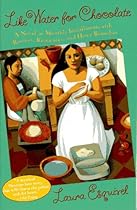
 Like Water for Chocolate by Laura Esquivel is almost a genre by itself. The traditional Mexican recipes are provided in a novel format as it tells the story of Tita, Tita’s overbearing mother, and Tita’s lover, Pedro, who marries her sister. And yet, it’s not a cook book, and I don’t think it’s not an ordinary novel.
The title comes from the state of water just before it’s ready for hot chocolate: the water is simmering and the bubbles are about to burst on the surface.
Such a near eruption is Tita’s state throughout her life. From her childhood, Tita has been in the kitchen, and she longs to live a life of her own and to feel the passions that she is forbidden. As the third daughter, Tita is forced to care for her aging mother for the rest of her life, rather than to love and experience life. As much as Tita longs to escape, she is constantly trapped preparing the traditional dishes that only she knows how to prepare. These dishes, and the memories and emotions that stem from them, capture the sorrows of her life.
I loved reading this book. It was part novel. It was part romance. It was part magic. It was part cook book (although I’d never attempt to create the meals, given the long-winded, unclear instructions that start with plucking feathers and so forth). Certainly, Like Water for Chocolate had it faults in that it is short and all people in it were caricatures. And yet, I didn’t care. It was a fun book.
I liked it so much that I’d like to share it with a reader of Rebecca Reads. I’m giving away my lightly used copy.
The narrative reminds me of the erotic fairy tale style that I found in The Arabian Nights. It’s also impossibly sensual, much as One Hundred Years of Solitude by Gabriel Garcia Marquez (which I read about three years ago, pre-blogging). For example, eating a dish (made with rose petals) arouses a woman so much so that she bursts in to flames, jumps in the shower to cool off, and then runs off, completely naked, with the army captain who had searched out the source of the delicious aroma she exudes.
I haven’t read much Latin American literature, but I understand that this is a great example of magical realism. Wikipedia defines magical realism as a genre in which “magical elements or illogical scenarios appear in an otherwise realistic or even “normal” setting.” There is a lengthy discussion on Wikipedia about what that actually means, and I find it interesting to consider that magical realism is often renamed “fantasy.” This novel seemed different to me than fantasy, because the majority of the actions and descriptions were logical and realistic, except for the unrealistic exaggerations. But then, I don’t read much fantasy either.
To me, the exaggerations were delightful. It was highly amusing and yet strangely practical to imagine that tears could became a worrisome flood down the stairs, or that food can be so sensual that wedding guests had to, well, immediately satisfy their lusts.
Like Water for Chocolate is often a “banned book,” I assume because it is so sensual. Before I read Like Water for Chocolate, I noticed that the movie is labeled a “steamy romance” and I worried about reading this book simply because I don’t like romances. Not only that, but I tend to dislike reading novels with excessive sexuality, especially when it’s not necessary or poorly written.
But Like Water for Chocolate by Laura Esquivel is a genre of its own, and simply acting out the actions contained between the pages could not possibly capture the emotions in this text. Just like I’d never want to see a movie of One Hundred Years of Solitude, I would never want to see this cook book novel in a movie format. Some things just can’t be captured. I won’t be seeing the movie.
Further, this book has lots of sexuality, and it is in fact a huge theme of the book, but because it was addressed in a fairy tale like way, it honestly didn’t bother me. Like Water for Chocolate emphasized the need to have a passion, a love, and a purpose in life, and Esquivel defined those aspects of life by the recipes and the sensual exaggerations. To me, this was tastefully done. Be warned: if you don’t like sensual novels or novels with lots of sexuality, this may bother you.
All said, it was an amusing and powerful book I’d like to revisit in Spanish some day. I think I could get through it (with a dictionary to look up all the unfamiliar foods).
How would you define “magical realism”? Do you like the genre?
Would you like my copy? I’m giving away my lightly used mass market paperback copy of Like Water for Chocolate. It came to me from Bookmooch, has a movie-tie in picture on the cover, and is in good condition. I’d be happy to send it on anywhere in the world. If you’d like to be entered to receive my copy, please mention that in the comments.
The giveaway will end Friday, August 7 and I’ll choose a winner next weekend.
Giveaway is ended.
I read Like Water for Chocolate for The Spice of Life Challenge.
Other Reviews:
- Trish’s Reading Nook
- Boston Bibliophile
- A Reader’s Respite (Info about the book banning)
- Life and Times of a “New” New Yorker
- ChainReading
- B&B ex libris
- Medieval Bookworm
- Books for Breakfast Drinks for Dinner
- Bibliofreak
If you have reviewed Like Water for Chocolate on your site, leave a link in the comments and I’ll add it here.

I’ve leard a lot about this book in passing, but don’t believe I’ve ever seen a review. It sounds really interesting and unique. I’d love to win a copy, so you can enter me. 🙂
I’m very interested in this book. A few people mentioned it when writing about books from more obscure countries.
I love cooking and powerful books, so it sounds as though this book is for me!
I’d love to win a copy!
I’d love to read this book, please enter me! I’m a big fan of magical realism, so this one sounds right up my alley! I loved the moment you mentioned in which the woman bursts into flames in a fit of uncontrolled passion. Yowza!
I once read a funny description of Magical Realism in which someone snarked that it was simply Fantasy written by Latin American authors… 😉
I would love to read the book. I think I saw the movie (but cannot remember it).
I never had a desire to read this book until your review. I’d love to win your copy! 🙂
This is one of my most fave books of all time, because I read it in adolescence and has a sentimental value. Have probably read it more than three times. I agree, it is sensual, but there isn’t overt sexuality at all. It is kind of wholesome. I haven’t seen the movie and don’t plan to, either.
In Julie & Julia, Julie talks about her attempt to cook the quail in rose petals recipe from Like Water for Chocolate.
No need to enter me as I own a copy of the book. 🙂
I read this book a while ago and loved it too. Don’t enter me in the giveaway.
Those who were interested have been entered 🙂
Amanda, I’d heard of it too, but I didn’t even know much of what it was about, just that many people liked it!
Jackie, The author was from Mexico. Is that obscure? I guess I don’t read a lot of Mexican literature…
Steph,Yowza is right, I guess. That “meaning” for magical realism is interesting. I’d have to say that I think it’s a lot more than “just fantasy” 🙂
chris swan, well, this is one I wouldn’t want to see the movie of! You are entered in to the giveaway for the book.
Heather J., Oh I’m glad I got your attention!
claire, I can imagine it being a sentimental book if it related to adolecense. I think you describe it very well: sensual but not overlly sexual. I still felt I need a warning in there because I know some people who’d be shocked by this. They’d probably not like The Arabian Nights or Marquez either.
I’m looking forward to reading Julie and Julia! I can’t imagine trying to put one of these recipes actually into a real recipe format. It was a bit long-winded (which of course made it fun!)
Kathy, I’m glad you liked it too!
Don’t enter me in the give away, as I have it and reviewed it here:
http://bibliofreakblog.com/fiction/water-chocolate-iby-laura-esquiveli/
Over the last few years, I’ve gotten more and more into Magical Realism. I don’t like it when it gets dubbed as fantasy, because like it or not, that can have a negative connotation (not necessarily in my opinion, but others seem to think so). I love that you refer to it as exaggeration, as that is how I always describe Magical Realism, too!
J.T. Oldfield, I’ve added your link. Yes, I agree that “fantasy” just doesn’t sound right when it’s so much more! *off to read your review*
I’ve heard of this book before, and not because of the movie. I just can’t remember how… Anyway, it sounds great, so please enter me in the giveaway.
Kim, it seemed to me like it was a book everyone had heard of or already read, so that’s how I’d heard of it. I’m glad to finally have read it!
Please enter me in your giveaway. This book is already on my list, and now I really want to read it after seeing your review! 🙂
I would love to win this book. I’ve seen parts of the movie and liked what I saw but I’d love to give the book a read.
Okay, I’m here reading this book now, and I have to say the comparison to Arabian Nights is absolutely perfect. I’ve only read a few of the Nights tales, but I believe they were some of the most ludicrous (not meaning in a bad way, just that they’re not very realistic and such), since they were specifically pointed out to me for seeing the magical realism. (if that’s what it’s called) I can’t stop thinking about the Arabian Nights reading this, though. It’s so interesting! A Fascinating book.
Amanda, I’m glad you are enjoying it! If you like this, you may like other magical realism books. There are so many out there!
I loved this book! Your review reminds me that I should reread it one of these days. Since I already have a copy, do not enter me in your generous giveaway.
Hi Susan, I’m glad you liked it too!
I have picked up this book several times in a bookstore, wondering if I should buy it or not. Thanks do your superbly written review I will buy it the next time I see it.
mel u, I hope you enjoy it!
Great review–I’m linking to it on my own review.