
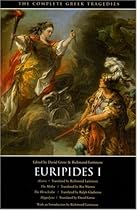
 Medea is another ancient Greek play by Euripides, and yet, it is completely different from the other play I read last year. I read the Rex Warner translation in The Norton Anthology of World Masterpieces (seventh edition). As I haven’t read any other translations, all I can say is that this one was refreshingly easy to read. I loved it!
Part of what I loved was the character of Medea. She was a wronged woman, but ultimately a strong one. Medea had left her home to come to a foreign land, and now she was being cast aside. Her husband Jason had not only cheated on her but had cast her away and married another, younger woman.
Medea’s reaction to the situation and her subsequent actions are extreme. Like Lady Macbeth, she casts aside her instincts of kindness and, particularly, her motherly love. She murders her own children. But unlike when I read about Lady Macbeth, I felt Medea was in the right. She is acting out of revenge, while Lady Macbeth had acted out of selfish desire for power. I was cheering for Medea as I read her story.
It was gruesome, and I don’t want to suggest that every wronged woman should go and kill her children or husband in order to give revenge. In fact, I would suggest that revenge is not the best solution to problems in the modern world! That said, the concept of a strong woman standing up for herself really made me happy, and since this was a Greek play, the gruesome aspects of the revenge made it seem appropriately Greek.
As for the underlying Greek-ish-ness of this play, I should say first and foremost that I am not very familiar with Greek literature. I have not read very much. But this play seemed different in that I was not constantly made aware of the presence of the gods as I was with Homer and with the other Euripides play I read last year. The last lines of the play (sung by the Chorus) are especially interesting:
Zeus in Olympus is the overseer
Of many doings. Many things the gods
Achieve beyond our judgment. What we thought
Is not confirmed and what we thought not god
Contrives. And so it happens in this story.
I don’t really understand it. When I went back and read the two-page introduction to my volume, I read the translator’s comments on the role of gods in the story and I still didn’t understand much of it. But one line does stand out:
The play creates a world in which there is no relation whatsoever between the powers that rule the universal and the fundamental laws of human morality. (page 641)
My lack of noticing the gods, then, ultimately makes sense to me. Euripides showed how the gods and man really are separate. That subject made it feel more modern than ancient Greek.
I also want to add that while Medea is a play, I had no trouble following the story and action as I read it. It would be interesting to see it performed, of course, but reading it still conveys the force of character: the characters are strong enough to exist through their words.
I finished reading Medea a few weeks ago, and I feel that I’ve forgotten many of the other impressions I had at that time. I should write my reviews shortly after finishing a work!!
Have you read other Greek plays you can suggest?
How soon after finishing reading do you write your reviews? If you wait to write your review, how do you remember what you wanted to talk about?

I read this for school a while ago, but I think I should revisit it because I’d probably appreciate it a lot more now. I’d love to read all the main Greek tragedies someday, really.
As for your question about reviews, I usually mark passages and write down a few thoughts as I read the book. That makes it easy to remember that I meant to say in my review even if it’s been a while.
I’m realizing right now that I’ve hardly read any Greek plays – this, Oedipus, and Lysistrata, and that’s it. I’m more with the Latin prose and poetry writers. I am just about to start rereading The Aeneid (in English straight through for the first time in my life!) which I’m very excited about.
I try to write my reviews promptly! But I’m well behind right now, because of Christmas shopping and organizing a major project as a gift for my mum.
This is the only Greek play I remember enjoying in college. I loved it. I don’t think this is the translation I read, but my translation was so easy, too. I think the play itself is just less convoluted than some of the others. It’s very different in the way it deals with characters, too, very progressive!
Nymeth, I’d love to read all the Greek tragedies too. And they go fast! There is just so much to read, it’s hard to make it priority!
Jenny, I haven’t read the Latin folks…still have Aeneid on the TBR. But I’ve loved Greek, so I’m hoping I enjoy the Latin too! I’m behind for lots of Holiday reasons, so I hope we all get caught up come the new year!
Amanda, I think it was your mention of it last year that encouraged me to move it to the top of the list! Thanks, I did enjoy it! And yes, rather progressive!
I love Medea! It is one of my favorites. I saw a version of it acted a few years ago and the cast was made up of two women. It was marvelous and very affecting. I had to keep wiping tears from my eyes. Have you read Aeschylus’ play Agamemnon? It’s a good one because of Jocasta regardless of whether you see her as an evil b* or a woman wronged.
I like Greek and Latin literature for all the usual reasons, Rebecca, but I also enjoy the contrasts to be found when comparing these ancients’ worldviews with literature from a more Christian mindset (be it medieval or contemporary). Very interesting to take note of the continuities and discontinuities in this regard in terms of our own “western culture” today. That being said, your Zeus in Olympus quote above seems to me a parallel of the “God works in mysterious ways” line of thinking still commonly expressed today: an attempt to come to grips with forces beyond mere mortals’ control or explanation. Did it strike you that way within the context of the play? Interesting review!
I haven’t read that much Greek literature myself but I was obsessed with the myths and legends as a kid. I think I may have seen one of the movie or TV adaptations of Medea awhile back though.
I tend to take notes when I’m reading for my reviews later. I’m trying to write up the reviews as soon as I read them now because I have such a hard time remembering everything later on down the line. Plus, my reviews tend to suffer if I wait more than a week or so…
As soon as I saw what book you were reviewing, I thought instantly it would be great for the Unbound challenge! Glad you chose it for that. I read this in high school and remember thinking at the time that Medea was insane- I feel like if I read it now, I might sympathize with her a bit more.
I love Medea as well. It’s easy to read and you do feel sorry for her and understand her, even though she takes such terrible action in the end. You’d probably also like the Lysistrata by Aristophanes. The women withhold sexual favors to get the men to agree to peace. It’s a comedy, so it’s a little different, but it’s really good. I also love the Oresteia by Euripides because of Clytemnestra. She’s a character I really sympathize with.
As for writing reviews, I try to do it quickly, or mark certain passages I might want to refer back to. It’s hard not to just jump into the next book (or keep reading the second, or fourth, or sixth book I’ve already started), but one of the reasons I started my blog was to help me pause after reading to reflect on the book so I usually try to do it quickly. Of course, I have two I need to do right now and haven’t…
I’m actually reading this right now – I’ll read your review more fully when I finish reading (I just skimmed it this time). How funny that we would both choose to read this one at about the same time?!
Cool, I have the “Euripides IV” book of that same series. It’s good to hear that you enjoyed the translation. Madea sounds like a fascinating woman.
For other Greek plays, I would highly highly recommend anything by Aristophanes. His plays are very different from Euripedes’ plays. His are hilarious. One of his plays, Lysistrata, would be great for the Women Unbound challenge, as it’s about a community of women who band together to try and stop a war.
I really enjoyed reading Prometheus Bound, and the Prometheus Unbound by Shelley afterwards…
Stefanie, oh how cool to see it acted! And no, I haven’t read Agamemmnon yet. Thanks for the recommendation!
Richard, Actually, it seemed to me that the gods were strangely absent from this. The introduction mentions how the characters kept calling on the gods for help and blessings but to me, it seemed rather godless, especially compared to the other Greek things I’ve read. I think that’s why it felt so modern….
Ladytink, I enjoy the myths and legends, I should read them more often! I hadn’t heard of Medea before, though. I should take more notes… it would make it so much easier to write a review!
Aarti, I do think she was somewhat insane, but I think people are driven to the edge today. Again, not sure revenge in her way is the best answer to problems, but it made for a great Greek tragedy!
Lindsey, oo a Greek comedy sounds like fun. I didn’t know they existed! *Adding those to my list*
Heather J., oh that is so funny! Great minds think alike!!
Marie, Lindsey just mentioned the comedy, sounds so fun!
Jason, I remember your thoughts on that! How fun!
Medea sounds so interesting – just out of curiosity which ‘wronged woman’ did you prefer out of Hippolytus and Medea? I can see you’ve read all the Greek plays I have, but I wonder if you’ve thought of giving Roamn plays a try (if you haven’t already). The surviving ones are largely comedies.
Duh I mean wronged character, out of Hippolytus and Medea because it’s the son who is wronged in Hippolytus isn’t it. Must read comments back before typing.
I loved Medea. I read it first in high school, and then again in one of my introductory English major classes in college. Have you read Beloved by Toni Morrison? We read that in high school, right after reading this play, and there are a lot of similarities between the mother in that book and Medea in this play. I wish I could remember more but this was all about seven or eight years ago. I do remember enjoying Medea more, though.
My favorite Greek play is Medea. I had to read several others in high school and in college, but the ones I remember enjoying most (and finding the easiest to follow) were Antigone by Sophocles and Prometheus Bound by Aeschylus.
Jodie, I much preferred Medea. Hippolytus just wasn’t as interesting to me, plus Medea had this “I am woman see me take revenge!” thing that woman-hating Hippolytus just didn’t have. I haven’t tried any Roman plays! So much to read still!
M seldomyes, I LOVE Beloved! I love how you connect the two of them. You’re right, there are some similarities. Thanks for the other recommendations. I’ll have to get to them.
I went to see Medea in high school, and it was amazing. I don’t remember everything about it (except the killing of the children and the RAGE), but I know we gave the young woman who played Medea a standing ovation because she was fabulous.