
I spent two months in Jerusalem in 2000 as part of a religious study abroad experience. While our focus was on Old and New Testament Biblical studies, I also got a healthy dose of Jewish and Palestinian history and religious information. I loved my time there and I loved the people I met – Jew, Muslim, and Christian.
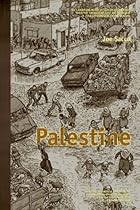
When I found Palestine, Joe Sacco’s journalistic report of the intifada circa 1992, I thought I’d experience another graphic novel, this time an account of a place I’ve lived. But the world Sacco explores is not the world I visited.
Sacco’s account focuses on the horrible conditions of the Palestinian refugees in Israel, the torture of the Isreali Defense Forces, and the reasons why the youth felt the need to rise up in rebellion in the intifada. While I can’t say I loved the blatant anti-Jewish slant of the book (which was to be expected), it was a fascinating experience to read it and I learned a lot that I hadn’t realized.
The Story

Palestine is horribly violent and painful to read. And yet, that is exactly Sacco’s purpose in writing it.
As a journalist, Joe Sacco went to Gaza and the West Bank looking for stories of pain and suffering. And he found it. The Palestinians were driven out of their homes in the 1960s, and 25 years later, they are still living in camps without paved roads, proper toilets, or roofs over their head. Their family members are jailed by Israel without being given a reason and tortured horribly because they won’t reveal the information that the soldiers want, information that they don’t actually know.
Reading Palestine made me very angry at Israel, a country that tends to get only positive press in the USA. That, again, was Sacco’s purpose. I don’t feel torture is acceptable in any circumstance: not in Guantanamo Bay by the CIA, not in Gaza by the IDF. Palestine made me angry at all governments that practice torture.
The Graphic Novel
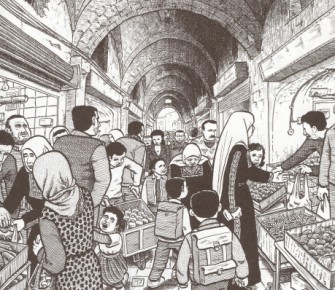 As a graphic novel, Palestine is incredibly powerful. I really loved Sacco’s detailed and powerful illustrations, and having the story partly told via the pictures made it less painful – and yet more painful: he didn’t have to describe the torture methods because they were illustrated for me to see. My only previous experiences with graphic novels were The Complete Maus and Persepolis I and Persepolis II. This was different than those in that many pages didn’t have picture boxes of story action and dialog: often, Sacco drew a full page illustration with text boxes splattered throughout it. A few pages were all text; it was very text heavy. However, it was a perfect format for trying to capture the events, background, and despair prevalent.
My Thoughts
Since I spent time in Israel-Palestine 8 years ago, during the second intifada, I found familiar aspects in his story: for example, the young boys follow him, call him something in Arabic, and then throw stones at him; that happened to me on occasion as I walked to the Old City from where I lived. But there were differences too. Apparently the Old City didn’t feel very safe to many people; when I was there, I felt safe. I felt that the violence had ceased, although I did see tire burnings on occasion. (Ehud Barak was about to entered in to peace talks, talks which I predicted erupting in violence come September 2000 — they did). I certainly hope that there wasn’t torture occurring in prisons, but I wouldn’t have known if there was.
In the end of his report, Sacco wrote:
…that’s the thing about coming to the Holy Land or Palestine or Israel or whatever you want to call it … no one who know what he’s come here looking for leaves without having found it. (page 280)
I went to Jerusalem looking for holy sites and inspiring religious experiences. I found those. Sacco went, 8 years earlier, looking for Palestinian suffering. He found it. If you are looking for the beauty of Israel, you’ll find that too. It is beautiful land.
After reading Maus and other Holocaust literature, I feel sympathy to the Jewish plight. After reading Palestine, I feel sympathy to the Palestinian cause. What’s the answer to the Middle East question? Don’t even try to answer that; it’s far too complicated. Who knows?
Palestine is a painful graphic novel to read. Don’t expect a “comic.” There is nothing comical about the things Sacco experienced. But if you are interested in Middle Eastern affairs and curious about the plight of the Palestinians circa 1992, read Palestine and prepare to be horrified and enlightened.

Rebecca, thanks so much for posting this! We in America oftentimes don’t realize or understand exactly what is going on over in Israel/Palestine. I visited the area in Jan-Feb of this year because my sister was getting married out there. She is very biased against Israel, and I didn’t pay any attention to some of the things she told me because I hadn’t experienced them myself – I figured it was just her bias talking. However, going over there, I was shocked by the conditions on the West Bank, especially in comparison to the obvious wealth of the places I went to in Israel. My brother in law is a Palestinian refugee and he told me first hand accounts of the torture he’s met by the hands of Israeli guards, despite the fact that he has never been a political person and he’s never fought. I own a book written by the children of the refugee camp in Jenin, an arabic-english book my brother in law helped translate. The human rights violations going on in the West Bank are attrocious. I wish, wish, wish that as a country we would stand up to Israel and tell them that if they want to continue to receive our friendship and assistance, that they need to adhere to basic human rights laws. I know that’s not a popular statement to make as an american, and I’m sure some people will blast me for it, but I went into Israel and onto the West Bank not knowing what the conditions would be like, and what I experienced those 10 days really sickened me. My thoughts are shaped on experience, not on what anyone else has told me.
Note: I don’t condone the behavior of Palestians who react violently against Israel and use acts of violence. I don’t condone violence in general. But seeing what I’ve seen, it’s easy to understand WHY they do what they do. The whole situation is so sad, and like you, I don’t know what the solution is. I do wish we could find some way to live peacefully, though.
Amanda, thanks for sharing your story. I was horrified to learn what Israel has done and I likewise understand why Palestinians do what they do. Like I said, how do we solve this problem? I have no idea. But it was horrifying.
A graphic memoir/journal like *Palestine* might make learning about the Middle East more accessible to more readers. The format isn’t as heavy as a journalistic report (though of course the substance of the book is heavy), making it more approachable for some people. I haven’t read *Palestine*, but I think I’d like the way the story is presented.
Dawn, I agree it makes the subject more accessible to readers, but readers have to keep in mind that it’s only one side of the story. It’s a horrifying side: I doubt Israeli citizens have much suffering since they aren’t refugees. But there is another side to the story and there isn’t a graphic novel about it, so I think non-readers need to be careful to access many sources for information, not just this one graphic novel.
I agree with you too! It’s a hard book to read, but as I said in my review that you referred to, it’s probably a necessary read in conjunction with other research. What an incredibly hard topic – from whichever side you’re on!!
Bookoholic, yes, very hard topic!
If you like “Palestine”, you should read Rutu Modan’s 2 graphic novels “Exil Wounds”, “Jamilti”:
http://www.leblogdelamirabelle.net/notes-de-lecture-bd-graphic-novel-reviews/anglophonegraphicnovels/underground-in-japan-and-israel