
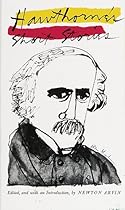
 After reading Edgar Allan Poe last week, I thought I’d stay in the same era and read Nathaniel Hawthorne’s stories. To my delight, many of Hawthorne’s stories perfectly fit the “gothic” theme of Halloween in a style that I loved. Even though I dislike of being “scared,” these stories were again the perfect amount of creepy for me.
One of Hawthorne’s collections of stories is called Twice-Told Tales. As I read, I began to understand why: while many stories are on the surface about Puritans in the early days of America, they aren’t really about Puritans. Hawthorne is telling us a different story. (Links below are to the stories in the public domain.)
For example, in Hawthorne’s probably most well-known story, “Young Goodman Brown,” the titular character is invited by the devil to practice witchcraft one night. To his surprise, the people he sees with the devil are his own religious teachers and leaders. But what we read is only a part of the story. The “tale” is told again when we realize the symbolism: even those striving to lead are hypocrites full of error.
Other stories likewise have a “ghostly,” Halloween-ish feel to them. For example, in “Rappaccini’s Daughter,” the woman is literally poisonous. In “The Snow-Image,” two children make a snow person come alive; I loved this “Frosty the Snowman” precursor. Similarly, in “Feathertop,” a witch brings her scarecrow to life. In”Lady Eleanore’s Mantle,” a woman’s coat becomes the carrier of a plague of sorts. In “Ethan Brand,” the titular character has sold his soul to the devil. I think these would be perfect for a ghostly but not scary Halloween read! I think “Feathertop” and “The Snow-Image” would also be appropriate for children.
While not all of Hawthorne’s stories are gothic, all of them have subtle meanings. Some people may not like Hawthorne’s blatant messages in his stories, but I thought his stories were also entertaining stories.
Probably my favorite non-ghostly story is “The Great Stone Face.” In this story, a small rural community is looking for the fulfillment of the legend: a person whose countenance appears the same as the face on the local hillside. This person will bring honor to the community. Over the course of a lifetime, they find the image of the stone face in a rich entrepreneur, a war hero, and a poet, all of whom end up failing the community. I loved the message of this story: that we can make a difference to others without doing something grand, and humility is always better than pride.
Further, in “The Birth-mark,”a husband wants his wonderful wife to undergo his experimental surgery to remove a birthmark from her face that he thinks is the hand print of the devil; but it’s not the hand of devil. A young man enters Boston in “My Kinsman, Major Molineux” looking for his relative to help him get started in the world; but his relative doesn’t have time for him. In “The Great Carbuncle” a group of people are searching for a huge, precious jewel, each for their own reasons — to their ultimate downfall. Finally, in “The Wives of the Dead,” two sisters find out on the same day that their husbands have died. I won’t tell you what happens, but it is “touching” in the end.
There were other, well-known stories that I read and didn’t like very much. I think I disliked the slow pace and the lack of engagement I felt with any particular character. These were “The Minister’s Black Veil,” “The May-Pole of Merry Mount,” “Wakefield,” “The Gentle Boy,” “Endicott and the Red Cross,” “The Gray Champion,” and “The Ambitious Guest.” While these stories were good, and I don’t want to miss mentioning them, I wasn’t drawn in to them. Maybe I’ll revisit them sometime and find them delightful as well!
In the end, Hawthorne has a style of his own. I can almost say he’s a favorite for me, after Maupassant and Chekhov. His style may not be a favorite for you, but why not give him a try? These are short stories, after all.
Have you read Hawthorne’s stories? What do you think of his “subtle” (or not so subtle) messages?
For the rest of October, I’ll donate 10 cents to World Food Programme for every (non-spam) comment I receive on any post of Rebecca Reads. See most post on Blog Action Day 2008 here. I’m also donating any proceeds (4%) from my Amazon Store.

Thank you so much for posting this topic. It reminded me of all the Hawthorne stories I’ve loved throughout the years. He’s one of my favorite (if not my favorite) classic author. Rappucini’s Daughter is my favorite, followed close behind by The Birth Mark. I will have to go and read these again. If you really liked Chekhov, I can see why Hawthorne may not be your style. When it comes to classics, you don’t really lose by experimenting. Worse case scenario, you can now talk about his stories with others. Thanks again for the reminder.
I read The Scarlet Letter in high school, and I remember thinking it was awesome because I thought the book was essentially the first soap opera. I clearly didn’t grasp the gothic elements of his stories as well as I should have 🙂
The Birth-Mark is a good one! Oh, and The Minister’s Black Veil! I have read a handful of his stories but would love to read more. Unfortunately I don’t make time for SS as much as I should–I have a collection of his but haven’t gotten to it yet. 🙁 We visited Salem a few weekends ago, but I was really disappointed that we arrived after dark and didn’t get to see The House of the Seven Gables in daylight.
Do you like Washington Irving’s short stories?
Literate Housewife, Hawthorne’s short stories are on my favorites list now, after Chekhov and Maupassant! I really did like these!
Kim, I think I missed the gothic elements in Hawthorne before too: I only noticed this time since I’d just read Poe and Irving.
Trish, yes, I liked Irving’s; I reread them again just the other week. After reading Hawthorne, though, I think I like Hawthorne a lot more! Oo, Salem after dark! How spooky!
Ooh, I think I’ll have to check these out! After The House of the Seven Gables, I never thought I would read anything by Hawthorne again, but I DID like the Scarlet Letter, so I guess I should be willing to give Mr. Hawthorne another shot!