
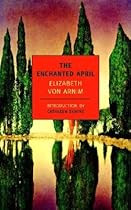
 In The Enchanted April by Elizabeth Von Arnim, an exotic Italian villa becomes a retreat for four lonely London 1920s women in four different stages of life. By allowing herself a vacation, each woman “finds” herself as she needed to do, and the significance of friendship and love in their lives solidifies. It’s a reminder that we each need time for ourselves.
It’s an interesting classic from an historical view point, and the universality of women’s needs speaks to me as a modern stay-at-home wife and mother. Although some of the details aren’t the same anymore, the sentiments in Von Arnim’s forgotten classic haven’t changed much over the years. This is a great book for any person in need of a vacation to recharge, and it’s one I’ll be suggesting to my book club of busy women.
Isolated thirty-year-old Mrs. Wilkins was the one who first discovered the advertisement for an Italian villa. As the novel opens, it’s clear she’s intimidated by her husband and bored with her life. When she finds neighbor Mrs. Arbuthnot likewise dreaming about the villa in the advertisement, Mrs. Wilkins takes matter in to her own hands and reserves the villa, despite her fear of her husband’s displeasure.
By the time April comes, four strangers are ready for a month of reflection and friendship. The story is formulaic, but that does not take away the charm nor the humor. By the end, I found myself wishing I too could have spent April on the coast of Italy.
The Enchanted April reminded me of the getaways I’ve taken with my friends. One summer, my college roommates and I took a road trip across the Midwest: six of us borrowing my mother’s van for five days. A few years later, after some of us had gotten married, we met in a family cabin for two days: no spouses, just girls having a weekend-long sleepover full of gossip and giggling. One fall, years later, another friend and I toured Paris and Italy for a week. Von Amrin’s description of the villa at Portofino reminded me of Cinque Terre.
The fact that my husband and I haven’t had a similar child-free vacation since before my two-and-a-half-year old was born made this book all the more timely. Someday, maybe, we too will get away!
The novel illustrated what it meant to be a woman in the 1920s, and it made me glad to live when I do. As in the contemporary novel of Virginia Woolf’s Mrs. Dalloway, The Enchanted April referred to each woman as called “Mrs.” Their identity was defined by their husbands, and the two young married women had to ask their husbands for money. Mrs. Wilkins truly was trapped with her dissatisfaction and boredom in her marriage, and Mrs. Arbuthnot’s only options were to adapt and accept her husband’s estrangement. In this novel, the ending was happy, although i’m sure in many real-life situations, it is not quite so easy to resolve deep-seated issues. I feel, by contrast, quite free in my marriage and life choices. Yet, it struck me that these 1920s books (I’m also thinking of Virginia Woolf) were so focused on the plight of women. There is much to learn from the past, and I suspect such limits to life options are still quite a real situation in many women’s lives today.
I’m glad this particular forgotten classic has been republished. This gives classics a good name. It’s a delightful and easy read, the setting is somewhat “magical,” and it has a universal theme, for we each have need of a vacation to recharge at times.
Highly Recommended.

I picked up this book because I saw it in the New York Review Books catalogue. The Spotlight Series is highlighting this small publisher in May. Sign up before tomorrow to invite them to your blog as well!

This sounds really good — I’m going to check it out.
Thanks for the review.
.-= Suzanne´s last post on blog ..The Queen of Palmyra =-.
Suzanne, I think it is 🙂 Enjoy!
This sounds really interesting! I can well relate to the feeling of never getting away. Jason and I went on our first weekend out without the kids in March, but it was just a night trip. We haven’t had a full vacation together, sans kids, since Morrigan was born in 2000. We’re really due for a vacation, but I’m not sure how we’ll manage it…
.-= Amanda´s last post on blog ..Blue is for Nightmares (series – Part I), by Laurie Faria Stolarz =-.
Amanda, oh dear, sounds like you two need to get away! Definitely due for a vacation!
We’ve taken off for an overnight before, but I never really counted that as “vacation” since I was never away from my son for more than 24 hours…
I read Enchanted April last year and absolutely adored it. It is a book that you cannot help but feel happy while reading it. Even my husband loved it. The movie is pretty good too though of course they change a few things.
.-= Stefanie´s last post on blog ..Orion You Came and You Took All My Marbles =-.
Stefanie, I totally agree re: the feel happy while reading it. It was just the right time for me to read it too, since I’ve been reading long and dense and depressing books like Crime and Punishment this month!
I agree with comments above. It sounds really interesting. Defining the characters as Mrs. so-and-so and keeping them tied to their husbands would really, I think, point to the fact that they are dependent on them. I feel rather lucky sometimes reading comments that I am single with no kids – I feel so free sometimes!
.-= Amy´s last post on blog ..Review: Reflections on Islam by George Jonas =-.
Amy, I definitely had a lot more freedom when I was single — I’m glad I got the chance to travel a lot. Since I don’t get to anymore!
What fortuitous timing! Tony and I just watched this movie and did a podcast about it… Unfortunately, I didn’t think the movie was all that great, but I suspected the book was probably better. There was something oddly (but perhaps inadvertently) campy about the film, and the women did not come across as well defined to me. It does sound like the book is worth reading; I think we can all do with the reminder that it is worth making time to recharge ourselves!
.-= Steph´s last post on blog ..What We Watched: April 12 – April 27 =-.
Steph, oh no, sorry you didn’t like the movie! As for “campy,” well, the book is a little too. But I loved it. It was just what I needed — a feel good book about how women need space.
I’m so glad you enjoyed this, Rebecca! It’s one of my favourite reads of the year so far. I agree that even though we fortunately have more options today, those feelings of entrapment are still a reality in many women’s lives.
.-= Nymeth´s last post on blog ..Mistress of the Art of Death by Ariana Franklin =-.
Nymeth, even though I do get out (and work one day a week, etc.) sometimes I too feel similarly! I never truly get a vacation from being a mommy. So yeah, it definitely spoke to me on many levels.
The Enchanted April was one of my favorites last year. I’m so glad you enjoyed it, too! The movie is definitely worth watching, even though it’s nowhere near as good as the book. The scenery was gorgeous.
.-= JoAnn´s last post on blog ..South of Broad by Pat Conroy =-.
JoAnn, I’m looking forward to seeing the scenery in the movie. Glad you liked the book too!
I loved this book, and much as I felt it was about the healing power of a beautiful place, it also seemed to me to be about the capacity for very different people to bring fresh perspectives into each other’s lives. I’d like Mrs Wilkins as my friend!
.-= litlove´s last post on blog ..He Ain’t Heavy =-.
Litlove, great point — I loved the fresh perspectives each woman discovered and I’m with you on Mrs. Wilkins. I hope when she went home, she didn’t get all scared of her husband again…
I saw the movie when it first came out and loved it, but I only got around to reading the book last year. It was even better than I hoped. I also loved Elizabeth in Her German Garden, which is a nonfiction work by Elizabeth von Arnim, describing her life in a country house in Germany (she married a German nobleman). It’s wonderful. I just wish I could find more of her books in print here in the U.S.!
.-= Karenlibrarian´s last post on blog ..Jamaica Inn by Daphne DuMaurier =-.
Karen, The movie is on the way to me from Netflix! Yeay, I’m glad you liked it so much.
The Enchanted April is my ‘comfort’ book (along with Rebecca), I loved E in her German Garden too. Vera, Christopher and Colombus, In the Mountains and the rest are all worth trying to get a hold of. As a stay at home mum who never did get any time away from the kids, now grown up, just reading Enchanted was my vacation time.
Katrina, reading is my vacation time too — and I’m with you on Enchanted April being a great book for that!
One of my all time favorite reads. Someday I’d love to see “where even the very clouds are fat.” Other than how she ends it for Scrap (I thought it a little to convenient) I think the description of women at different stages of their lives is spot on. Who doesn’t have a friend or relative like the ladies in this book?
Great review!
Lula O, isn’t it fun! I’m glad I found it, and yes, I would LOVE some friends like this!