
My LibraryThing group (called Group Reads – Literature) read The Forsyte Saga in March and April; I’m rather behind. I’m now midway through the second of the three novels.
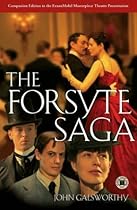 The Forsyte Saga by John Galsworthy tells the story of the end of the 1800s and the early 1900s: the cusp of modernity. The younger generation is sending off the older generation by living outside of the norm, much to the horror of the elderly Forsytes.
Such horror is only understood when one understands the Forsyte family. The Forsytes are atrociously self-conceited and yet cold. It is a family we’d all hate to be a part of today, let alone 100 years ago: everyone must be proper and follow tradition. Emotions are shunned in favor of practical, reasonable business. The main life goal of the ten Forsytes of the first generation was to propagate money. They are now comfortably upper-middle class and hope the second generation Forsytes keep things that way.
For those Forsytes that do stray from the “right way,” they are sure to be shunned. The Forsyte Saga is their story of life.
The Forsyte Saga, An Introduction
The Forsyte Saga is a collection of three full-length novels about the Forsyte family, with interludes between them. It is the first of three similar volumes (hence, nine independent novels) in The Forsyte Chronicles, which covers, I believe, forty years in the history of the fictional Forsyte family.
They were published as follows (information thanks to Wikipedia):
- The Forsyte Saga, 1906-21, 1922
- The Man Of Property, 1906
- (interlude) Indian Summer of a Forsyte, 1918
- In Chancery, 1920
- (interlude) Awakening, 1920
- To Let, 1921
- A Modern Comedy, 1924-1928, 1929
- The White Monkey, 1924
- (Interlude) a Silent Wooing, 1927
- The Silver Spoon, 1926
- (Interlude) Passers By, 1927
- Swan Song, 1928
- End Of the Chapter, 1931-1933, 1934 (posthumously)
- Maid In Waiting, 1931
- Flowering Wilderness, 1932
- One More River, 1933 (originally the English edition was called Over the River)
- John Galsworthy also wrote numerous short stories about the Forsyte family at various stages of his writing career.
My edition of The Forsyte Saga has a family tree at the front; this reveals the subsequent genealogy of all the novels, therefore revealing the plot twists (i.e., spoilers). For me, though, learning how things happen is the most interesting part of the novel, so “spoilers” are impossible. This is story of changing social perceptions and how amazingly realistic people live and react in such a volatile social time.
Beyond the subject matter, I love Galsworthy’s writing. He writes as if he is not in a hurry: he takes the time to flesh out the characters, including their thoughts and feelings. For, despite the fact that emotion is frowned upon by Forsytes, they certainly have real ones within them. While the entire plot may be considered similar to a soap opera (such as a wife having an affair with her husband’s cousins’ fiancée), Galsworthy writing makes the story real: the social world of the late 1800s becomes real to me as I read.
John Galsworthy was awarded the Nobel Prize in Literature in 1932 for his body of writing. He died in 1933.
The Man of Property
The Man of Property is the first of the nine novels in the entire collection. “Man of property” has a double-meaning as it refers to Soames Forsyte, a second-generation Forsyte.
At first, I thought “man of property” simply referred to Soames’s purchase of land and a mansion in the country. For the first generation Forsytes, owning land and owning “things” is a distinction of being a Forsyte. Soames, a second-generation Forsyte, is therefore showing his status by building property. Soames’ uncle Jolyon says at one point, “I don’t know what Soames is about … to make a fuss over a few hundred pounds. I thought he was a man of property.” (page 258). Thus, being a man of property is a status symbol to that generation. To Soames’s surprise, his wife and others in his generation don’t seem to grasp the impact of this status; the times are changing and he’s not certain what is significant anymore.
But it soon became apparent to me that there was another, more significant way that Soames was a “man of property”: “property” refers to Soames’s wife, Irene. Irene has expressed her dislike of him and desires to leave the relationship. The older generation Forsytes urge Soames to beat his wife into submission, to take the locks off of her doors, and to force her to submit to him and be a “proper” wife. Yet Soames is a man torn between two generations. He cannot do so: he loves his wife and does not want to hurt her. And yet, he still holds to some of the ideals of the old generation and considers his own “status” before that of his poor wife, who loathes him.
Ironically, Soames is only one “man of property.” Another of the second-generation, young Jolyon, has been cut off from the Forsyte family for “breaking up” his own marriage fifteen years earlier. When he re-enters the family arena, he likewise adds to the modern generations’ views, for he can understand a spouse being unhappy in the marriage and seeking freedom. He’s the opposite of Soames in that he cannot understand much, if any, of the import of “property” and why it should be praised. He has the best grasp of the situation, as his thoughts show when he visits the zoo with his father.
To shut up a lion or tiger in confinement was surely a horrible barbarity. But no cultivated person would admit this.
The idea of its being barbarous to confine wild animals had probably never even occurred to his father, for instance … In his eyes, as in the eyes of all Forsytes, the pleasure of seeing these beautiful creatures in a state of captivity far outweighed the inconvenience of imprisonment to beasts whom God had so improvidently placed in a state of freedom!
But as young Jolyon had in his constitution the elements of impartiality, he reflected that to stigmatize as barbarity that which was merely lack of imagination must be wrong; for no one who held these views had been placed in a similar position to the animals they caged, and could not, therefore, be expected to enter into their sensations. (page 162)
Young Jolyon had been in such a cage: a loveless marriage. Therefore, he understood the plight of the animals. Being cut off from the Forsyte family as a result of escaping his “cage” meant lots of struggle. But although young Jolyon is destitute, it seems clear to me that he is the “richest” of all the Forsytes, simply because he is happy. If anyone is a “man of property” in this book, I’d say it’s young Jolyon, for he is happy in his status: no other second-generation Forsyte has that, riches not-withstanding.
Indian Summer of a Forsyte
After the novel and before the next begins, Galsworthy has written an “interlude,” which is an extended story about a few of the Forsyte characters. This first interlude is absolutely beautiful: it describes the last summer of old Jolyon, who is dying of old age. Galsworthy perfectly captures old Jolyon’s thoughts and emotions as he seeks for some special connection with beauty and with the rest of the world, a world that has changed much over his long lifetime. It is beautiful, and reads like a self-contained story, even though it does relate to the other novels, and in fact is quite important to the next novel.
I’ve already made great progress on the second novel in The Forsyte Saga. I’m enjoying the continuance of the story and I look forward to more.
Have you read The Forsyte Saga? Does this sound interesting to you?
What social period would you most like to see developed in a “saga” over forty years? I never would have thought the 1880s to 1920s would be so interesting!

I have not gotten around to reading the Forsyte Saga but its on my TBR list I got the book used 2 yrs ago. I have few others in the series but I can not recall their titles at this time.
I haven’t read The Forsyte Saga, but it does sound interesting to me. I think there are still plenty of people to whom appearance is everything, so the book still sounds relevant.
Shannan, it’s good (both story and writing style), but not a fast read. I hope you enjoy it when you read it!
Kathy, you put it so well. The thing is, the Forsytes think the rest of the world likewise still believes appearance is everything; most of them aren’t realizing that the world is changing!
I haven’t read the books, but I saw the mini-series. I didn’t sympathise with the main ‘heroine,’ which made it difficult. :/ But I always enjoy a good costume drama!
Eva, I look forward to watching the mini-series! I don’t like any of the main heroines in the book either…
I enjoyed the book. I actually came across it before I saw the mini-series which is how I like to experience things so I was really lucky. But I agree not a fast read but still a great one!
Courtney, I like to read the original before I watch a movie of it too! I’m usually disappointed with the movie if I liked the book, but at least I’m expecting it.
I’m glad you liked the book too. I do think it’s great, although I’m not enjoying the last two novels as much as I did the first part of it.
I am old enough to have seen the first Forsyte Saga when it was in black and white on the television. I and most of the country and LOVED it. It was repeated several times and I watched every one. I bought all the books and read them avidly.
If you watch the original you will love Soames, acted brilliantly by Eric Porter. When he dies at the end, I wept buckets,. I know we are all supposed to sympathise with Irene, married to a man who revolts her physically, but it is Soames, I feel sorry for, he is a red blooded male, after all and he loves her after all. I have the original series on video and have just watched them all again for the umteenth time. Dont bother watching the remake, its rubbish as most second attempts are. It doesn’t even follow the story, they always mess about with things these days and end up ruining it.
Barbara, I requested the 2002 remake from the library but you’ve convinced me to find the other one as well! I very rarely like remakes of books I like so I would expect the 2002 version to change the story — but I love a costume drama, so I was looking forward to that.
I’ve finished the book since I wrote this post. I hated Soames so much in the book: I felt emotion at the end only because he was such a pathetic, hateful, lonely man despite his money. I hope I don’t like him in the movie; he was so horrible in the book, nothing could convince me otherwise. Maybe the movie(s) don’t do a good job transferring his despicable character to the screen. If he’s too nice I don’t think I can watch the movie.
I think you captured the spirit of The Forsyte Saga perfectly. Any comments I would make would only be repetitious. For the first 100 pages or so, I had to work to stay with the story, but after that I couldn’t stop reading. Galsworthy brought the characters and that time in London to life so clearly. It is a pleasure to read such good writing. Very few authors today match up to this. I have read about 2/3 of the book and am at the passing of Jolly. I like the Jolyons best of all. Enjoyed your review.