
 When I started blogging about books, I didn’t know what “graphic novel” meant. In fact, in June 2008, I wrote a post explaining my confusion. But at Dewey’s urging, I gave some of them a try. Since then, I’ve read a few graphic novels. But I admit that I still hadn’t completely understood the concepts behind writing a novel (or a memoir) with pictures. Why? Shouldn’t we focus on learning to read, not handing our teenager illustrations?
It seemed odd to me, and although I’ve enjoyed the ones I’ve read, I didn’t understand it, I’m sorry to say.
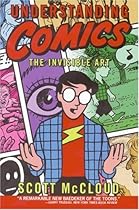
Thanks to a tweet from Nymeth, I found Understanding Comics: The Invisible Art by Scott McCloud, which is a nonfiction comic all about comics. It’s kind of like a poem about poetry, except that analogy fails, for poetry is limited to words. Comics (or graphic novels, if you will) are multi-dimensional compared to a poem.
McCloud illustrates the power of comics by showing the reader what it can do. This is a book that literally shows, not tells.
Yes, Understanding Comics is nonfiction. If you do not normally read nonfiction, you may be bored. It goes through a brief history of comics, it analyzes what makes a comic good, and it gives some background on how comics interact with the reader. If you, like me, are interested in understanding what is meant when someone says “comics” or “graphic novel,” you will, like me, be fascinated by Scott McCloud’s book.
Because I’m such a neophyte when it comes to this type of book, I feel I can’t coherently put into words all the amazing things I comprehended about comics as I read this book. Instead, I’m going to give you some bullet points what I’ve learned from each chapter. I suspect if I read it again, I’ll get even more out of it. (I wish I could “quote” the pictures to you!)
- No genres define “comics.” “Comics” is not a genre, but a format. “Sequential art” can be about any subject. (Chapter 1)
- Viewing cartoon-like images helps us picture ourselves. A simple style does not necessarily mean a simple story. Symbols and icons are somewhat universal. (Chapter 2)
- The white space (or lack of it) between frames tells a story to. Comics allow each reader to use his or her own imagination to close each panel and move to the next. (Chapter 3)
- Comics allow time frames to get tangled up. (Chapter 4)
- The art in comics provokes emotion by using symbols and recognized. (Chapter 5)
- In comics, pictures and words work together in an appropriate balance to show and tell a story. (Chapter 6)
- Successful comic writers have to balance these things: purpose; form; idiom (i.e., genre); structure; craft; and surface. (Chapter 7)
- Color has not historically been a bonus to comics – it tends to overwhelm the purpose – but with new technologies, it could be used as a bonus to the format. (Chapter 8)
- In short, comics can go anywhere – and they do! (Chapter 9)
As I started realizing what he’s saying about genre, I got really excited. Comics is not a genre, but a format to tell a story. No wonder I am not drawn to the superheroes and the fantasy fables comics. It doesn’t mean I don’t like comics, I just don’t like the genre; I don’t normally like superheroes in novels either. But there are comics about subjects I’m interested in, and those the comics I should look for.
I also was fascinated by the discussions in chapters 4 and 6 about how comics successfully capture a reader and make a reader participate in the creation of story.
Notable quotes (note that they don’t seem nearly as powerful without the awesome illustrations:
If people failed to understand comics, it was because they defined what comics could be too narrowly. | A proper definition, if we could find one, might give lie to the stereotypes – and show that the potential of comics is limitless and exciting. (page 3)
The artform – the medium – known as comics is a vessel which can hold any number of ideas and images. | The “content” of those images and ideas is, of course up to creators, and we all have different tastes. (page 6)
A good rule of thumb is that if readers are particularly aware of the art in a given story — | — then closure is probably not happening without some effort. | Of course, making the reader work a little may be just what the artist is trying to do. Once again, it’s all a matter of personal taste. (page 91)
The idea that a picture can evoke an emotional or sensual response in the viewer is vital to the art of comics. (page 121)
And because I love you all, here’s something from Scott McCloud’s website so you can read the first pages and see just what I’m talking about when I say “a comic about comics.”
Even after reading Understanding Comics, I’m not certain the comics format is for me. It seems many comics are fantasy, and I just am not drawn to it (even something like Fables doesn’t appeal to me much; although I did enjoy reading Castle Waiting). That said, the nonfiction comics I have read have always fascinated me. While I don’t normally enjoy a memoir, I have loved how comics give dimension to memoirs. I may pick up more of those, particularly the political impact memoirs. I have a few on my list, including Safe Area Gorazde by Joe Sacco and Pyongyang by Guy Delisle. Can you recommend any others?
Understanding Comics is excellent. If anything is missing, it is only the effect of the past 17 years of comics history and impact, for this book was written in 1992. It seems the graphic format has exploded in the past decade. I highly recommend it to anyone who seriously wants to understand the hows and whys behind comics.
If I’d recommend one comic/graphic novel to you, I’d say start with The Complete Maus. It’s excellent.
If you have reviewed Understanding Comics on your blog, leave a link in the comments and I’ll add it here.
Other Reviews:

What a great post! I must confess, I haven’t read a single graphic novel (though I have read some comic books… maybe they aren’t that different? Clearly I need to read this book!), largely for the reasons you expressed at the beginning of this post. It’s not that I don’t think that illustrations have a place in literature, because they certainly can add to the reading experience (I’m currently reading the Penguin Illustrated Jane Eyre, and it’s a lot of fun!), but I think I’ve always wondered about the quality of the writing in question. It might be different for graphic novels than comics, but if you have to get all your text out in terms of dialogue or expository information, I wondered if there would really be room for the actual prose to flourish. It turns out that my library has a copy of this book (in the YA section), so I may just pick it up on my next visit!
While I don’t find myself attracted to graphic novels in the least, it’s good to know something like this is out there in case I ever decide to give them a try!
Lezlie
Loved the bullet points! I’m so glad you found this as rewarding as I did, Rebecca! I’d been a fan of the medium for a while before I read this, but it really enhanced my enjoyment of it, as well as my understanding of how comics work.
One of these days I’m going to make myself a t-shirt that says, “Comics: NOT A GENRE” 😉
Stephanie, I think what I learned the most from this book (and from reading the other comics I’ve read) is that reading a comic (i.e., graphic novel/they are the same thing) is that it is not meant to be the same thing as reading a novel. You don’t go to an opera to listen to the words: you go to listen to music and words and to experience that mode of art. Reading the words from an opera would seriously not be so exciting. Probably even boring.
Reading a graphic novel is similar in that you aren’t reading for the words alone: the illustrations and words work together to form a completely different type of art all together.
Of course, some people don’t like opera at all. That doesn’t mean it’s not art, it just means those people don’t like that type of art. I happen to like it, even when it’s a bit more work. Graphic novels are a different type of art, and it may or may not be your thing too.
I think you’d learn much from this book! It does put comics in perspective!
Lezlie, I didn’t think I was attracted to graphic novels either, but I do find I enjoy the political memoirs more than I enjoy a wordy political memoir.
Nymeth, I can totally see you in that tee-shirt! Thanks for your encouragement to read this book — I think it has helped me figure out the format a bit more!
Great review…I plan to read this book as part of self-education in comics next year. 🙂
The September issue of The Artist’s Magazine had an article about comics and graphic novels which I thought was interesting. They say many modern cartoonists are doing works that “fuse literature and art”.
Unfortunately I could not find an online link to this article (their website is artistsmagazine.com) but perhaps it could still be found on the newsstands. They had a suggested reading list included also — one book may be similiar to the one you read, it’s called “Comics 101: The History, Methods and Madness” by Ryall and Tipton.
I edited an article about graphic novels earlier this year that referenced this book and went on at length about how the graphic novel/sequential art is a form, not a genre. I have read a few graphic novels and enjoyed them. I’m not sure I fully understand the language of the form, but I do like how the words and pictures together can eloquently express ideas and emotion that would be difficult to convey with words alone. I might pick this up at some point to see if it helps me understand the language behind the art a bit better.
Before I got to the end I was going to recommend Maus to you. It totally earned its Pulitzer. Let me suggest instead Gemma Bovary by Posy Simmonds. Here’s my review:
http://oohbooks.blogspot.com/2009/08/review-gemma-bovery-by-posy-simmonds.html
I’ve only recently started reading graphic novels and not that many at that but what I have read I’ve enjoyed. Manga still confuses me a bit though.
Excellent review! I’m fairly new to graphic novels and this sounds like a must-read for me. As an extra incentive, my library system even has a couple copies (I just checked!).
This review is so much better than the one I wrote! When I read this book, it really opened my eyes to what comics can do and how comics work — something I had no idea about before. I haven’t had the chance to read a comic since I read the book, but I’m looking forward to applying some of the things McCloud said to the review.
I’m glad you enjoyed this! I’d love to see a more comprehensive history of comics (McCloud touches on this but doesn’t go into it all that much) – I wonder if there is such a thing.
This is a really great review and I’m so glad you were able to learn more about the form! When I read it earlier this year, it was so helpful, since I’ve been reading graphic novels/comics for close to a year now. After I read it, the devices and techniques I learned I was able to pick up, and it really helped my understanding.
Since you asked for recommendations, here’s a few non-fiction/memoir ones I’ve read: Blankets by Craig Thompson was incredible, it’s basically about a boy growing up in Wisconsin, dealing with his first love and family issues. It’s truly beautiful, and also the first time I’ve ever cried after reading a graphic novel. The Photographer by Emmanuel Guibert and others chronicles Didier Lefèvre’s journey to Afghanistan during the 1980s as a photographer with Doctors without Borders. It’s a combination of Lefèvre’s actual photographs (there are a ton), Guibert’s illustrations, and a narrative as told by Lefèvre. It’s intense and real, and heightened so much by the story-telling style. A. D. New Orleans by Josh Neufeld is a telling of five different people’s stories during Hurricane Katrina, and while it wasn’t my favorite, I enjoyed and appreciated it. There’s also You’ll Never Know by C. Tyler, which is the first in a series (I’m not sure how many are planned.) The artwork is stunning, and the story is one of a daughter trying to connect the man her father was during the war (he’s a WWII veteran) to the man she knew growing up. A large portion of the book is styled like a photo album interspersed with her current life situation and her worries/excitement about writing the book. And there’s also Persepolis and Fun Home.
I don’t know if you’re interested in any fiction, but Aya is wonderful, in both content and form. It revolves around the lives of three girls living in the Ivory Coast during the late seventies and deals mostly with their interactions with men. I really loved it a lot (and want to read the sequel sooo bad but my library doesn’t have it.)
I didn’t mean to leave you so much to read, but I hope you find something you like!
Amy, a perfect place to start for your self-education in comics! I’m trying to figure out where to go next.
Valerie, that history book sounds like what I’m looking for! The history bit really interested me in this one, but also the “hows” were fascinating!
Teresa, did you see Nymeth’s comment for the tee-shirt she wants: “Comics: Not a GENRE!”
I too have enjoyed the comics I’ve read but I found this one perfectly explained why it’s so powerfully done sometimes. (The only graphic novels I’ve read have been pretty great.) I hope you enjoy this if you get to it!
Cara, YES! Maus is the book that I’d recommend to ANY newbie to comics. Seriously great and universal, I think. Thanks for the link to your review of Gemma Bovary. I had thought it was a copy of Flaubert’s classic, and I’m always a bit wary of retellings. But it sounds different! Something to consider.
Ladytink, I don’t know anything about Manga, and I’m not sure they have works in subjects I’m interested in. But I do like the graphic novels/comics.
JoAnn, Oh I’m glad you can get a copy! It’s so excellent if you interested in learning more about the format!
Kim, I agree, it opened my eyes too! As I read I kept getting excited for reading my next comic. I’ll look forward to seeing which you read next.
Jenny, Valerie just mentioned another book about the history and development of comics, by Ryall and Tipton. I’ll have to see if there is more about the history of comics. Very interesting stuff, huh.
Shannon, I picked up a few of the memoirs you mention and I just wasn’t interested in reading about first love/sexuality in a comic format. But, that said, the one about the doctor going to Afghanistan sounds fascinating!! I loved Persepolis, and Aya has caught my eye (I like the illustrations). I didn’t know Aya had a sequel! So thanks for all the recommendations and I’ll have to see which ones I get to next!
I want to read that book. Sounds interesting. I just don’t understand why on earth comics are now categorized as graphic novels. Well, yes, I DO understand it, I think (and then I’ve been reading graphic novels since I was able to read, btw, growing up surrounded not just by books but also by all kinds of comics: Lucky Luke, Asterix, Tintin, Donald Duck etc etc etc), but I don’t think my 10 year old nephew will tell me that he “reads graphic novels” each time he grabs a Lucky Luke from his stack. Are the stories in a Donald Duck magazine then graphic short stories? I am not trying to be fresh or ironic here, not at all. I just thought that there were COMICS and then there were GRAPHIC NOVELS. A comic (although it does not have to be comical at all) is for instance like the ones I mentioned above and a graphic novel is for instance Maus or Persepolis, just to name two (those that came to mind at first).
Granted, some of the works I termed comics before are more like graphic novels in their style and theme, but otherwise…can anyone explain why they are suddenly the same? Or need I read that book 🙂
Thanks for a very intersting post, Rebecca. I just bought a new graphic novel which I am looking forward to read: Fun House by Alison Becdel.
Louise, I think the point of this book is that graphic novels is just a “fancy name” for a comic. Donald Duck is just not a memoir, like Maus is. The point of this book is that comics is not a genre: it’s a format. Much can be done, whether it’s light hearted and “fluff” (which is how I’d see Lucky Luke) or deep and emotional, like Maus. Further, the format is artistic and worthy of discussion and analysis.
I hope you enjoy your graphic novel/comic read!
Valerie, I did some research and it looks like the Comics history book you recommend is all about the superheroes. :(. Kind of the opposite of this book! A History of the stories of comic book heroes. I’m so disappointed!
Thanks for clearing that up for me – I definitely know what you mean 🙂
By the way, the copy of Maus that I have is in a one-volume hardback which is just a couple of centimeters larger than a “normal” hardback. But my brother has an ancient copy, and that is in a two-volume comic-book size (like the same size Lucky Luke albums have for instance) edition. I think that Maus was made as a”comic” book, and then it turned somewhat iconic and melted into being a “graphic novel”. Am I making sense? Just a thought.
Louise, I’m more inclined to think that comics versus graphic novel is just about marketing. Kind of how most young adult novels are really just adult novels marketed to a younger crowd (at least in the USA). The softcover versus the hardcover doesn’t change the same book from comic to graphic novel, in other words. It just made it feel more grown up, which is marketing.
Again, all just my impressions from what I’ve read and observed. You can believe what you want too!
I think I’m going to have to look for this. I admit a bit of “eh” towards comics. I have a very good friend who just published a graphic novel (which I have not reviewed because he is a very good friend) and I had to admit I just didn’t “get” it.
Lisa, this may help you understand the medium! Highly recommended.
Understanding Comics: The Invisible Art and basically everything by Scott McCloud is a total pleasure. It’s simple. It’s clever. Now, I don’t know if it’s really for the neophyte in a way. I mean… Basically when you’ve already the habit of reading comics, you notice how it work and then you go…”hey ! It’s was always under my nose and I never understood that !” 😉
Xavier, I’d read a few comics before I read Understanding Comics so I did have a little idea of the concepts. I do think it’s a pretty good thing to read early in a comics experience. I think I am rather a comics neophyte but it helped me!
I love comics. They got me into reading when I was a kid and got me interested in science. I became a science writer.