
Native Nations: A Millennium in North America by Kathleen DuVal (published 2024, Random House) is a sweeping overview of some of the many nations of Native Americans throughout history. It begins by looking at the societies that thrived long before European contact and continues looking at major nations through to today. It is a comprehensive book that is certain to become a constant staple in Native American studies today.
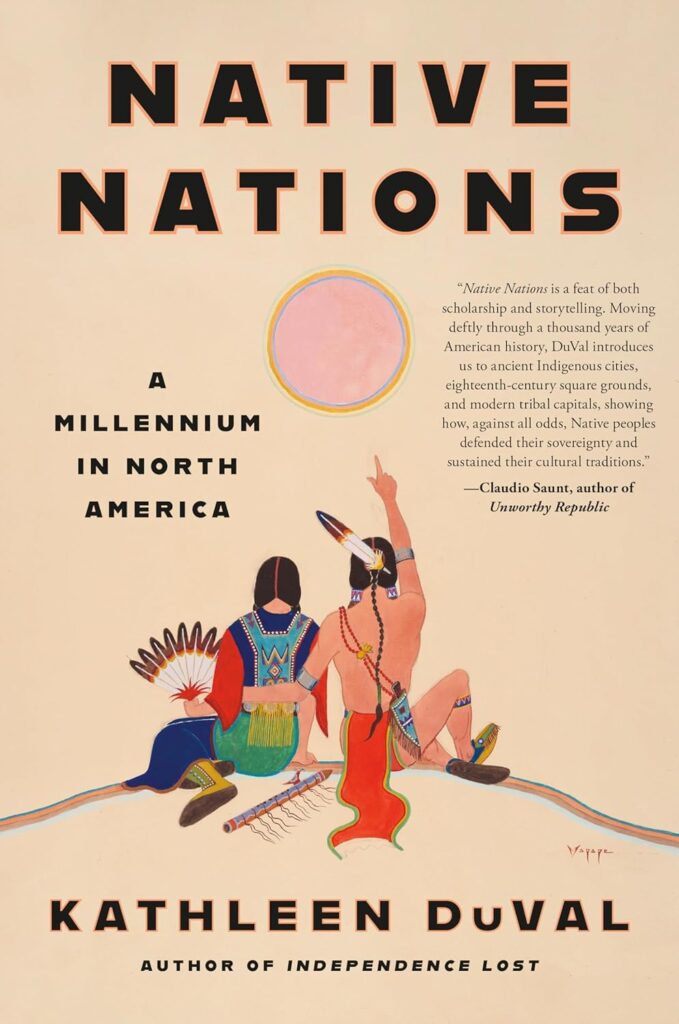
Part 1 deals with the indigenous people in North American from 1000 to 1750. This is the era I have traditionally l considered when learning about Native Americans: the past. I learned so much from this section, though, about the bright and vibrant civilizations that existed and thrived during this era. I had heard about the Mound Builders, and there was no surprise to learn more about them here. I also learned about the ancient nations in Arizona and Alabama (the latter being somewhat of an extension of the Illinois mound builders).
Chapter two looks at the change from the large cities to that of smaller “more equal” groups, and I loved seeing how such a shift was not a cultural demotion (from big city to smaller) but rather a shifting of perspectives and leadership. It was much more like life in Europe in the same era, shifting from large castles and serfdoms to smaller villages. At least, I assume that happened in places in Europe. If not, smaller villages certainly was more equitable than the serfdoms had been! Rather than being backward, the Nations were complex. Their way of life was simple, as were (again), probably many of the lives in Europe in similar years. So much of history in Europe was recorded by the well-to-do. It should be no surprise that many did not live in castles and feast as we picture knights and kings do.
Natives and Roanoke, war with the early settlers, Catholic proselytizing amongst in the desert people in New Mexico et al: While some of these facts may have drifted briefly through my studies, the “real story” as written here is about nations strong enough to plan and adapt. Especially in the west, the story was not one of Catholic conversion but rather Native acceptance of random people in their midst as they continued on doing their own thing (himdag means way of life). I loved seeing how, for the indigenous Americans, the missions in the West were simply an addition to the landscape. That said, there was plenty of violence and depressing situations due to Europeans’ self-centered ways. I dislike seeing just how vicious European colonists had been, but the story must be told.
Part 2 of the book looks at the even more depressing eras of Native American history. There was so much compromise on the part of the Natives. They simply wanted survival. I was not familiar with most of the conflicts in this section from the Native perspective. So much of the brief education I encountered about Native Americans were the brief battles and conflicts, all from the colonial/United States perspective. This book, rather, focuses on the people, the compromises, and the conversations that native leaders had in anticipation of colonists, of further conflict, and in how to survive.
The last chapter deals with the shift from annihilation to survival, and the last chapter even illustrates the perspective of many natives that they’d like to shift perspective of “…this worst era as transformation and survival rather than just victimization and erasure” (Chapter 12). I felt the hope of survival of the beautiful Native Nations still in existence as I read the last chapter and the afterword. I only wish that it hadn’t taken so long to let the people be themselves, and that such beautiful nations of traditions hadn’t been nearly eradicated through generations of genocide.
Note: I received a digital copy of the book for review consideration.
Get a copy of Native Nations at Amazon.
