
The Teacher of Nomad Land by Daniel Nayeri (published 2025) is a historical fiction middle grade book about two orphans in Iran trying to find their place in a world confused by war and occupation. As a “World War II” novel (as the subtitle states), The Teacher of Nomad Land provides a unique look at a part of the world separate from the traditionally discussed locations for this time in history. Rather than focusing on oppression or violence of battle or taking sides in Germany, Britain, or Poland, this book focuses on the complications of occupation of a distant country and the lack of communication among different groups during a turbulent time.
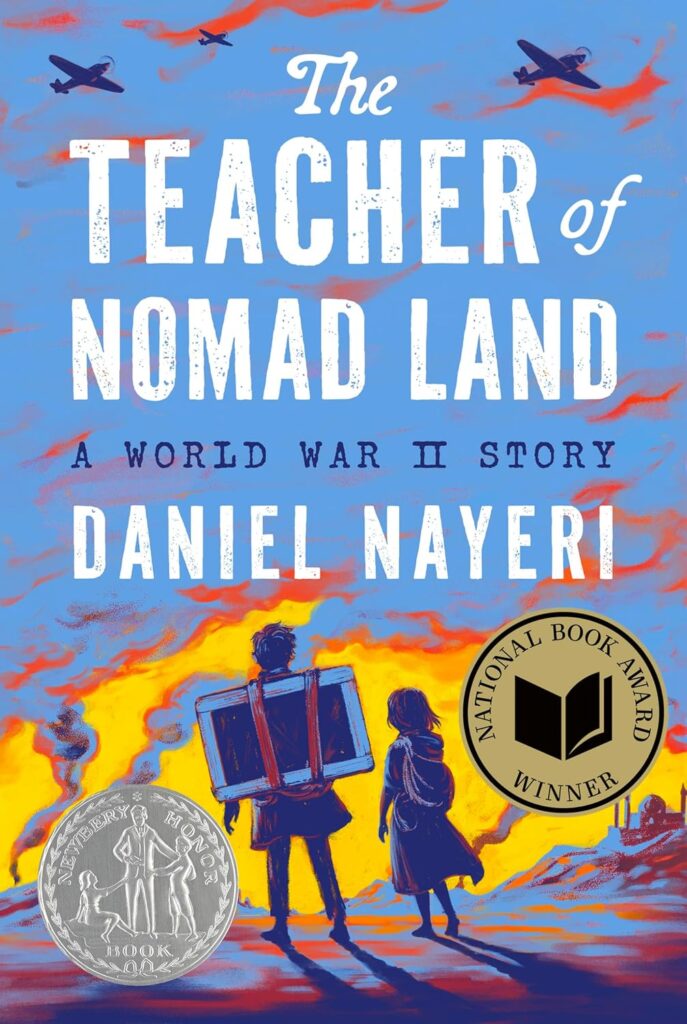
Babak and his little sister just want to stay together, but that is hard to do when there is a war and money is tight. Babak decides the best option is to join the nomads, the Bakhtiari, and teach them, as his father had, using the chalkboard, books, and lessons his father had taught him. In the process, he ends up teaching and learning from all the characters he meets: a British soldier, a German spy, the Russian troops, and a fleeing Jewish boy. It is a celebration of learning and literacy and how learning helps everyone communicate and find peace.
If only communication could eliminate war from our world as beautifully as Nayeri writes in this book!
Favorite Quotes
I listened to the audiobook twice, so I don’t have page numbers for these quotes. I hope I’ve quoted them accurately based on my notes upon listening!
How do they even begin to communicate? Babak gets the feeling that this is the whole world. No one able to hear anyone else, everyone with a different map for the same spot of ground.
I like this quote because it kind of sums up what this book is about. The maps Babak has do not correlate to the maps the various soldiers from different countries have, which also don’t seem to correlate to the land he is traversing. Similarly, everyone speaks a different language, has different priorities, and so forth.
Babak doesn’t know what to say, except to be specific. That is the core part of the teacher’s job: to make the world understandable in part.
I love how Babak’s inspiration is his father’s teaching. Not only did he learn how to teach reading lessons, he also learned the true meaning of teaching, including the need for patience. I really like how he teaches me about the role of teacher in the process as well.
This book has strong religious elements. Although I know, from my life experience, Babak must be Muslim in Iran, he and his sister simply refer to God, and all their commentary about God directly relates to the entire Judeo-Christian tradition, just as it should. I do hope people recognize that whether someone says “God” or “Allah” we are all talking about the same. I find it an interesting choice that the author says “God” throughout rather than “Allah.”
The Teacher of Nomad Land received a Newbery Honor in 2026. It also won the 2025 National Book Award for Young People’s Literature.
Get this book at Amazon if you wish.
