
When I decided to start posting reviews of a few books at the same time, I still intended to write the reviews as I go as I did for my math and science reviews the other week. Although I wrote a separate review for the cookbook memoir I read by Emily Franklin, once I read the two books by Julia Child I realized I could not post my thoughts about Ms Franklin’s book in quite that way.
You see, I’ve been converted. There is, there has been, and there will have been, only one Julia Child in all of history. Her story (which I read in My Life in France) is fascinating and inspiring, her cooking style (which I experienced in part in Julia’s Kitchen Wisdom) is refreshingly simple, and together the two Julia Child books I read gave me hope for my own pathetic cooking abilities. It is, therefore, completely unfair to include Ms. Franklin’s book (and my criticisms of it) in the same post. Nevertheless, because I read Julia Child on the wake of Too Many Cooks, Ms. Franklin is a part of my experience in the past few weeks.
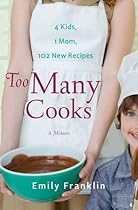 I enjoyed Too Many Cooks: Kitchen Adventures with 1 Mom, 4 Kids, and 102 Recipes by Emily Franklin to some extent. Some of her ideas were right on with what I’d expect. For example, she believes one gets kids to eat healthful foods by feeding them healthful foods, not by hiding vegetables in brownies. Also, she suggests great ways to introduce unfamiliar foods by explaining how they are similar to the foods the children are already familiar with.
Yet, I had expected more cooking inspiration for how to feed a family. Instead, I felt it was a Mommy-blog style book, with lots of emphasis on how great a mom she is because she does such and such. That’s not to say it was bad: it just wasn’t my style, since I personally get bored with mommy blogs. “Mommy blogs” also give me a guilt complex since I know I will never have the energy and talent, for example, to improvise a muffin recipe in the 45 minutes before soccer practice.
Too Many Cooks also failed to inspire me in the kitchen because it seemed Ms Franklin was so far beyond my abilities, especially since she readily admitted to having worked as a cook in a luxury yacht in the years before mommy-hood. In my pre-mommy years, I was preparing Rice-a-Roni four or five nights a week. That’s not to say the recipes in Too Many Cooks (for example, Monte Cristo sandwiches and Cornish pasties and chicken nuggets) are “fancy” or incredibly challenging. But they are not simple, and they are not recipes that give you a foundation for future cooking. (I felt rather incompetent when Ms. Franklin’s easy Mommy Chicken Nuggets recipe took me two hours. I wrote a few posts about some of the recipes I tried on my Cooking Journal.)
I didn’t realize how uninspired I was until I picked up Julia’s Kitchen Wisdom, a slim 110-page volume Julia Child produced in the last years of her life. I’ve always been intimidated by Julia Child, since Mastering the Art of French Cooking is a monster tome (and comes in two volumes) and “French Cooking” in general is not practical for a mommy on a budget. In short, I’ve been afraid of reading Julia Child.
All that was without foundation, for Julia’s Wisdom made cooking sound easy. The best part is that I believe her: it is that easy. She’s not trying to give us recipes for a lifetime of cooking: she’s trying to share tidbits of the most important techniques that we may need over a lifetime. Her philosophy is
Once you have mastered a technique, you hardly need look at a recipe again. (page 3, Julia’s Kitchen Wisdom)
Kitchen Wisdom has a few basic recipes for soups; salads; vegetables; meats, poultry and fish; egg cookery; breads, crepes, and tarts; cakes and cookies. Each section also has ideas for variations. I’ve tried a few of the recipes and they seem simple enough. While they all certainly have the French influence, they are not as overwhelming as I anticipated. I almost want to check out Mastering the Art of French Cooking now!
As I write about this book of “essentials,” I am reminded of Alice Waters’ book (The Art of Simple Food), which I reviewed at the beginning of the Spice of Life Challenge. I’m not sure what the difference was (both focus on the basics to help us know how to make food taste good) but in some respects, I feel Julia Child is better able to speak to the incompetent cook: myself.
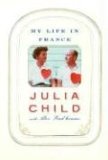 I fell even more in love with Julia Child when I read her memoir, My Life in France. Just as I doubted her cookbook, I doubted I’d relate to this story. But I was delightfully surprised. I was amazed to learn that when she was first married, her cooking was much like my cooking when I was first married:
My meals were satisfactory, but they took hours of laborious effort to produce. I’d usually plop something on the table by 10:00 p.m., have a few bites, and collapse into bed. (My Life in France, page 6)
Julia Child did not know how to cook. Her husband’s work took them to France, and there Julia Child found herself without much to do. But the delectable food had made an impression on her from the first day, and she became determined to learn how to produce it.
I could relate to that as well. Although I am not sure I’ve had any true “French” food, my husband took me to a delicious restaurant in Chicago while we were dating and I was so impressed by the meal as an experience I’ve wanted to improve my own cooking abilities. There is something about eating that can move you, if you let it!
The most impressive part of Julia Child’s story was her determination. She spent weeks on a project (mayonnaise, for example) until she got it right. Although she was a student at the Cordon Bleu, the school was (from this perspective) rather inept, and she had to teach herself the essentials of cooking. And she did.
Although a French-style cook book for American audiences was Simone Beck and Louisette Bertholle’s idea, Julia Child was the one that understood what creating such a book for an American audience would require. She was the one that worked out the amounts for most of the recipes. Although Simone Beck did a lot of work too, Julia Child was the rock behind the project. If you’ll pardon a ridiculous pun, she was the yeast that allowed it to rise to its monumental size, depth, and ultimate success.
I loved the memoir. I loved Julia’s relationship with her husband, Paul. I loved the image of France it created in my mind. It’s probably changed since then (as Julia mentions), but the idyllic people, places, and food were simply fascinating from the historical perspective. We can only wish it were so peaceful now! (And someday I will make it to Provence.)
There were so many inspiring quotes in My Life in France. I imagine it is one I’ll reread someday: maybe then I’ll take care to write down the snippets of Julia’s wisdom so we can all learn from the Master.
Julia Child’s memoir (and her cook book) is inspiring for the busy family cook. Just as it illustrates that learning to cook good food is not a year-long project, but a life-long pursuit, it also illustrates that it is possible and even fun! Thanks to Julia Child for bringing delicious food to America, and for giving housewives the inspiration to attempt the seemingly impossible!
As my husband said every time I stopped reading to tell him an inspiring story: “There is a reason Julia Child is a household name!”

My husband read My Life in France recently and kept telling me details from the book. I finally had to tell him to stop since I want to read it too.
Julia has been one of my idols since I started watching her on PBS as a child.I bought My Life in France just before I went to see Julia & Julia, but I still haven’t gotten to it. I’ll have to move it up on my to-read list. Have you seen the movie? I really enjoyed it, Meryl Streep was just fabulous as always.
Julia Child seems to be an inspiration for many. I’ve never been much interested in cooking and when I was a teen my mom badgered me that I had better learn to cook because I couldn’t expect my husband to do it. I told her I would marry someone who liked to cook and she laughed at me. Well now I am laughing because my dear husband loves to cook and the kitchen is his domain. Half the time he makes up recipes out of thin air and vegetables and I am always amazed and love him dearly for his wizardry.
Listening to the audiobook of My Life in France gave me an appreciation of Julia Child that I wish I gained earlier. She led an incredibly interesting life.
It also made me wish to return to Paris and have ‘vrai’ French onion soup and croissants. Two years since I’ve been and have the memories of the food still embedded into my brain and taste buds.
I’m supposed to be reading MY LIFE IN FRANCE for my 12/1 book club, but it hasn’t come in from the library yet. I think you’ve convinced me to go buy a copy to keep – it does sound like a wonderful book!
This is a fantastic post! I keep hearing about Julia Child, but don’t really know much about her. I have always been interested to know more about her cook books, but haven’t known where to start. It sounds as though Julia’s Kitchen Wisdom would be the perfect place. Thank you for explaining it all so well!
I really enjoyed “My Life in France”, too! I thought it was neat that one thing that Julia and Paul did was send hand-made Valentine’s Day cards out annually to their friends and families (instead of Christmas cards, because that time of year was just too busy); the cover picture is one of the cards they made and sent out. And they didn’t mind him being a lot shorter than her….really seemed like a wonderful relationship that they had.
Kathy, I don’t think knowing the details would ruing My Life. It’s so inspiring I want to read it again!
Karen, I never saw Julia Child as my mother NEVER watched television. I feel I’ve missed something. Ah well, I have not seen the movie but now that I’ve read this book (my self-imposed prereq.) I look forward to it a lot! Plus, I have to wait until it comes to Netflix as we never go to the movies….
Stefanie, that sounds much like my own story, as I too hated the thought of cooking! My husband learned to cook because he gets so tired of eating out (he travels all the time). And he’s great, just like you say about your husband!
Suzanne, I went to France on a backpacker’s budget! At least I’ve gone but oh, when I go again, I’m going to do it right!
Heather J., it is simply wonderful!
Jackie, I too didn’t know much about her– and was very intimidated by the idea of French cooking! But I think Kitchen Wisdom is/was the perfect starting point!
Valerie, I too liked the idea of homemade cards — and for a split second I thought we’d do it too. But then I remembered that I hate that kind of thing and I’m not creative!
My mother taught herself to cook (from virtually no cooking skills at all) from Mastering the Art of French Cooking. Bless Julia Child — the reason I ate so well as a kid! 🙂
Jenny, that’s awesome! Julia is so inspiring.