
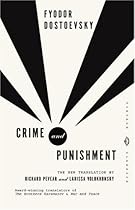
 “Crime and Punishment,” says Richard Pevear in his introduction, “is a highly unusual mystery novel: the most mystified character in it is the murderer himself.”
At first glance, there is no mystery. The answers to “who, what, when, and where” seem self-evident, especially since the murder occurs center stage in the first 80 pages of the novel. Yet the “why” behind Raskolnikov’s crime arrests attention, and the mystery is determining exactly what is the “punishment” of the title. From the beginning section to the epilogue, Fyodor Dostoevsky’s psychological novel captures a disturbed mind in turmoil from its own philosophic ideals. Raskolnikov’s expectations for himself as a “Napoleon” above the law are distorted by his own inner turmoil, and his “punishment” may be realizing his place as a human in the midst of humanity.
But I say “at first glance.” The best facet of Crime and Punishment is its depth. An abundance of characters, some stereotyped and some individual, and layers of complexities of situation and personality illustrate just how each one of us has both a “devil” and a “saint” inside us.
As the Penguin Reading Guide asks, “Who among us is not a criminal? Who among us has not attempted to impose his or her will on the natural order?” I love Crime and Punishment because of the universality of that concept. The concepts do not seem specifically Russian or nineteenth century. Instead, it is universal in its look at human nature, and human nature has not changed much in the past 150 years, although the specific settings vary.
Upon this reread (probably my third reading), I was struck by some new things such as the structure, the variety of characters, and the family relationships. Most particularly, though, the religious elements stood out to me on this read. Although I realized before that there were religious elements to it, this time it seemed much more religious in retrospect. In my book group last night, I came to more of an understanding of the significance of the raising of Lazarus to the story. Raskolnikov’s request that Sonya read the passages from the scriptures was a way of asking her to help him with his faith. I have more thoughts about it, but since I am no longer in school, writing papers about such elements of the novel, I’ll leave that here for future reference: next time I read this book, I should consider Lazarus from beginning to end.
Crime and Punishment is a novel that I cannot praise sufficiently and that I could not reread frequently enough. Subsequently, I struggle to discuss it in an impersonal internet-post format. Just as with the murder motive, I cannot properly explain the “whys” behind my passion for this novel. I love it, and this post will have to remain as is. If I had more time, I’d do a three–part “why I love this” series as I did when I read The Iliad a year and a half ago. But I don’t have time for that anymore. Instead, I’ll look forward to yet another reread, and maybe then I’ll revisit it on this webpage.
I’ll just leave with a (rhetorical) question: How did Dostoevsky create such a complex psychological portrait? He did create a realistic and intimate portrait in this volume. Yes, there is such complexity in each person, yet Dostoevsky’s ability to portray humanity so realistically in text testifies that he is a truly great writer. I am in awe.
What novels leave you in awe of the author’s ability to create?

I read this a few years ago…and though it took me a long time to get through it, I LOVED it. You pinned it: Dostoevsky paints human nature so realisitically. Though I’m not a murderer, I “got” Raskolnikov and his sin and emotions because I see the same thing within me.
.-= Ronnica´s last post on blog ..Turning My Focus Outwards =-.
Ronnica, yep, glad you loved it too!
I am with you on this one – simply brilliant writing from beginning to end. I read this book before I started writing reviews on my blog, but I wish so much I had written my thoughts down after reading it. Your review is great – it made me remember things about the book I hadn’t thought about for awhile. Thanks for that! This is one of those classics that really stick with the reader, I think …
.-= Wendy´s last post on blog ..Therese Raquin – Book Review =-.
Wendy, that’s why I love rereading! I’m trying to make my way through rereading the favorites I’ve read in past years so I CAN write up something on my page.
Why is the Penguin Reading Guide accusing me of being a criminal? I’m not a criminal! I think the Penguin Reading Guide must be a criminal – and it’s accusing others to hide its despicable crimes.
Since when is imposing my will on the natural order a crime? Whenever I make a sandwich, I’m imposing my will on the natural order.
.-= Amateur Reader´s last post on blog ..Putrid Zola – don’t read this post over lunch =-.
Amateur Reader, lol I think it’s meant like Ronnica said, we can relate to Raskolnikov (at least I can) even though I am not a murderer. I do some things “sinful” in my life, just like everyone in the novel had some fatal flaw.
Maybe Dostoyevsky was secretly a murderer and that’s how he got that psychological aspect so well 🙂 I actually enjoyed this one, though I don’t remember much about it excepting an axe and all that gory-ness. Maybe I’ll get a reread in sometime.
.-= melissa @ 1lbr´s last post on blog ..This and That and Everything Else =-.
melissa, actually Dostoevsky was in Siberia for 4 years for political reasons, so maybe he got to know the murderers…
Blast, I think I’ve been spelling it wrong all my life – I meant, of course, Dostoevsky
.-= melissa @ 1lbr´s last post on blog ..This and That and Everything Else =-.
Melissa – Dostoyevsky is fine. There’s no standard spelling. Different systems of transliteration from Cyrillic result in different spellings. Dostoievsky, Dostoevskii, etc.
.-= Amateur Reader´s last post on blog ..Putrid Zola – don’t read this post over lunch =-.
Of all the reviews I have read, this one makes me actually want to go read this book the most! You make it sound so interesting…
.-= Amy´s last post on blog ..Review: The Heart of Islam by Seyyed Hossein Nasr =-.
Amy, YEAY! I’ve succeeded.
I read this book in high school and LOVED it. I thought it was so redemptive. It made me fall in love with Russian literature.
As for a book that really left me in awe- the one I most recall doing that is The Count of Monte Cristo, with all those intricacies coming so neatly together.
.-= Aarti´s last post on blog ..With Reverent Hands: Call it Sleep =-.
Aarti, ugh, I wish Dumas did that for me. But i’m so glad you loved this one too! I have not yet read another Russian lit book that has moved me so much. Brothers Karamazov is a big blank (can’t remember a single thing) and Anna Karennina was enjoyable but not so powerful for me.
I think I need to give this book another go-round. I read it in high school (as part of assigned reading) and was not yet ready or willing to appreciate the novel. I think I would have a completely different reading experience with it now.
Bookshelf Monstrosity, oh so sad. I can understand not appreciating it if you were forced to read it…Not a book to be rushed into or through.
It’s interesting that you see so much universality in this novel – and I have encountered many others who do, as well – but when I read it, what struck me was more the foreign-ness to my perspective. Part of that was the disjunction of the “why” from the deed, similar to Camus’s L’etranger, so that all the guilt that came after seemed predictable yet pointless. I can understand killing someone because of some overwhelming temptation of material gain (not support, but understand), but I don’t know…I guess I almost prefer Camus’s narrator, because I can understand feeling numb upon randomly committing a murder, but I can’t imagine randomly committing a murder if I was going to be wracked by guilt afterward. I did like the book, but I didn’t relate to it at all. Always fascinating to see others’ points of view!
.-= Emily´s last post on blog ..Almost No Memory =-.
Emily, I guess I see universality because I see myself in not just Raskolnikov but Sonya and Marmeladov and the others too — not that I purposely go out and do “bad” things but because I do bad things and then feel guilty about it. (And when I say bad things, I guess I mean yelling at my son or something like that, i’m not a murderer or anything of course!)
I also didn’t see Raskolnikov’s “why” as for material gain. He knew from the beginning he wasn’t going to use the money right away, he just felt a strange (insane!) compulsion to prove himself as a Napoleon, I think. He felt murdering the woman was the first step to being the person his family expected him to be. Insane, yes. Rational, no. Likely to produce guilt, yes.
I, on the other hand, couldn’t understand how the person in Camus’s novel could have been so cold. Even after he committed murder he didn’t have any humanity in him. He just plain didn’t care what happened. That was completely foreign to me. I’m rereading it in a few months for a book club so maybe I’m recalling it wrong. I do look forward to discussing it — and it’s so interesting you compare C&P to The Stranger since they are both for the same book club!
I read this back in September and I loved it. Now that I am reading another Dostoevsky novel, I am seeing a trend in the power of his writing. C & P definitely trumps The Brothers Karamazov (at least so far).
.-= Allie´s last post on blog ..Thursday Treat # 15: Summer by Edith Wharton. =-.
Allie, unfortunately, I can’t remember a thing from BK! I did read it all!
I’m a great fan of Dostoevsky’s works. Sometimes, I think that he is really unique and without peers.
.-= Kinna Reads´s last post on blog ..Poem #10: Sonnet of the Sweet Complaint by Federico García Lorca =-.
Kinna Reads, I have lots of favorite books, but none quite matches this one!
Loved this book. It has been ages since I last read it and you have reminded me that I should pull it off the shelf and wallow in its greatness again sometime 🙂
.-= Stefanie´s last post on blog ..Earth Day =-.
Stefanie, “wallow in its greatness” indeed. I was far overdue for a reread!
I’ve had a paperback of Crime and Punishment on my bookcase for almost two years now. Although I have heard many great things about the book (that’s why I bought it), it has always intimidated me a bit. This is perhaps because I have never read anything by a Russian writer. I am determined, though, to try and see how it goes. You inspired me, Rebecca.
Susanna, it’s long (some paragraphs go on for pages) but it’s so great. I love the internal turmoil so well captured. I hope you enjoy it too!
I remember this as being a page-turner and feeling wowed when I was done. In my fantasy reading world (which is quite different from reality) I will reread it some day. Although being in the middle of Brothers Karamazov right now, I would need a very long break from Dostoevsky first!
.-= Shelley´s last post on blog ..The Brothers Karamazov Part II =-.
Shelley, “wowed” is right in my opinion. Such an incredible book!
I really enjoyed your review, but gosh, I really hated that book. You make it sound so good! Maybe I’ll try again in a few years.
The Lord of the Rings Trilogy is the book that holds me most in awe. The various cultures described are shown in such detail.. and yet all are completely fabricated. It’s like an incredibly detailed work of art–beautiful, down to the smallest detail. Ahhhh.
.-= Angela´s last post on blog ..Her Fearful Symmetry =-.
Angela, I wonder if it was the time you read it at? Was it for a class?
I personally am disliking LotR. I LOVED Silmarillion so I’m surprised to be disappointed in The Two Towers. I am having a hard time making myself read more!