
 I know next to nothing about Philosophy, so when it came time to approach the “100s” century (Philosophy and Psychology) for the Dewey Decimal Challenge, I decided to read something from the half more challenging for me (Philosophy). This is about learning, after all, right? But between packing and moving, I felt the need to read something light and easily accessible this month. Is anything about philosophy light and accessible?
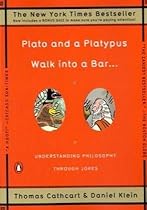 I found Plato and a Platypus Walk into a Bar by Thomas Cathcart and Daniel Klein to be such a light approach. The subtitle is “Understanding philosophy through jokes.” How can one go wrong by reading a book of jokes? While I appreciated the light-hearted approach (especially this month), I unfortunately thought there were too many “jokes” and too few concrete details about philosophy. I enjoyed my short perusal of Plato and Platypus, but I don’t feel I have a much greater understanding of philosophy having read it.
Each chapter focuses on a field of philosophy, including Metaphysics, Logic, Epistemology, Ethics, Philosophy of Religion, Existentialism, Philosophy of Language, Social and Political Philosophy, Relativity, and Meta-Philosophy. Each chapter had a brief overview of the key thinkers and then a plethora of jokes that supposedly illustrate the subject. The jokes were amusing, and the importance of all the concepts was clarified to me. Unfortunately, a week after reading it, I can’t recall more than the basic differences between the philosophies. (I wrote this post two weeks ago; it has now been three weeks since I read it.)
A few other things about the “playfulness” of this book bothered me. For example, when discussing the great philosophers, the authors called them by nicknames, trying to be funny. But now I can’t remember the last names of those key thinkers. Calling them by different names made them less memorable to me. Also, the jokes were predominately sexual, which I’m sure helps make them amusing (not so much to me, but maybe other people) but became rather annoying by the end of the short 188-page book. Are those really the only jokes that can illustrate their points?
I suppose Plato and Platypus partially achieved its purpose. That is, it illustrated philosophy through jokes. Whether or not it helps one to understand philosophy is another question: I personally felt that the grand concepts of philosophy introduced to me between its covers are still just barely out of reach of my understanding.
Can you recommend a basic philosophy book that is informative yet easy to approach?
 This book also counts for the Dewey’s Books Reading Challenge.
Other Reviews:
- Breeni Books
- The Hidden Side of a Leaf
- Kay’s Bookshelf
If you have reviewed Plato and Platypus on your site, leave a link in the comments and I’ll include it here.

I have this book in the TBR stacks. I think I’ll enjoy it – eventually.
I can’t suggest a good basic philosophy text, but years ago I read the novel “Sophie’s World” by Jostein Gaarder, which is more like a philosophy survey course disguised as a novel. I picked up quite a bit from it – if you haven’t read it, you might want to check it out.
I’m so glad you reviewed this because it’s been on my TBR list for a while but my library doesn’t have it, so I would have to buy it and wondered if it would be worth the money. I wanted to read it to learn some philosophy basics, but it sounds like I should find a different source. Maybe some good recommendations will come.
Well, at least it’s got a good title.
Florinda, that novel sounds great! I’m adding it to my ever-grown list!
Chain Reader, well, I realize I’m incredibly prudish, so maybe it’s just me that finds this rather crude. I was just disappointed that “making philosophy simple” had be “make philosophy about sex.” Maybe less prudish people would find it funnier and therefore more worthwhile…I suppose it was ok as a very low-level introduction to philosophy…
Kathy, yes! It does appeal, especially with the subtitle!
I have this book on my shelf because I thought it might be a fun way to refresh my memory on some of the things I learned when I tok philosophy a couple of years ago. I’ll get around to it eventually. Maybe it’s better as a memory jogger and not so good for learning from scratch.
I wish I knew of a good intro to philosophy book to recommend. The text we used in my class was focused on Philosophy for Christian Theology, and it read like a textbook. I mostly learned what I do know my philosophizing with my classmates. Reading about it just isn’t the same, alas.
Too bad this book didn’t live up to your expectations-I hate being disappointed in reading! 🙂
I used to be really into philosophy in high school/early college, but I mainly read primary texts, so I don’t know many good overviews. The YA novel Sophie’s World by Jostein Gaardner is a history of philosophy book that even my non-reader sister loved! (Oh-I just saw Florinda already recommended this one, lol-ok, I second it.) One of my favourite primaries is Alexis de Tocqueville’s Democracy in America; I found it very accessible and fascinating!
I read a philosophy book for this month’s 100 as well: The Consolations of Philosophy by Alain de Botton. It’s a kind of philosophy-as-self-help book, that introduces the reader to the lives and thoughts of six philosophers and how they apply to modern life. I absolutely loved it. 😀
I do like the title but I wouldn’t readily pick up something like this as I don’t read this genre (not without wanting to fall asleep!) 🙁
Teresa, I think you’re right — Philosophy is a subject to be discussed to understand. Alas. But I’m not going back to school, so reading is it!
Eva, two rec’s for the same novel! I think it sounds like I must read it. I have read that a few people are reading Alain de Botton’s book this month; I was going to read it, but I decided to for something a little lighter. Maybe in the coming months I’ll have a chance. I’m glad you loved it!
Ladytink, to each her own!!
Hey! I just got this book as a present from a friend. I’m in the middle of reading it now. However, I’ve been sucked into Dan Simmons Drood and have put Plato And A Platypus aside for now.
blackin, I’d be interested to hear how you like this one!
I’m also going to recommend Sophie’s World, it really is an excellent introduction to philosophy and the most influential philosophers.
Paula, thanks for the rec! It’s been added to the list. Glad to hear so many people like it!!