
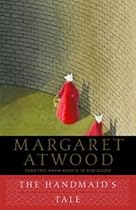
 In The Handmaid’s Tale, Margaret Atwood creates a powerful futuristic dystopia in which a quasi-religious political organization has taken control of the United States, creating a men-centered universe determine to procreate, even if via “handmaids.”
In the attitude of George Orwell’s 1984, Ray Bradbury’s Fahrenheit 451, Lois Lowry’s The Giver, and I’m sure many others, Atwood’s dystopia is a dire reminder of the danger of extremism. It is a chilly tale of life under fanatical leaders and the danger of swinging from one extreme to the other. It was an intriguing story of how a changing law changes one’s moral acceptance of things. I literally had a hard time putting down the captivating story.
I enjoyed the narrative. I enjoyed the pacing of the story. I sympathized with the narrator. I was fascinated by the political warnings of what the world could come to. But I can’t say I loved The Handmaid’s Tale. It is one that many people should read, but it’s not a favorite that I will reread.
What I Didn’t Like
While I found Atwood’s tale to be engaging and fascinating, I disliked a number of things about this book.
Religion
My main dislike was the negative portrayal of religion. Certainly, religious extremism is real on the earth. However, I personally found some concepts in this book to be a horrible distortion of religion (for example, that sex with a nameless handmaiden in a distorted “ceremony” is more sacred than IVF or other methods of conceiving a child in love). As a religious woman who believes in God’s command to “Multiple and replenish the earth,” I still believe in birth control. I still believe in a woman’s right to choose (although I personally disagree with abortion). I still believe sex is a beautiful gift from God, not a distorted “ceremony” only for conception of children. One can believe in religion without being extreme.
Reading a book showing distorted Christianity helped illustrate to me why followers of Islam might be frustrated when people assume that fanatical Muslims represent all Muslims. I can better sympathize to that frustration now.
Sexuality
In The Handmaid’s Tale, sexuality was a political tool, and obviously, the handmaid (the narrator) was defined by her ovaries. I don’t read books with lots of sexuality in them, and I wasn’t unduly concerned with sexuality in this book since I knew the premise of the novel when I began it. However, I can’t see myself rereading it, and I would hesitate to recommend it to anyone easily bothered by excessive sexuality in fiction.
The Narrator
Woman in the dystopia were not allowed to read or write, and the unnamed narrator had no materials for writing. Supposedly, this story was told on to cassette tapes found 150 years later. However, the story was told mostly in the present tense, as events were happening. I had a hard time determining how the narrator could tell her story on to cassette tapes as events were happening. It seemed so unrealistic that it bothered me throughout the narrative.
Suspension of Disbelief
I had small disbeliefs, but my main disbelief was in the basic premise: over the course of five years or so, the U.S. government was slaughtered in a massacre, a religious fanatical group took over, banks denied access to all women, and second marriages became illegal and children of those marriages confiscated by the government. Not only that, but children were suddenly very scarce because most people didn’t want to become pregnant, women couldn’t become pregnant, and one in four children were born with horrible birth defects that made the child mortality rate very high. I had a hard time believing that all these things would suddenly allow the creation of a society where a formerly married woman accepts being a handmaid for a married man. I realize Atwood wanted to create a society within the narrator’s viable childbearing years, but the rapid development of such a radical society was so unbelievable as to bother me.
What I Liked
As I read, I kept disbelieving: is it really possible that an outrageous political group could take control of the country and turn the nation, in five years, from a free society to one where women had to be veiled? Is it really possible that Japanese tourists would visit the former USA and take photos of such oppressed women?
There is no way the world would let it happen. I thought time and again. The population of the country would never support such radical moves. There is no way they’d accept such propaganda.
And then I remembered: 1932. The National Socialist German Workers Party was democratically elected to power. Within six years, non-Nazi leaders and Jewish peoples were being taken to concentration camps.
The Nazis, an “extreme” political group, came to power because people let them; the people were politically apathetic. The rest of the world let the Nazis take over; after all, they were elected.
When I read Einstein’s biography a few months ago, I learned that Einstein himself expressed apathy to the political situation in the early 1930s: “It will blow over once the economy improves,” he said to reporters. But the Nazis didn’t go away. They took more and more power and made their agenda into a World War.
Other societies on earth deny freedoms, and the world likewise watches.
The Bottom Line
The Handmaid’s Tale, then, is an important addition to dystopian literature and an important reminder of our individual role in political affairs. I certainly don’t like Atwood’s image of the world before the government takeover (pornography is rampant; high pollution causes birth defects; low birthrates encourage kidnappings in supermarkets). But Atwood’s warning-dystopia is even more disturbing.
Let us each take some role in our governments; let’s not let either extreme happen. Vote if you can: Your society depends on your voice.
It seems most people love The Handmaid’s Tale; I’m probably the small minority that only “liked” it, although I’m sure some people hated it. What did you think of The Handmaid’s Tale? Why did you love it? Did anything bother you about it, or am I the only one?
Other reviews:
- In Spring it is the Dawn
- Passion for the Page
- things mean a lot
- ChainReadings
- 5-Squared (Amber)
- 5-Squared (Amanda)
- The List — Books for the Obsessive Reader
- Reading Room
- Melody’s Reading Corner
- The Bluestockings
- Bold. Blue. Adventure.
If you have reviewed The Handmaid’s Tale on your site, please leave a link in the comments and I’ll add it here.
For the rest of October, I’ll donate 10 cents to World Food Programme for every (non-spam) comment I receive on any post of Rebecca Reads. See most post on Blog Action Day 2008 here. I’m also donating any proceeds (4%) from my Amazon Store.
I’m giving away books! Visit here to enter the contest.

I love the way your did this review. It made it very easy to read.
You waited to read my review until after reading the book right? It’s interesting that you came up with the same dislike with regards to the narrator. I firmly believe this would have been a thousand times better had it been told in near-third person, limited, and ended with the ambiguous exit with the possible Eyes.
My book club read 1984 this summer, and one person commented that she had the same trouble with suspension of disbelief as you talked about above – how could a society so completely take over in such a quick time and how could people allow it to happen? There was a new guy at our meeting from Cuba, and he said that 1984 was his favorite book because it did a great job depicting the life in Cuba. That what the government said there, you did, you thought, you lived by, even if it was 2+2=5. Having never lived through that myself, I find it difficult to imagine, but the book was perfectly within the realm of belief for this guy from Cuba.
Perhaps this book is somewhat like that for us? Maybe it would resonate better with someone who has lived in a religiously-repressed societ (be it Christian or Muslim or athiest socialism or whatever). I’ve read a lot of books about countries run by religiously-distorted laws, where the people know the holy book (whichever is involved) is being corrupted but they are powerless to do anything but survive. I thought that Offred’s need to survive but also to stay emotionally alive was one of the most powerful and realistic parts of this book.
But I’m with you. I would recommend other people read it, but I definitely wouldn’t read it again myself. I was disappointed.
Kathy, I’m glad! I just like to organize my thoughts!
Amanda, I only read the first paragraph, where you said you didn’t like it. Then I thought I’d hold off. Then as I read, I was so bothered by narrator. By the middle, I was so bothered I skipped to the end to see if there is some frame explaining it. The “Historical Note” wasn’t strong enough for me.
I’ve been thinking about the third person perspective. I’m not sure that would have been as powerful to read as Offred’s own thoughts were. But again, the power was diminished by the fact that she never could have written her thoughts like that.
The perspective comparing it to Cuba is fascinating: living where I do makes it hard to believe situations like that. But it happens!
Excellent review – I’m glad to hear your thoughts. I’ve been reading reviews of this book for as long as I’ve been blogging, and yours is quite different than the rest. I like hearing a differing perspective!
Rebecca, great review! I thoroughly enjoyed reading your thoughts on this book. I read it last week and really loved it. Maybe I’m a pessimist, but I could see things falling quickly. Maybe not quietly, but fairly easily.
One part that really affected me was an offhand reference to societies in London to “Save the Women.” I feel like there are things like this happening in the world right now (see Darfur), and I generally ignore it because my life is happy. I’m going to try to pay more attention to such things in the future.
Also, here’s a link to my review:
http://thebluestockings.com/2008/10/the-handmaids-tale/
Maybe the third person wouldn’t have been as powerful, but I still wish Atwood hadn’t let her struggle with how to deal with first person narration become so apparent to the reader. I think a lot of the power was lost in that struggle.
I really loved this review. I had similar thoughts on the book but I was not able to put it into such a good perspective. I did read it quickly as some sort of fantasy fiction. I read it with my book club and some that read it found it disturbing and depressing. My jaw did drop at the initial story but I didn’t find it too depressing because I guess I never ascribed a believable quality to it.
For instance, when I read “The Road.” I got chilled and very depressed because I found some sort of horrid believability to the story… probably due to the lack of details.
Handmaid’s Tale reminded me of a book I read in one of my book clubs called “A Gift Along the Shore” by M. K. Wren. In my opinion this book had a more realistic take on
“populating the earth.” But still there was the certain portrayal of religious groups. However, there beautiful theme of friendship between women and the preservation of BOOKS!!
opps..look at me go on and on….. thanks for the review. AWESOME!!
Toni
Heather J., I know — most people seemed to rave about how great the book was, so I guess I was only just disappointed. I still liked it and am glad to have read it!
Jessica, that’s what struck me! That similar right restrictions are happening around the world, and what are we doing about it?! Where does one even begin?
Amanda, good point. It’s interesting to me that many people weren’t bothered at all by it? I wonder what Atwood thinks about the narration? Apparently she was satisfied enough to let it be published as it.
Toni, thanks so much for your thoughts. I haven’t read the Road yet. Thanks for going on… I appreciate your insights!
Like others said, I love the way you structured your review. And though I loved this book I understand your misgivings. About religion, I took it as an example of the dangers of extremism, be it political or religious, but I am not religious myself so it’s easier for me not to see it as an unfair portrayal of Christianity. I do understand why you felt that way, though. I think that there were some religious members of the resistance too in the book? It’s been a while, though so I might be misremembering. But anyway, I didn’t think the book portrayed Christianity accurately at all, but I thought that maybe her intention was to take a religion Western readers are very familiar with and take it to an extreme, just to show how dangerous extremes can be.
“And then I remembered: 1932. The National Socialist German Workers Party was democratically elected to power. Within six years, non-Nazi leaders and Jewish peoples were being taken to concentration camps.”
I agree, this is a perfect historical example of an extremist group taking over very, very quickly. Hopefully this won’t happen again, but like you said, it’s good to keep it in mind when we feel tempted to be apathetic.
Hm. I know I should appreciate novels like this, and 1984, for their ability to challenge the flaws of our contemporary society, whilst also providing speculation on the future of human existence. And yet I infinitely prefer books that are well-grounded in reality – I think there’s so much to capture now and in the present, without having to create dystopian societies. I know a lot of people would disagree with me, but that’s just what I think.
I should probably read this for myself before forming an opinion, but after your (excellent) review, this particular Atwood has been pushed further down my to-read list
I feel like I need to reread this–I’ve already forgotten lots of the details. But I remember loving the way the story unfolded a little bit at a time. I also think she is very effective at creating the proper mood (tone?). I also love her style of writing. The POV issue was not even on my radar. I would love to hear from the author why she chose to present it that way–she may have had her reasons, however annoying it may be. I seem to remember more environmental issues being the cause of the infertility-maybe I’m getting that mixed up with another book. I also felt like she was warning of the dangers of a fundamentalist religion taking over the government; the importance of the separation of church and state. All in all, I love dystopias, and I was really sad when this one ended, I was so enthralled. This is a great discussion going! I just feel like I need to read it again.
I read this book, gosh, something like 10 years ago and loved, loved, loved it. I do agree with you about the suspension of disbelief. I think that’s often a problem with dystopian novels, and I usually just put it aside and let the siutuation be what it is. However, After reading Stolen Innocence this year, a memoir by one of the child brides from the FLDS, I could start to see how this sort of thing could happen, and how it could happen in the name of religion.
I wasn’t bothered by the distorted view of Christianity partly because, much to my chargin, I have seen people say and do all kinds of horrible things in the name of Christ. Also, there are several mentions of the Baptists’ involvement in the resistance. Being a Baptist myself, I couldn’t help but notice this, and that was enough to reassure me that Atwood was not trying to criticize Christianity in general, just a particular way of thinking and understanding the scriptures.
Nymeth, in my comment on another blog, someone pointed out to me that Quakers had been a good example. That’s true and I’d forgotten to mention that. But I guess it was the combination of religious extremism also distorting sexuality that really made it disturbing to me! As I think about the extremism, I realize that the Nazis were only one example in the world. There are many such societies today! Scary thought….
ChainReader, I just didn’t like the point of view, but it was an intriguing writing style and I want to try Atwood again. I wonder, if I ever read this again, if it would bother me as much.
Teresa, I haven’t read the other dystopian novels for years, so I wonder if I’d have the same suspension of disbelief problem with those now. But I think the narrator added to my annoyance. I think you’re probably right that she was talking about extreme, and it’s interesting how our own beliefs shape our responses to novels.
Gosh, it rather astounds me that most of the posters here seem to think this novel is about ‘somewhere else.’ Just stand outside an abortion clinic as I do every Saturday, and read the body language! Women, unprotected by any legal prohibition, are being literally shoved into a procedure that has too many frightening ramifications to list, psychological and physical. Literally pushed!
Two weeks ago I witnessed an African American women pleading with a man inside the foyer of the clinic. She was on her knees, holding on to his shirt at the sides, looking up and him with tears streaming down her face. Her eyes were huge and she was clearly terrifed. I watched him knock her hands free of his shirt, and with an aggrieved and disdainful look on his comfortable face, he straightened the fabric of his shirt. And then he pointed at the door of the clinic. It made me think of the Handmaiden’s Tale with a twist: this is what happens to women who reproduce without ‘permission.’ They are powerless. (Oh that it was his body the ‘procedure’ would have been done to. Do you know that there are two tiers to the price of abortion? One with anesthetic, one without. I kid you not.)
Some books–some stories–are not there for us to like or dislike. They are cautionary tales, ignored to our peril. They are meant, in fact, to offend.
Come visit my blog, I deal with some related topics you might find interesting. This is a very nice blog, and it is good to read the discussions of books and ideas.
I was both horrified by this book and loved it at the same time. I think that was exactly Atwood’s point. It is supposed to be disturbing. Her portrayal of Christianity and sexuality are supposed to be distortions of the truth. At least for me, that is the whole point of the book — religious extremists are dangerous. It doesn’t matter what religion it is. When any one group attempts to force their beliefs on society as a whole, it is very dangerous. Sometimes, people don’t see a problem with it when it’s their personal belief that is being shoved down the throats of people. The problem is that the next group in power may decide that they want to change things and force their personal beliefs on everyone. That is why separation of church and state is so important in a democracy. All you have to do is look around the world to see evidence of this.
Jan, Thanks for sharing your insights! Very sad.
Lisa, I think “horrified” is a good word, and yet I can see how people could love it. Thanks for the thoughts.
Rebecca – this is a wonderful, well-written review. Your list of “didn’t likes” reminded about parts of the book that I’d forgotten (it’s been many years!).
Interesting that you listed a struggle with suspension of disbelief (“this couldn’t happen here”), then connected the historical context in our world (my parents’ generation).
I’ve seen *The Handmaid’s Tale* around quite a bit lately; maybe it’s time for me to pick it up again.
Dawn, I’ve heard so much about it too; that’s how it got up on my list!
Einstein’s political apathy doesn’t surprise me. When the Nazis began passing legislation restricting the rights of Jews to run businesses, go to university, etc., it seemed to Einstein like another “here we go again.” This systematic oppression had been seen before. No one realized or admitted to realizing that what was going on was a genocide of a people and anyone else who didn’t fit the Teutonic Myth. Other groups included: the mentally ill, the handicapped, homosexuals, blacks, and basically anyone who didn’t agree with the political talking heads of the time.
As for the Handmaid’s Tale, I read it years ago and found it disturbing on many levels. Not a fave.
Give Alias Grace a try. I read that a long time ago, too, but I remember liking it.
People like to believe these types of events won’t happen anywhere and yet they do. Take a look at Darfur–it’s the same kind of genocide going on there was in Germany in WWII.
Take a look at Darfur–it’s the same kind of genocide going on there was in Germany in WWII. Edit: it’s the same kind of genocide going on there like Germany in WWII.
blacklin, thanks for the recommendation!
Wonderful review, Rebecca. I like how you clearly explained what you both liked and didn’t about the book. For the portrayal of Christianity, I agree with Nymeth that I took it as her example of the dangers of extremism of any religion but she brought it closer to home to make her point, as it were. I wouldn’t call it a favourite book either but it was definitely a thought-provoking, worthwhile read.
I reviewed this book as well. I agree with you, some of the elements seem fantastic, but I think Atwood’s point is that when totalitarism takes over, it usually happens quickly.
Anyhow, great review!
I love your reviews! Very straight forward, user friendly presentation of ideas. And I wholeheartedly agree with all of your comments regarding this book. I, too, only “liked” it in a sense that I’m happy to have read it, but will never return to it. Despite being a non-religious person, I agree with your frustration regarding the portrayal of religious fanaticism.