
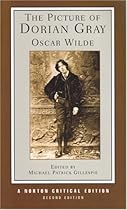
 Oscar Wilde’s The Picture of Dorian Gray is creepy. Dorian Gray, as an innocent and attractive young man, in a fit of passion exclaimed:
How sad it is! I shall grow old, and horrible, and dreadful. But this picture will remain always young. It will never be older than this particular day of June. … If it were only the other way! If it were I who was to be always young, and the picture that was to grow old! For that – for that – I would give everything! Yes, there is nothing in the whole world I would not give! I would give my soul for that! (page 25)
And that is what happened. In the beginning, Dorian was fascinated by the painting: scowls (representative of his wickedness) immediately began etching itself on the painting, while he remained innocent and attractive looking in all respects. At times, though, the image of his soul disgusted him and he decided to abandon his life of sin, hoping his image would then right itself. But Dorian Gray found himself unable to stop embracing the life he’d created for himself, even when it disgusted him.
When I found out that Oscar Wilde’s The Picture of Dorian Gray was written in 1891, I was surprised. It seemed far more modern than that, since it deals candidly with issues of immorality. It captures issues of sin versus innocence. But such issues seemed appropriate for the late Victorian age, since it is questioning the existing morals and the social constraints of that rigid era.
“[Society] feels instinctively that manners are more important than morals, and in its opinion the highest respectability is of much less value than the possession of a good chef,” says Lord Henry Wotton at one point (page 119). Although I found Lord Henry to be a bit of a devil, his comments on society always seemed the most enlightening. I enjoyed his interesting perspective on society.
In the end, then, is Wilde’s novel a warning against debauchery (such as American audiences thought)? Or is it a catalog of Wilde’s own life (such as British audiences thought, even calling on Wilde to defend himself)? I found the discussion of original understandings of the novel to be very interesting. (See the Norton Critical Edition.)
My Favorite Part
The part I enjoyed most was Sybil Vane’s commentary on finally falling in love:
Dorian, Dorian. Before I knew you, acting was the one reality of my life. It was only in the theatre that I lived. I thought that it was all true. … I believed in everything. The common people who acted with me seemed to me to be godlike. The painted scenes were my world. I knew nothing but shadows, and I thought them real. You came – oh, my beautiful love! – and you freed my soul from prison. You taught me what reality really is. … You had brought me something higher, something of which all art is but a reflection. You had made me understand what love really is. … Suddenly it dawned on my soul what it all meant… (page 73-4)
In contrast to Dorian Gray, who only is going through an act throughout his life (the painting is the real Dorian Gray), Sybil’s relationship with another human being helped her to understand her own life. I found it tragic to see this sweet girl contrasted with Dorian Gray, and I honestly could relate to her epiphany of what love and life were.
The Graphic Novel
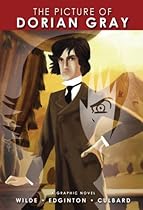 The graphic novel adaptation (done by I.N.J. Culbard and Ian Edginton) was, in short, horrible. It took me about 30 minutes to read this 125-page adaption and there was nothing intriguing about the story. It moved so fast that the tension and creepiness was nonexistent. I picked up the graphic novel because January’s Graphic Novel Mini-Challenge was to read an adaptation of a classic. Since Dorian Gray is about a painting, I thought it would be nice to see the painting’s changes illustrated. The picture was creepy but it changed so quickly that it didn’t have the same effect that reading a full novel about it changing had. A picture is not worth a thousand words in this version.
It horrifies me to think people will read the graphic novel and think “I’ve read that book” when they hear The Picture of Dorian Gray mentioned. I am not a fan of the concept of adapting a classic into a graphic novel to begin with, but this was even more disappointing than I anticipated.
The Bottom Line
The Picture of Dorian Gray made me uncomfortable. I don’t like creepy books, and I guess the sell-your-soul aspect was a bit out of my comfort zone.
It seems that many love Dorian Gray, though. Since I’m leading a book group about it tomorrow night, I’d love to know: What do you most enjoy most about Dorian Gray?


The Picture of Dorian Gray is one of my favorite books but I do like creepy books. I thought the idea of the painting showing the sins of the man was an interesting idea. Mostly I loved Wilde’s writing. He just has a way with words.
.-= Chris@bookarama´s last post on blog ..The Adventures of Blanche by Rick Geary: Review =-.
I really need to read The Picture of Dorian Gray. My fiance read it a few months ago and hated it immensly, but I have the feeling I may like it.
.-= Stephanie´s last post on blog ..Book Review: Eating the Dinosaur =-.
I haven’t read this yet, but plan to soon as my husband wants to watch the DVD. I don’t mind creepy – in fact I like creepy if it is weel done. I’m looking forward to finding out what I think of this one.
Chapter XI wasn’t creepy, was it? Most people seem to hate or ignore that chapter. It’s the center of the meaning of the book, that and the preface.
.-= Amateur Reader´s last post on blog ..His mind was thronged with answerable ideas and images – the short fiction of Robert Louis Stevenson =-.
I read this in my early teens, I think, and remembered really enjoying it. As you said, it reads as quite modern, and I liked how witty and biting Wilde’s humor was. I’ve never been one to shy away from a creepy read, and I really loved the idea of this painting slowly decaying and rotting over time!
For something more lighthearted I highly recommend any of Wilde’s plays! The Importance of Being Earnest is particularly great!
.-= Steph´s last post on blog ..“The Catcher in the Rye” by J.D. Salinger =-.
I loved the language of the book — the story had its moments but I found it not only creepy but shallow.
My edition has some contemporary reviews of the book which are interesting to read; as well, it noted that Dorian Gray was used as evidence in Oscar Wilde’s trial for moral indecency.
.-= Suzanne´s last post on blog ..Home to Harlem =-.
I wasn’t a big fan of Dorian; I think because I love Wilde’s other works so much, my expectations might have been a wee bit too high. On the plus side, since I didn’t love the book, I can’t wait to see the movie version! hehe
.-= Eva´s last post on blog ..Eating Animals (thoughts) =-.
Loved Dorian Gray. Love the creepy. Love Wilde’s writing too. When I read it I couldn’t believe how many aphorisms that I’ve heard or used appear in it. I though Dorian’s growing paranoia about someone discovering the painting was well done
.-= Stefanie´s last post on blog ..Elektra =-.
I tried to read this book in Jr. High I think. I couldn’t really get into it, so I didn’t make it very far. Maybe I’ll pick it up again someday.
I love Oscar Wilde (a LOT) but Dorian Gray isn’t my favorite thing of his. He’s better, really, when he’s trying to be funny. Dorian was used in his trial – the first one, where he was prosecuting the Marquess of Queensberry for libel, spends an inordinate amount of time talking about the “immoral” stuff in Dorian Gray. The transcript’s well worth reading – or anyway I love reading it, I’ve reread that way more often than I’ve read the actual book!
.-= Jenny´s last post on blog ..Update on Fellowship =-.
I LOVE the Picture of Dorian Gray and have read it several times. Lord Henry is just wonderful – he loves the sound of his own voice and talks simply for conversation, not at all to give his real opinions, and no one seems to understand that. I’m sorry to hear the GN was disappointing. Maybe I’ll read it in-store instead of purchasing it (my library doesn’t have it). It’s too bad because I know it’s part of a line of GNs which are actually pretty good adaptations!
Have fun discussing this with your book group! We had a really good time when we discussed it a couple years ago.
This is on my To Read Before I Die list. For some reason I never pick it up despite my desire to read it.
.-= Trisha´s last post on blog ..Book Review: Fingersmith =-.
I liked Dorian Gray – to me it was just a grown-up’s fairy tale. In the same way that, say, Hansel and Gretel isn’t REALLY about witchcraft, Dorian Gray the story, and Dorian Gray the idea are two very different things. In some sense, in fact, when I was Mormon, the idea of Dorian Gray made me think of doctrine – sin is, essentially, bad because it ISN’T just an appearance, it wastes away at something internal and invisible but much more important – after all, while Dorian’s body doesn’t get older and more corrupt, his soul does, he does really become more debauched.
Chris, yes, I did like the writing! I’m not one for creepy, though.
Stephanie, I’m more in between: I didn’t love it but didn’t hate it either.
Jackie, the new DVD? I can’t find it here in the USA. Not released yet 🙁
Amateur Reader, The entire concept was rather creepy. Chapter 11 bored me to death. Seriously. I wanted to stop reading.
Steph, I know I’ve watched Wilde’s plays (movies) so I really need to read them!
Suzanne, yeah, I saw that, so interesting to me since the book seems to be a warning against living such a life…
Eva, I was underwhelmed, but I really should read the plays!
Stefanie, I did note a lot of aphorisms. Lord Henry, although a devil, has some great lines!
Haiku Amy, well, it’s one some people love!
Jenny, I knew you were a big Wilde fan, so I’m somewhat glad to hear you don’t LOVE this one! I’ll keep trying.
Amanda, I have a feeling I’m not going to like any GN adaptations. I’m going in to it with a prejudice here. I just can’t imagine capturing a full-length novel (or even a novella, as this case may be) in such a short space. The GN was just too short. But then, I didn’t really love the novella all that much either. Maybe since you love the novella, you’d love the GN too!
Trisha, some people love it! Read it when you’re in a “creepy” mood.
Jason Gignac, Interesting comment. As a Mormon, I saw it in a different light. Yes, sin is an internal thing — not just appearance. But it seemed Dorian wanted to escape it and make his image right again but he couldn’t. He was stuck. I see sin as something that can be completely cleaned away.
I hear your point about how sin is not just appearance. It is an interesting concept, and it really did creep me out. When he was fascinated with starring at his decaying soul, I felt myself shudder many times.
I’m another one who likes Wilde’s plays (and some short stories), but am only lukewarm about Dorian. I know it’s supposed to be more of a fable than a real “novel,” but Wilde’s lack of grace at being a novelist kept distracting me – I found the exposition kind of clunky and the characterization cardboard – intentionally so, but it was a little boring nonetheless. Dialog is Wilde’s strength; all the prose between the conversations seemed wooden, like he didn’t really enjoy writing it. Plus, Wotton is so much more sparkling and alive than any other character that he steals the show in a less-than-balanced way.
Also, I don’t think Wilde shines when he tries to moralize. To me he does better when he’s just displaying his delightful wit and poking fun at social mores.
.-= Emily´s last post on blog ..Hopscotch: Delights and Inspirations =-.
I read Dorian Gray a long time ago, and loved it. I’ve been wanting to re-read it soon, so that I can see what I think of it now! Would I feel the same way about it or not? Maybe if I pull it off the shelf and put it with my TBRs, I’ll get to it soon.
I loved Dorian Gray, but then I haven’t read anything else by him or seen his plays. It’s autobiographical to an extent, but I think it’s debateable which character represents Wilde (I kind of think Henry does in some ways more than Dorian and Basil to a certain extent can be seen as Wilde). When they used it against him at his trial I suppose it didn’t matter, they just needed to prove that the homosexual content of the novel was autobiographical. In my edition there were lots of notes about the parts that were toned down for republication after the trial and for the age it was written it was quite uncompromising in what it showed. I think that’s part of what’s so great about the novel, it’s Wilde’s attempt to be truer than he’s ever been, to expose more of society than he ever has done before.
.-= Jodie´s last post on blog ..There are easier ways to quit… =-.
The Picture of Dorian Gray has been on my TBR list for such a looonng time. But inevitably, I pick it up, flip through it, read the first few lines and then determine that I’m in the mood for something else. I am determined to give it a whirl one of these days though.
Emily, I agree with what you say about Wilde as novelist — and most of my book group last night felt similarly! But I’m glad I have his plays to look forward to now!
Valerie, Lots love it — I’ll look forward to seeing your thoughts on the reread!
Jodie, In some notes in my book, it said Wilde was a combination of the three: Dorian, Basil, and Lord Henry. Very interesting to see how honest he was in critiquing society. Quite amazing for the era, I think!
Nicki, I hope you’re one who enjoys it!
I like creepy books, so I’m looking forward to reading this at some point. I have a really old copy I bought from one of those book club forms when I was in middle school. 🙂
.-= Anna´s last post on blog ..Mailbox Monday — February 22 =-.
Anna, I hope you enjoy it!
[…] to read the GN adaptation because the book is one of my favorites. I was a little worried after Rebecca reviewed it as horrible a little while back, so I decided to try it in-store before buying it. Especially after […]